Get Full Government Meeting Transcripts, Videos, & Alerts Forever!
Get email alerts on the Storm Recovery Infrastructure topic
No spam. Unsubscribe anytime.
Manatee County and local governments urge state help for storm recovery, wastewater and water‑supply projects
Summary
Manatee County leaders, cities and local nonprofits asked the county’s legislative delegation for state appropriations and policy help focused on stormwater, wastewater resiliency, drinking water expansion, veterans services and homelessness supports following three damaging storms.
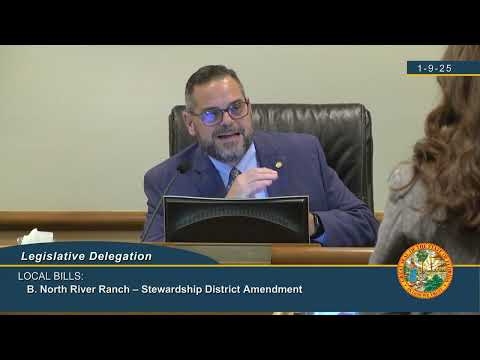
Manatee County leaders and municipal officials asked the county’s legislative delegation on Jan. 8 to seek state funding and policy changes to aid recovery from three storms and to finance multi‑year infrastructure projects including stormwater repairs, wastewater upgrades, expanded regional water supply capacity and housing supports for veterans and unhoused residents.
Chair Chris Cruz (Manatee County Commission) outlined eight appropriation requests and said three of the top priorities are stormwater projects that address neighborhoods still recovering from heavy rainfall and engineering failures. Cruz said the county lacks a dedicated maintenance funding source for stormwater and described immediate needs in areas such as Sylvan Oaks.
City of Bradenton officials told the delegation that the city’s wastewater system is stressed by inflow and infiltration into aging pipes. Bradenton staff explained that daily base flows of roughly 5–6 million gallons surge to 25–30 million gallons during storm events because stormwater enters deteriorated clay and cast‑iron lines; the city has prioritized rehabilitation and lining of about 65 miles of degraded pipe and has spent roughly $25 million so far to address the problem.
Bradenton also briefed the delegation on work toward advanced wastewater disposal—including a permitted injection option to move treated water back into the aquifer—and invited delegation members to tour local facilities. The city asked for “any modest and generous” assistance the state can provide to accelerate upgrades; officials said much of the work will continue to be funded locally but state support would hasten progress.
Longboat Key Mayor and barrier‑island officials said the island took direct hits and reported structural and beach losses—more than 2,700 structures damaged, with some residents unable to afford repeated rebuilds. Longboat brought two specific appropriation requests: a $33 million redundant subaqueous sewer line (town request: $1.5 million from the state for the line) and $950,000 for a lift station; the delegation said it will discuss those requests further in Tallahassee.
Regional water leaders from the Peace River Manasota Regional Water Supply Authority asked for two separate state allocations: $15 million to help build a reservoir and 24 million gallons of treatment to meet projected supply needs through 2045; and $6 million toward a $138 million, 20‑mile large‑diameter pipeline to extend supply to growing areas. The authority said each million gallons of capacity supports roughly 4,000 homes and that the projects would serve an estimated 240,000 future customers across Charlotte, DeSoto, Manatee and Polk counties.
Nonprofit and advocacy groups also presented funding requests. Manatee County Habitat for Humanity said infrastructure (roads, utilities, sewer and stormwater) for a donated lot development will cost about $4,000,000; the county has committed $550,000 and the nonprofit asked the state for roughly $3,450,000 (about 30% of the infrastructure cost) to build 27 houses in a development with an estimated total cost of about $12.1 million. Operation Warrior Resolution, a local veterans mental‑health provider that lost its facility to three feet of floodwater, described a plan for a new treatment site and said the program can place veterans into care within 24 hours; Senator Jim Boyd has sponsored appropriation requests for the group.
Mote Marine Laboratory asked for state support for manatee rehabilitation capacity and other marine‑science priorities. Mote requested funding to establish a secondary‑care manatee rehabilitation center that would increase capacity to rehabilitate roughly a dozen manatees and relieve bottlenecks at critical‑care centers.
Delegation members acknowledged the urgency but cautioned about fiscal limits. Senator Jim Boyd and Senator Joe Gruters said the state’s revenue outlook is shifting and leaders will scrutinize requests; Senator Gruters asked officials to frame requests tightly and prepare for competition for limited funds. Delegation chair Will Robinson and other members said the delegation will work to carry these prioritized requests to the Capitol when the legislature convenes.
What officials asked for (selected clarifying numbers reported to the delegation): • County priorities: eight specific appropriation requests; county estimate of total asks to the legislature “about $45,000,000” (commented by Senator Gruters as his recollection of the county package). Exact per‑item amounts are in delegation handouts and will be refined in Tallahassee. • Veterans Connection Hub: Manatee County has allocated $4,000,000 locally toward the project; county asks the delegation to support additional state assistance. • Habitat for Humanity infrastructure: total infrastructure cost about $4,000,000; county share committed $550,000; state request approximately $3,450,000 (30% match) to allow construction of 27 homes; overall community cost about $12,100,000. • Peace River projects: $15,000,000 request for a reservoir/treatment expansion; $6,000,000 request toward a $138,000,000 pipeline project (20 miles; 8.5 miles already in ground).
Officials and civic leaders said many projects will continue to rely primarily on local funds but asked for state support to accelerate recovery and reduce the time residents remain at risk. The delegation scheduled follow‑up meetings in Tallahassee and encouraged local officials to provide detailed scopes, cost estimates and regulatory approvals so members can assess the items against statewide priorities and budget constraints.