Get Full Government Meeting Transcripts, Videos, & Alerts Forever!
Get email alerts on the Tribal Compact Schools topic
No spam. Unsubscribe anytime.
Committee backs bill to allow tribal language‑immersion compact schools; pilot, reporting and prioritized language groups included
Summary
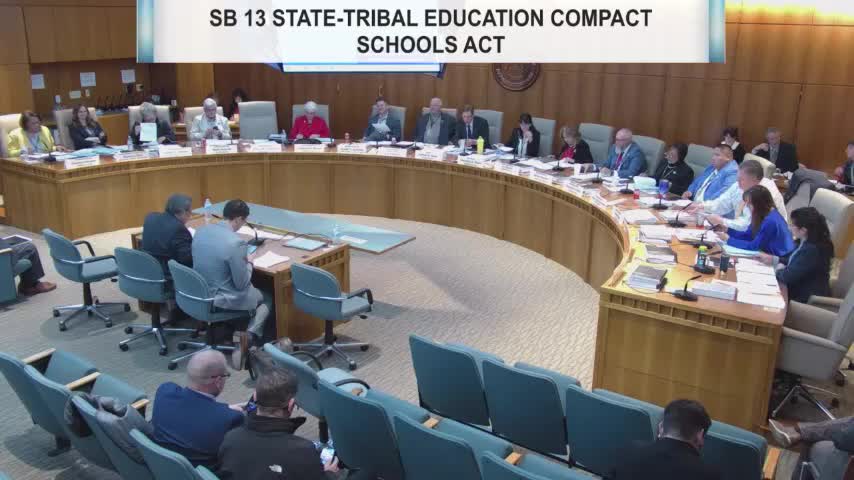
House Appropriations recommended a due pass for Senate Bill 13 with an amendment to pilot up to five tribal compact schools that prioritize indigenous language groups and to require annual status reporting to legislative study committees.
The House Appropriations Committee recommended passage of Senate Bill 13, which would authorize a Tribal Compact Schools Act to enable tribes to establish language‑immersion and culturally based public schools under negotiated compacts with the state. The committee also adopted a House amendment that limits an initial pilot to five compact schools and requires annual reporting on progress.
Supporters — including tribal education leaders and attorneys — said the bill is about preserving language, culture and improving educational outcomes for Native students. “Our worldview is linked to our language in place,” Ata Chavis said during public comment. Alicia Carisse, a member of Santo Domingo Pueblo, said immersion programs have produced strong graduation and college‑going results in other jurisdictions and urged support.
The amendment adopted by the committee adds a pilot of up to five compact schools, prioritizes certain language families (Tiwa, Tewa, Towa, Keres, Apache, Zuni and Dene) for the initial effort, and requires the state tribal education entity to report status and progress to the Legislative Education Study Committee and the Legislative Finance Committee by each November. Committee members noted this was the product of extended negotiations in the House Education Committee and described the amendment as a compromise to advance a measured pilot.
Committee members asked about funding and facilities. Representative Silva asked whether capital outlay and local‑share obligations would apply; technical staff said existing public school capital outlay and other funding sources would remain available but funding timing and local matches will depend on each school’s circumstances and whether facilities already exist. A technical expert told the committee the compacting process requires planning and is not expected to have immediate fiscal impact because implementation is estimated to begin in fiscal year 2027; student counts and other metrics will be reported during the planning window.
Public witnesses included tribal education leaders and representatives of advocacy organizations. Conroy Chino of the Pueblos of Acoma and Taos and the New Mexico Center on Law and Poverty said compacts allow tribes greater control over education and language preservation. The ACLU of New Mexico and the New Mexico Center on Law and Poverty testified in support as well. Several Pueblo education directors described existing immersion work and urged a structured, supported pathway for expansion.
The committee adopted the House amendments and recorded a due‑pass recommendation; Representative Little moved the motion and Representative Hernandez seconded it. The committee did not record a roll call with names in the transcript for this vote; clerks recorded the outcome as a due pass to the floor.
What’s next: With committee approval the measure moves to the House floor. Implementation details — particularly facility funding and local share requirements — will be developed during the compacting and planning process and through the reporting requirements added by the committee amendment.