Get Full Government Meeting Transcripts, Videos, & Alerts Forever!
Get email alerts on the Digital Government topic
No spam. Unsubscribe anytime.
Committee OKs bill directing Office of Technology to seek input on blockchain uses for specified agencies
Summary
House Bill 1322 would authorize an RFI for distributed‑ledger (blockchain) solutions to improve efficiency, data security and customer experience at selected state agencies; the Commerce and Technology Committee reported the bill favorably, 9-0.
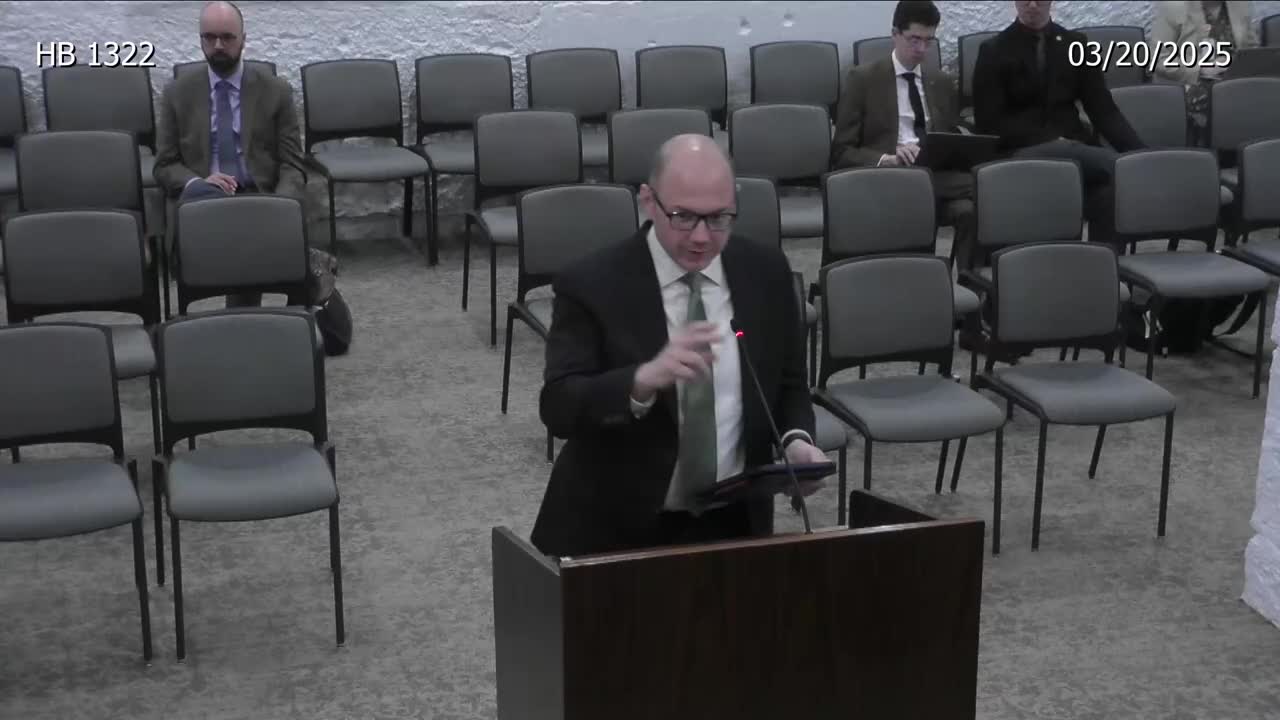
Representative Teschka presented House Bill 1322 as a narrowly framed request-for-information (RFI) measure for the Indiana Office of Technology (IOT). "This bill, I think, is a simple bill," he told the committee, explaining the request would focus on applications for four agencies: the Secretary of State, Family and Social Services Administration (FSSA), Department of Workforce Development (DWD) and Department of Child Services (DCS).
The sponsor said the legislation is intended to surface ways distributed‑ledger technology (commonly called blockchain) could strengthen data security, improve customer convenience and create administrative efficiencies. Teschka described blockchain’s technical premise and possibilities for government use: "Each block in the chain has a hash and it's like a digital fingerprint and it points to the next block," he said, and added the committee could consider applications beyond cryptocurrency such as timestamping records, smart contracts and secure custody of sensitive data.
Committee discussion and context: Committee members acknowledged the technology is new to many legislators and praised the sponsor’s concise approach. Senator Ford cited a public example — Baltimore’s use of blockchain to track vacant properties — as a potential analogy for Indiana applications. No outside witnesses registered to testify; the bill’s focus and technical framing kept discussion limited to potential agency use cases.
Committee action: The committee moved and seconded the bill and then called the roll. The committee reported the bill favorably; initial roll call showed 8 in favor with 0 opposed and the final reported vote was recorded as 9 in favor, 0 opposed after the committee held the vote open briefly.
What the bill does not do: The RFI requirement asks for information and options; it does not itself authorize procurement, require agency adoption, or allocate implementation funding. Representative Teschka emphasized the goal is to gather expertise about possible applications and tradeoffs.
Next steps: With committee approval, the bill proceeds for further consideration by the full chamber. If enacted, IOT would issue the RFI and report back to inform future policy or procurement decisions.