Get Full Government Meeting Transcripts, Videos, & Alerts Forever!
Get email alerts on the Zoning Variance 102 Flintlock topic
No spam. Unsubscribe anytime.
Council grants variance for existing deck but denies shed built without permit at 102 Flintlock
Summary
After a public hearing and questions about neighbor consent and a stop-work order, Peachtree City council approved a variance for an existing deck (6.2‑foot encroachment) and denied a requested variance for a newly built pool‑house shed (12.2‑foot encroachment); vote 4-0.
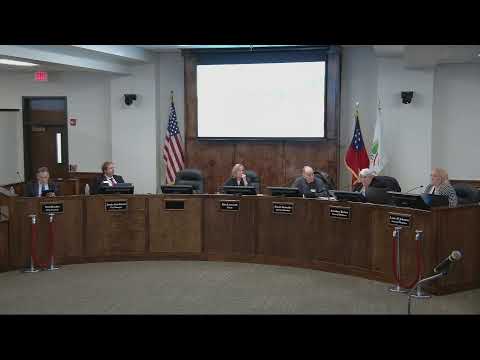
Peachtree City council heard a public hearing on a rear-setback variance request for property at 102 Flintlock and voted to approve a variance for an existing deck built by a previous owner while denying variance relief for a shed erected by the current owner without a permit. The combined council action carried 4-0; one member was absent.
City planning staff told the council that the property's rear setback is 30 feet and that the existing deck encroaches by 6.2 feet while the shed — described by the applicant as a movable pool‑house used for storage and built on blocks — encroaches by 12.2 feet and measures roughly 220 square feet. Staff said the shed was built without a permit; a stop‑work order was issued after construction began.
Applicant David Hart addressed council and said he placed the structure where he did because of how water runs across the driveway and property and because moving it would interfere with garage access. “It’s…a storage area really for recreational equipment and pool stuff,” Hart said, explaining he did not realize a permit was required for that structure and that doors and gutters had been ordered and installed after delivery.
Staff presented the variance criteria in the packet and noted the applicant supplied a justification narrative, a site survey and letters of neighbor support. Council questioned the provenance of neighbor consent: the packet included signed letters but council members identified inconsistencies in one document labeled with the address 100 Fieldstone Lane and asked whether that signature actually came from the neighbor directly behind the shed. Council members said the missing or unclear neighbor consent and the fact that construction continued after a stop‑work order were important considerations.
In deliberations council members said they were reluctant to routinely approve after‑the‑fact variances for projects that began without permits. “We need to guard against simply approving variances after a stop work order or after learning a homeowner has completed a project without proper permits,” Councilwoman Brown said during the debate and urged denial of the shed variance. Other council members noted the deck predated the current owner and said that fact favored allowing the deck variance while rejecting relief for the shed.
The council moved, seconded, and voted to approve the variance for the existing deck and to deny the variance request for the shed; the motions passed with four votes in favor and none opposed. Council instructed that the deck variance would bring the property into compliance for the preexisting decking, while the shed — having been constructed without required permitting and with incomplete neighbor consent documentation — would not receive relief.
The applicant may pursue compliant options (remove the shed, relocate it with required permits, or provide additional neighbor consent and return to council), and staff will enforce any follow‑up steps required by the zoning ordinance and building code.