Get Full Government Meeting Transcripts, Videos, & Alerts Forever!
Get email alerts on the District Finance topic
No spam. Unsubscribe anytime.
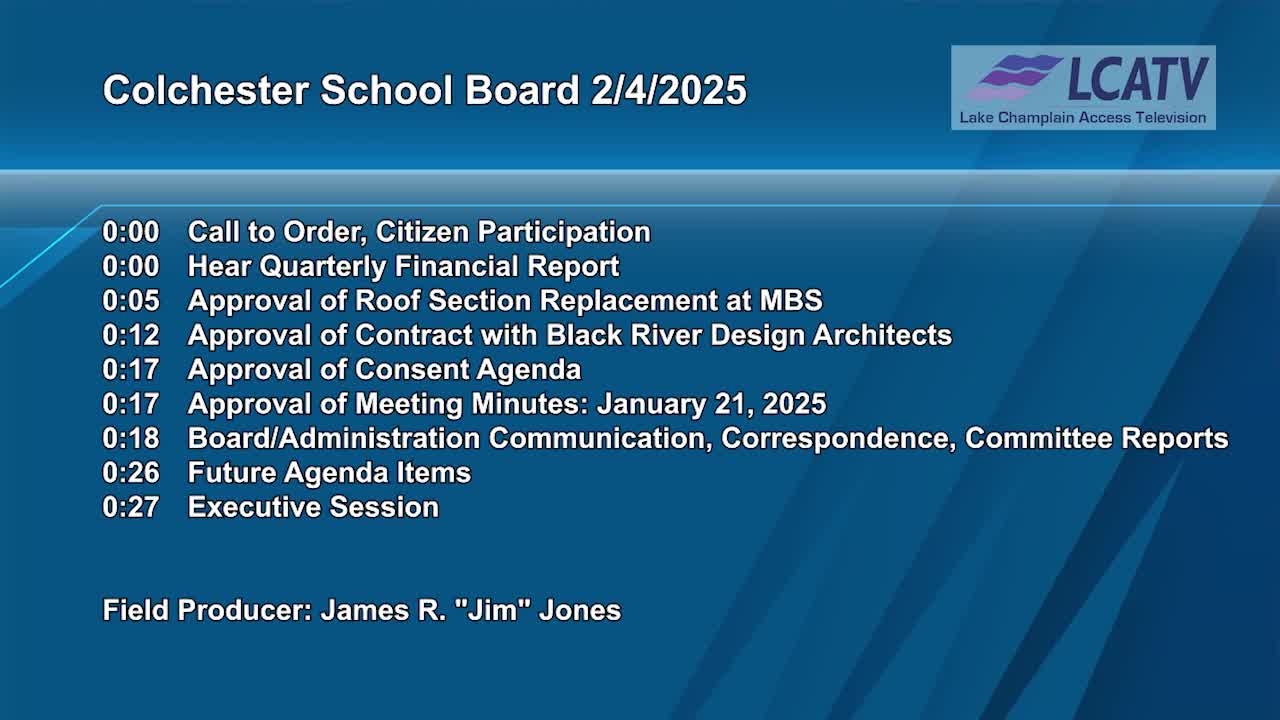
Quarterly report: Colchester School District posts nearly $1 million surplus after deferred state reimbursement
Summary
Business and operations manager George told the Colchester School District board the second-quarter financials are close to last year’s pace, and an extraordinary, delayed state reimbursement increased reported revenue by about $1 million, producing a near-$900,000 surplus.
The Colchester School District Board heard its second-quarter financial report and was told the district is essentially tracking with last year’s spending after a one-time state reimbursement increased reported revenue by about $1 million.
George (business and operations manager) reported that “the second quarter has closed, and things are pretty much looking like you would expect them to,” and that current spending is about 43.76 percent of budget compared with 43.32 percent last year. He told the board the auditors required the district to book an extraordinary reimbursement from the state as deferred revenue, which increased this year’s reported revenue by about $1 million and put the district’s surplus “a little closer to about 900,000 or almost a million.”
Board members asked how line items are defined and whether the district can provide more granular reports. George said those classifications follow a “state chart of accounts” so that local reports align with state reporting and the annual August submission. He added that while more detailed breakdowns exist (he described teacher-related accounts as having hundreds of sub-accounts), the district can provide them on request.
Board members also asked about transparency for bond-related spending. George said bond receipts and expenditures will be tracked in a separate spreadsheet that ties each expense to the applicable account and can be included in quarterly or monthly updates once bond funds are received and spending begins. “If the board would like to start seeing that once we start once we receive our money and start spending it, could easily be part of the quarterly or even monthly update,” he said.
Several clarifying details were noted during discussion: the district has budgeted for previously unplanned costs such as Black River design work and high-school bathroom prep; the district adjusted its professional education line in the budget to cover rising costs; and the currently reported surplus reflects both higher-than-expected reimbursement revenue and a mix of over- and under-spending across line items.
The financial report was presented as an informational item; no vote was required. Board members did not express concern about the district’s short-term fiscal position but asked the administration to continue delivering detail on bond-related expenditures and to make full account-level breakdowns available on request.
Looking ahead, the board will receive additional updates tied to the budget process and the bond timeline at upcoming meetings.