Get Full Government Meeting Transcripts, Videos, & Alerts Forever!
Get email alerts on the Blood Alcohol Limit topic
No spam. Unsubscribe anytime.
Experts tell Transportation Committee lowering per-se BAC to 0.05 would reduce fatal crashes, supporters say
Summary
Public health and traffic-safety experts testified that lowering the legal blood-alcohol limit to 0.05 would reduce alcohol-related fatalities, citing international studies, a U.S. meta-analysis and Washington state data; lawmakers raised enforcement and staffing questions.
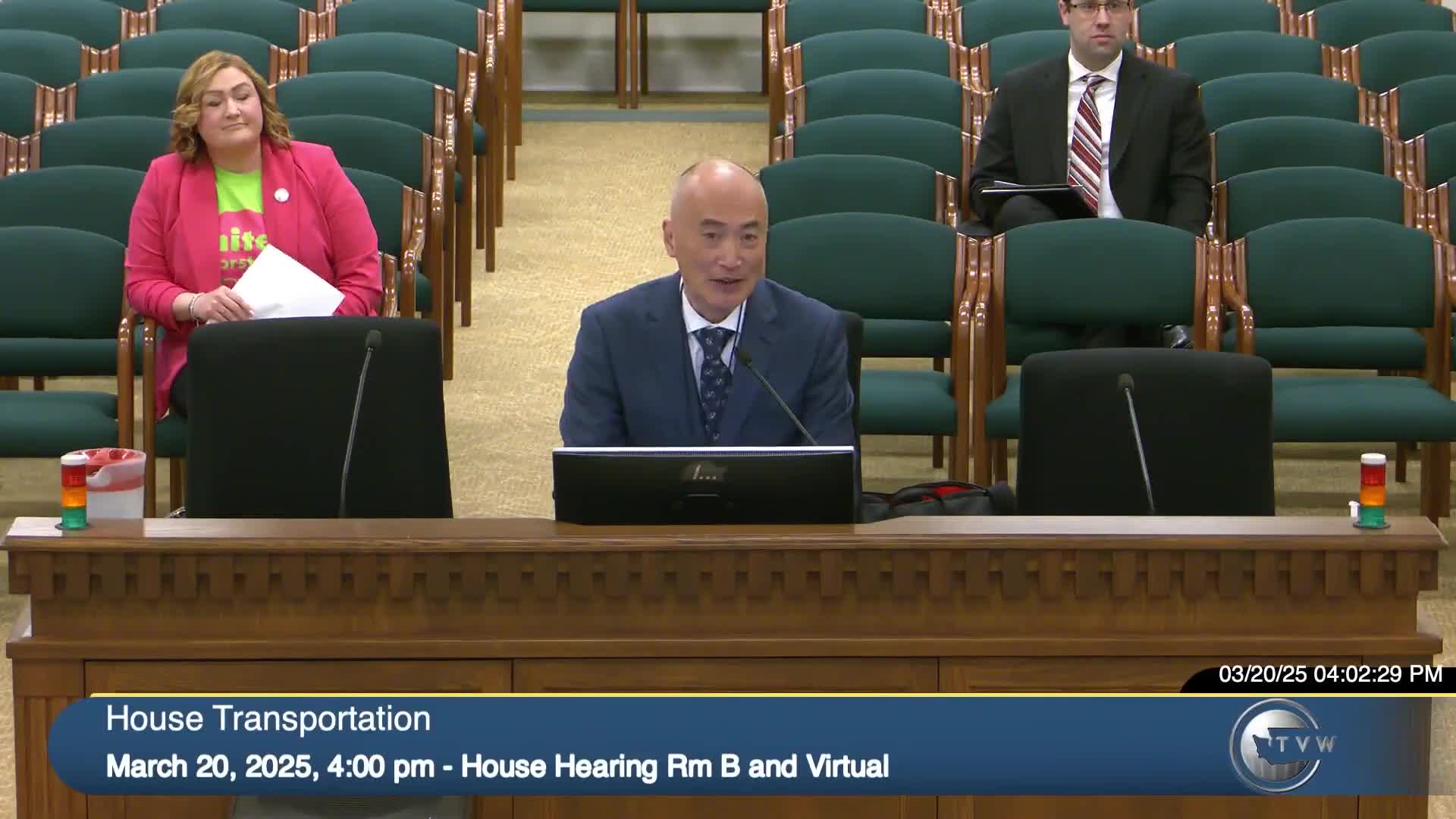
Dr. Taosheng Quan Get, the state health officer at the Washington Department of Health, told the Transportation Committee that alcohol “begins to affect the body and the brain almost immediately,” impairing judgment, coordination and perception and making driving dangerous even at relatively low blood-alcohol concentrations.
James Felt, principal research scientist at NORC at the University of Chicago, summarized decades of research and a meta-analysis his team produced on lowering per-se blood-alcohol concentration (BAC) limits. Felt said the meta-analysis estimated an 11 percent decline in fatal alcohol-related crashes if all U.S. states lowered the adult per-se limit to 0.05 and added, “we estimated that almost 1,800 lives could be saved each year if all states lowered their limit to 0.05 in the U.S.”
The committee heard national and state data showing impaired-driving fatalities have risen in recent years. Mark McKechnie, external relations director for the Washington Traffic Safety Commission, said total traffic deaths in Washington rose 75 percent from 2014 to 2023 and that impairment-involved fatalities increased 80 percent in the same period. McKechnie added that fatalities involving drivers with BAC at or above 0.05 increased 91 percent over the last decade.
Experts cited international experience and U.S. evidence. Felt and others pointed to studies from countries that adopted a 0.05 limit, reporting reductions in alcohol-related fatalities (examples given included double-digit declines in Australia, Japan and Sweden). Felt noted Utah lowered its limit to 0.05 (adopted 2018, effective 2019) and said the state saw a larger decline in fatal crashes than the national average in the years analyzed; he said Utah reported no significant drops in alcohol sales or tourism after the change.
Panelists and legislators discussed enforcement and staffing. Representative Stevie asked whether lowering the limit would work without stepped-up enforcement; Felt replied that a law must be enforced and publicized, but also said Utah did not change enforcement intensity yet had measurable effects. Representative Mendoza and others pressed the point that Washington has comparatively fewer patrol officers; McKechnie and Lieutenant Jeffrey Leonard of the Washington State Patrol said some effect can come from signaling that the state is “getting tougher,” but the impact would be reduced without enforcement and public education. Leonard, who oversees impaired-driving training for the state patrol, described officers’ three-phase contact approach — vehicle observation, personal contact and pre-arrest screening — and the standardized “yes, wait, or no” decision framework used in the field.
Panelists also emphasized mixed-substance impairment. McKechnie said alcohol remains the leading substance in impaired-driving fatalities; about 31 percent of drivers in fatal crashes involved alcohol only, and another roughly 27 percent involved alcohol combined with other drugs. He added cannabis (delta-9 THC) appeared in about 16.4 percent of impaired drivers in fatal crashes and that 9.2 percent had THC at or above 5 nanograms per milliliter, the state’s cannabis per-se threshold. Leonard said officers are trained to look for signs of impairment from multiple substances and to rule out medical issues before arrest.
A personal statement from Ashley Bonus, a volunteer and worker with Mothers Against Drunk Driving (MADD), gave a victim’s perspective. Bonus described losing her sister, Stacy, to a repeat offender driving under the influence and urged the committee to treat impaired driving as “a public safety crisis,” saying, “This was not an accident, this was a choice.”
No formal proposal or vote was taken at the hearing. Committee members asked presenters for sources and follow-up data; Felt and McKechnie said they would provide reports and the Utah analysis for committee review. The panel recommended a mix of measures beyond lowering the BAC limit — including public education, ignition interlocks for all convicted offenders, DUI treatment courts, and alternative-transportation options — along with enforcement and officer training.
The hearing closed after questions and a request by representatives for additional materials.