Get Full Government Meeting Transcripts, Videos, & Alerts Forever!
Get email alerts on the Commerce Authority Tax Free Bonds Utilities topic
No spam. Unsubscribe anytime.
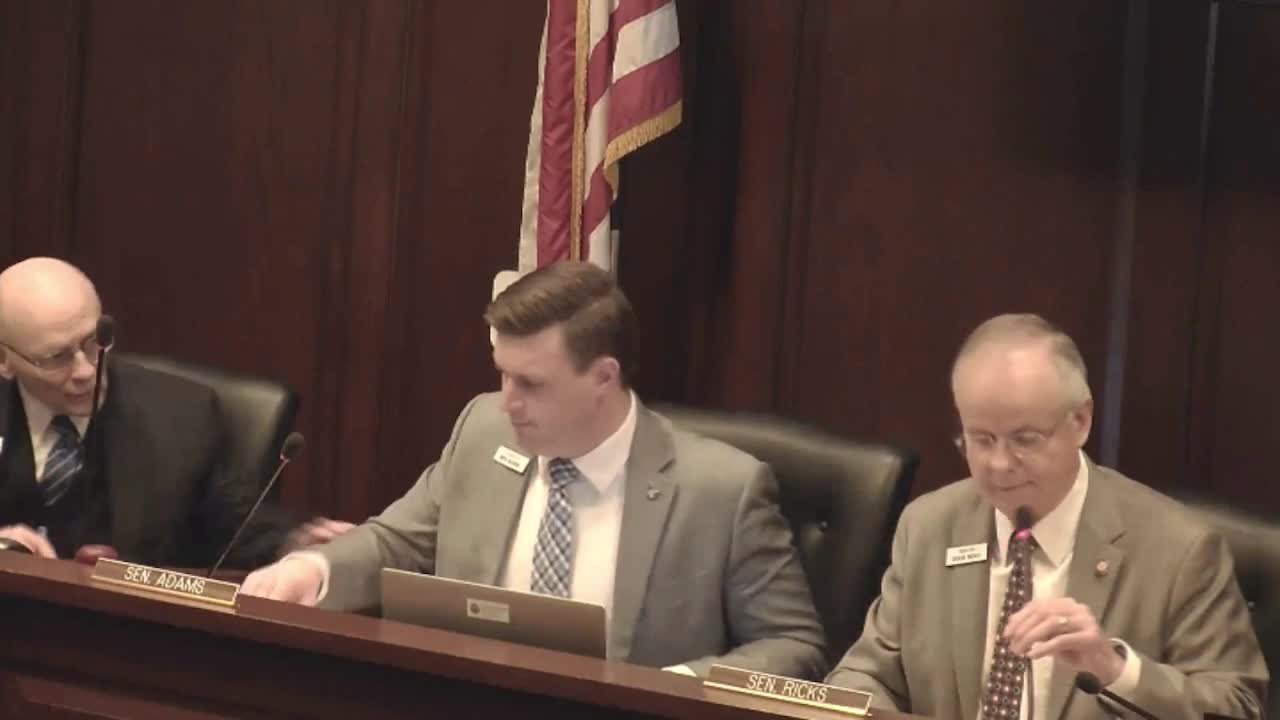
Committee advances bill letting local commerce authorities issue tax-free bonds for water, sewer projects
Summary
The Senate Local Government and Taxation Committee voted to send House Bill 171 to the Senate floor with a “do pass” recommendation after Representative Clay Handy described an amendment allowing local commerce or intermodal authorities to use tax-exempt bonding for water and sewer facilities (excluding electricity and broadband).
The Senate Local Government and Taxation Committee voted to send House Bill 171 to the Senate floor with a “do pass” recommendation after Representative Clay Handy, R‑District 27, described an amendment that would let local commerce or intermodal authorities issue tax-exempt bonds to finance certain utility projects.
The bill, Handy said, expands an existing commerce-authority bond program that currently covers land-port facilities, terminals, warehouses and related utility services “reasonably incident to a modern efficient and competitive land port.” The amendment would allow cities and counties that have a commerce authority to use that authority to sell tax-exempt bonds for other utility services including water and sewer facilities, but the change would not allow tax-exempt bonding “to transmit, distribute or produce electricity or broadband services,” Handy said.
“This will give local communities the opportunity to use their commerce authority if it exists in the area,” Handy said, pointing to a near-term need in Burley where, he said, the sewer plant is failing and the city needs roughly $120,000,000 and has already obtained $20,000,000 in federal assistance.
Committee members asked clarifying questions about whether the amendment would apply to municipally owned utilities and whether it would supplant other local financing tools such as local improvement districts. Handy said the change is intended to be an additional option that “could be implemented quickly” and that it is intended for sewer and water projects; municipal power providers and broadband would remain excluded.
With no public testimony in favor or opposition, Senator Taylor moved to recommend the bill be sent to the Senate floor with a do‑pass recommendation; Senator Berndt seconded. The committee approved the motion by voice vote. Senator Anthony was identified as the Senate sponsor who will carry the bill on the floor.
The bill now proceeds to the Senate floor for further consideration.