Lifetime Citizen Portal Access — AI Briefings, Alerts & Unlimited Follows
Committee hears broad public support for Discover Pass fee increase, sharp disagreement over revenue split
Loading...
Summary
The House Appropriations Committee heard hours of testimony on engrossed substitute Senate Bill 5390, which would raise the Discover Pass from $30 to $45 and increases the revenue threshold at which pass receipts are split equally among state parks, the Department of Fish and Wildlife and the Department of Natural Resources.
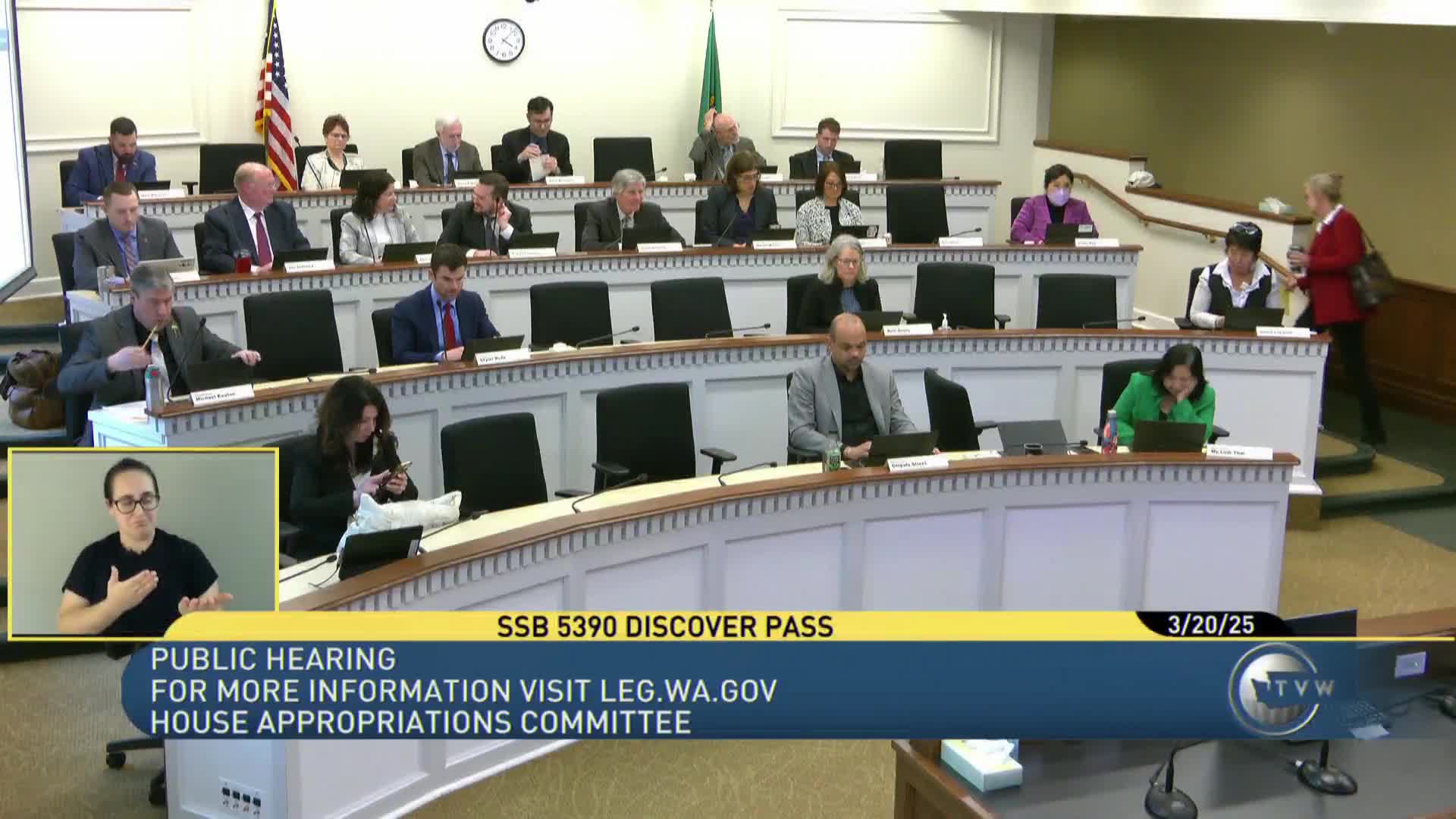
The House Appropriations Committee on a public hearing on engrossed substitute Senate Bill 5390 heard wide agreement that the Discover Pass fee should rise from $30 to $45, but sharp opposition over a proposal to raise the revenue threshold that would trigger equal sharing among the three recipient agencies.
Dan Jones, staff to the committee, outlined the bill’s mechanics: the Discover Pass provides access to lands managed by the State Parks and Recreation Commission, the Department of Fish and Wildlife (WDFW) and the Department of Natural Resources (DNR). Current law directs pass revenue first into the Recreational Access Pass account and then distributes 84% to a state parks account, 8% to WDFW and 8% to DNR; if revenue exceeds $71,000,000 in a biennium, the amount above that is divided evenly among the three agencies. Jones said the bill would increase the annual pass from $30 to $45, raise the equal‑split threshold from $71 million to $100 million, make the lifetime disabled‑veteran pass equivalent across all three agencies, and add a third space for license plate numbers on the pass. The fiscal note projects roughly $15 million in additional revenue in the 2025–27 biennium, with about $13 million to state parks and $1.2 million each to WDFW and DNR.
Why it matters: Discover Pass revenue is a major part of state parks’ earned revenue and funds daily operations and maintenance across hundreds of sites. Stakeholders said inflation, post‑pandemic visitation increases, and growing deferred maintenance make a fee change necessary; others warned that changing the distribution formula would shortchange WDFW and DNR, which manage large acreages of recreation lands and have distinct maintenance needs.
Supporters and caveats
Several conservation and parks groups said they back the price increase to recover purchasing power lost since the pass was created in 2011. John Floberg of the Washington State Parks Foundation said the increase “is essential to account for inflation since 2011, and ensure our parks can continue to provide quality outdoor experiences.” James King of Citizens for Parks and Recreation called the proposal “a fairly large catch up,” and said raising the fee is necessary after 14 years without change.
State parks representatives urged the committee to approve the package as written. Brian Constantine, legislative director for Washington State Parks, said the agency relies heavily on pass revenue and described the increase and threshold adjustment as an inflationary update: “This is about state parks and this is what funds state parks,” he said.
Opposition to the threshold change
Multiple speakers representing DNR, WDFW, off‑highway vehicle groups, regional trail clubs and local user groups supported the fee increase but strongly opposed raising the $71 million threshold to $100 million. Sam Hensold, recreation operations manager with DNR, testified: “We strongly oppose the provision in section 3 that raises the distribution threshold… Moving the threshold goalposts puts equitable distribution indefinitely out of reach for all users.” Melina Thompson, legislative director for WDFW, asked that distribution changes be addressed through an interagency conversation rather than an immediate threshold increase.
User groups and local advocates emphasized that DNR and WDFW manage large acreages and that many users rely on those lands for trail access, hunting, fishing and off‑road recreation. Jacob Perry of the Washington Off Highway Vehicle Alliance offered an amendment request that would preserve the $71 million threshold and direct a process for a sustainable, collaborative funding solution.
Fiscal and administrative details
The fiscal note accompanying the bill estimates a $15 million revenue increase in 2025–27, with one‑time costs for updated brochures and signs (state parks ~ $200,000; DNR ~ $60,000) and ongoing DFW transaction fees (~ $200,000 per biennium). State parks projected about $61 million in Discover Pass revenue for the current biennium; the bill’s authors and some park advocates said raising the threshold to $100 million reflects an inflationary recalculation, while opponents called the change a policy decision that reassigns future revenues away from DNR and WDFW.
Public reaction and next steps
Testimony ran more than an hour and included a mix of longtime parks commissioners, agency leaders, trail and recreation organizations, disabled‑veteran advocates and county and regional groups. Supporters urged the committee to approve the increase to maintain services and staffing; opponents urged retention of the current $71 million threshold or a more collaborative process for changing the distribution formula. The committee concluded the public hearing and moved to the next agenda item.