Get Full Government Meeting Transcripts, Videos, & Alerts Forever!
Get email alerts on the Utility Tax Reform topic
No spam. Unsubscribe anytime.
Committee advances bill replacing centrally assessed utility property tax with usage tax aimed at preserving local revenue
Summary
House Bill 329 would replace property tax on centrally assessed utilities with a usage tax (kilowatt-hour and therm) designed to be revenue-neutral statewide and to end litigation under the 1976 4-R Act; the committee moved the bill to the Senate floor with a due-pass recommendation.
The Senate Local Government and Taxation Committee on an unspecified date advanced House Bill 329, a proposal to replace property tax on centrally assessed utility property with a usage-based tax calculated from kilowatt-hour and therm usage data. Sponsors said the change is intended to avoid valuation litigation under the federal 4-R Act and to preserve roughly the same total revenue for local taxing districts.
Representative Jeff Ehlers, District 21 (Meridian), said the proposal grew out of multi-year negotiations among utilities, counties and state officials. He said the bill creates a usage tax for electric utilities measured in kilowatt-hours and for gas utilities measured in therms and that the drafters calibrated rates against historical usage to produce about $23,000,000 in statewide revenue distributed across existing taxing districts.
"So, these usages can be easily verified through its data that's submitted to the public utilities commission," Ehlers said, and described the measure as a compromise to avoid further litigation over central assessment and appraisal that has shifted tax burdens.
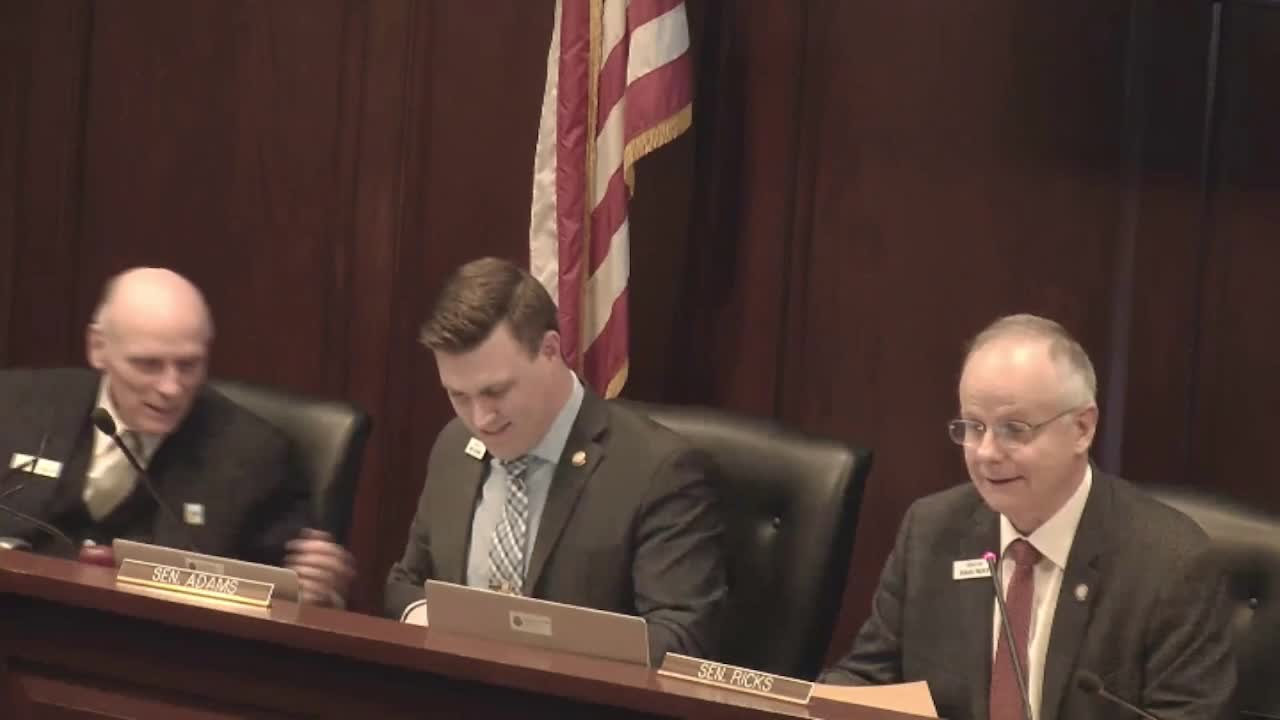
Senator Adams questioned the fiscal note and how confident drafters were that the usage tax would be revenue neutral. Ehlers and other supporters said the estimate is based on historical usage and that actual collections will vary with consumption patterns; the bill includes a provision to review implementation after five years. Committee members voiced that litigation under the 4-R Act had already reduced revenue in recent years and that the bill is a negotiated attempt to stabilize and apportion the revenue.
Senator Bernd moved to send House Bill 329 to the Senate floor with a due-pass recommendation; Senator Anthony seconded. The committee approved the motion by voice vote with no recorded opposition. Senator Ricks said he would carry the bill on the floor.