Get Full Government Meeting Transcripts, Videos, & Alerts Forever!
Get email alerts on the Judicial Compensation topic
No spam. Unsubscribe anytime.
Committee sends judicial pay increase to Senate floor with due‑pass recommendation
Summary
House Bill 322 would raise judicial salaries across Idaho’s courts; the Judiciary told the committee pay lags the market and cited declining applicant pools and judges leaving the bench. The committee recommended the bill with a due‑pass motion.
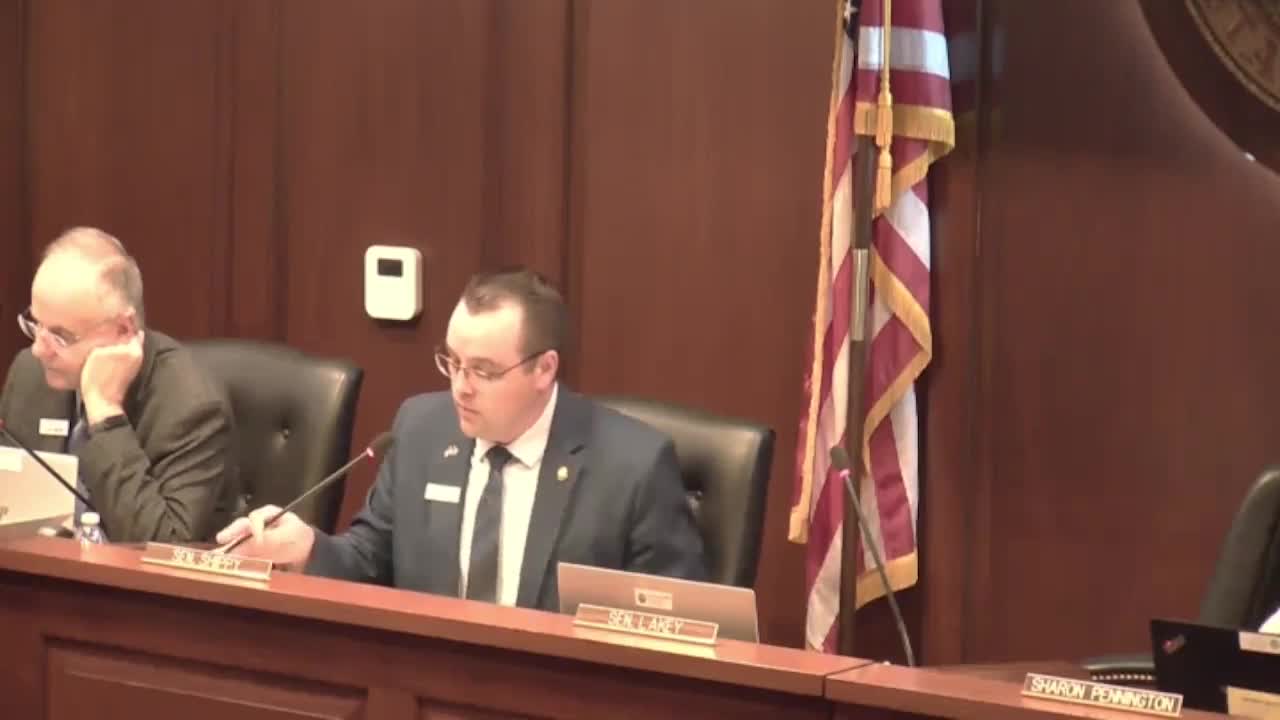
Senator Todd Lakey, sponsor of House Bill 322 and a state senator from District 23, told the Senate Judiciary & Rules Committee the bill increases judicial salaries as a step toward addressing recruitment and retention problems across Idaho’s courts.
Jason Spellman, legal counsel at the Administrative Office of the Courts representing the Judicial Branch, summarized a market‑based study showing judicial compensation in Idaho trails comparable public and private sector pay and lags neighboring states. Spellman said the number of applicants for vacant district judge positions dropped from an average of 11 applicants five years ago to about 4.6 today, and that several sitting judges are leaving the bench to return to other work. “Non‑competitive compensation is routinely cited as a reason that experienced attorneys are not applying for positions on the bench,” Spellman told the committee.
House Bill 322 would raise the Supreme Court justice salary and preserve existing differentials to other bench levels. Spellman provided current and proposed figures: under current law a Supreme Court justice is compensated roughly $169,500, a Court of Appeals judge about $161,500, a district judge about $155,500 and a magistrate about $147,508. House Bill 322 would move those numbers to approximately $180,650 for the Supreme Court, $178,500 for the Court of Appeals, $172,500 for district judges and $164,500 for magistrate judges; Spellman and the sponsor described the bill as a partial step toward a larger request the Judicial Branch plans to pursue in future sessions.
Senators generally voiced support. Senator Foreman moved and the committee seconded a motion to send House Bill 322 to the Senate floor with a due‑pass recommendation; the motion carried on a voice vote. Supporters argued the judiciary is an essential branch of government and that competitive compensation is required to attract qualified candidates.
The bill will next appear on the Senate floor for further consideration.