Get Full Government Meeting Transcripts, Videos, & Alerts Forever!
Get email alerts on the Indecent Exposure topic
No spam. Unsubscribe anytime.
Senate committee advances bill expanding Idaho indecent-exposure law to cover medically altered breasts
Summary
At a Senate Judiciary & Rules Committee hearing, members voted to send House Bill 270 to the Senate floor with a due-pass recommendation.
At a Senate Judiciary & Rules Committee hearing, members voted to send House Bill 270 to the Senate floor with a due-pass recommendation. The bill, presented by Representative Jeff Cornelis and Representative Tanner and sponsored in part by Nampa City Council member Sebastian Griffin, would amend Idaho Code 18-40116 to clarify the statute’s coverage of “willful” and “lewd” indecent exposure to include breasts that have been hormonally or medically altered to appear like developed female breasts.
Supporters said the change fills what they described as a loophole law enforcement has encountered at public events. Representative Jeff Cornelis (R., District 12) told the committee the bill “just simply says, cover up when you're in public” and that it is not intended to target any particular group. Sebastian Griffin, Nampa City Council member, said he observed individuals exposing themselves at a public park event and that local police told him they lacked clear statutory authority to act. “We have seen instances … and we've had no statutory authority to take action against somebody exposing themselves as the current law is outdated,” Griffin said.
Why it matters: The bill alters a longstanding indecent-exposure statute that prosecutors and law enforcement interpret through the “willful and lewd” standard. Supporters argued the clarification would give officers and county prosecutors clearer authority to pursue cases where exposure is intentionally provocative, especially in places where children are present.
The bill’s text relies on the existing requirement that conduct be “willful and lewd.” Representative Tanner summarized the intent as giving “law enforcement the footing that they need” to act at public events. The sponsors provided a letter from a Canyon County prosecutor stating that the office believed it could use the amended language to prosecute where facts comported with the statute’s elements.
Opponents and civil-rights speakers said the language is vague and risks unequal enforcement. Former state Senator Nixon Matthews, who testified in opposition, said the bill “expands criminalization in targeted ways” and described a scenario in which two people with similar chests could be treated differently under the law. Rachel Pierce and Jessica Evitt, both of whom testified against the measure, called the bill vague, argued it would invite community policing and legal challenges, and said it would disproportionately affect transgender and gender-nonconforming people.
Law-enforcement perspective: Edward Clark, policy assistant at the Idaho Family Policy Center, and other supporters said the statute would still require lewdness and would not criminalize ordinary conduct such as mowing a lawn shirtless where no lewd intent is present. Sponsors and supporters emphasized prosecutorial discretion and the multiple-warning pathway in the bill before escalated penalties occur.
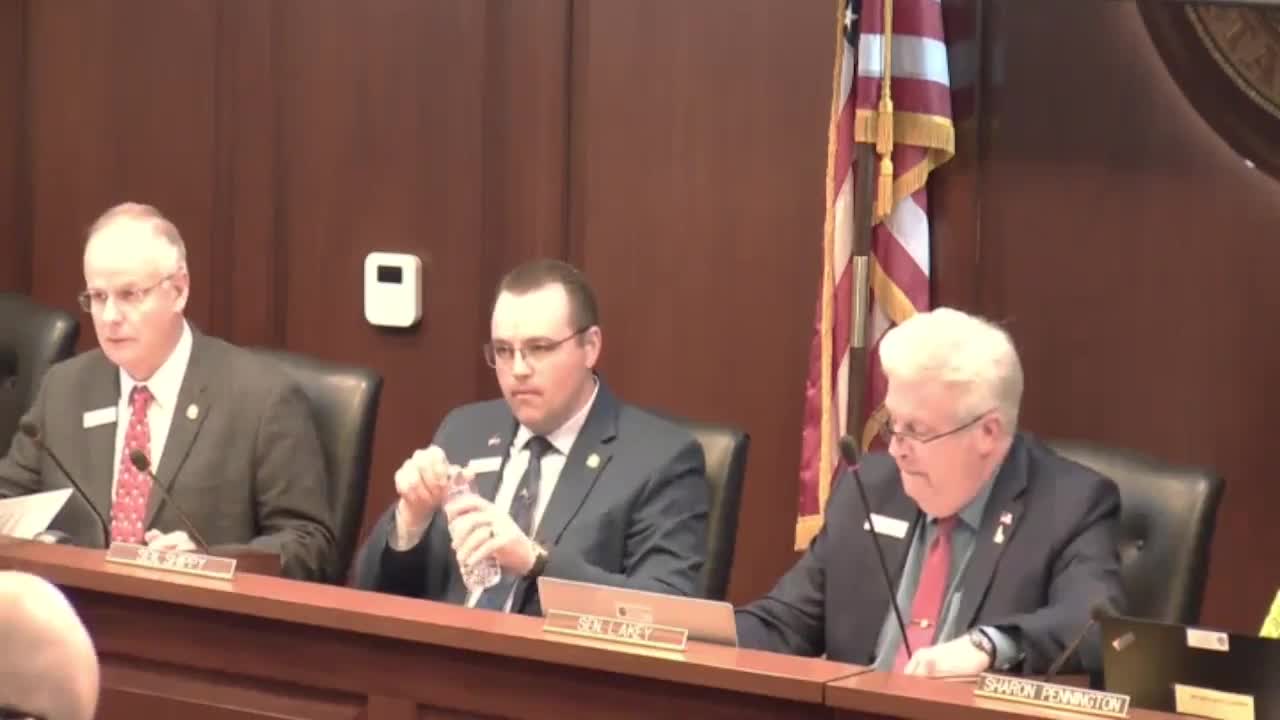
Committee action and next steps: Senator Lenny moved and Senator Forman seconded that the committee send House Bill 270 to the floor with a due-pass recommendation. The motion passed; during the recorded vote Senator Shippey and Senator Wintrow were recorded as voting nay. The committee will send the bill to the full Senate for further consideration.
Discussion, concerns and limits: Committee members questioned specific phrases in the bill, including language that would cover products “intended to resemble male or female breasts” and the statute’s reach into private settings “where there is present another person or persons.” Sponsors and supporters said those provisions mirror current statutory language and that prosecutorial discretion and existing legal tests (they cited Barnes v. Glen Theatre and City of Erie v. Pap’s A.M.) limit overreach, but several senators warned the language is broad and could produce unintended consequences without more precise drafting.
Votes at a glance: Motion to send House Bill 270 to the Senate floor with a due-pass recommendation — Motion made by Senator Lenny; seconded by Senator Forman; outcome: approved (Senator Shippey and Senator Wintrow recorded as voting nay).