Get Full Government Meeting Transcripts, Videos, & Alerts Forever!
Get email alerts on the Jones Act Cessation Lng topic
No spam. Unsubscribe anytime.
Senators consider asking Congress for Jones Act waiver so Alaska could receive North Slope LNG by ship
Summary
Sen. Robert Myers's SJR 11 and invited testimony from former Lt. Gov. Mead Treadwell focused on a potential congressional waiver to the Merchant Marine Act of 1920 (Jones Act) that would allow LNG shipments between U.S. ports and permit Alaska to receive its own North Slope gas by tanker while longer-term pipeline projects develop.
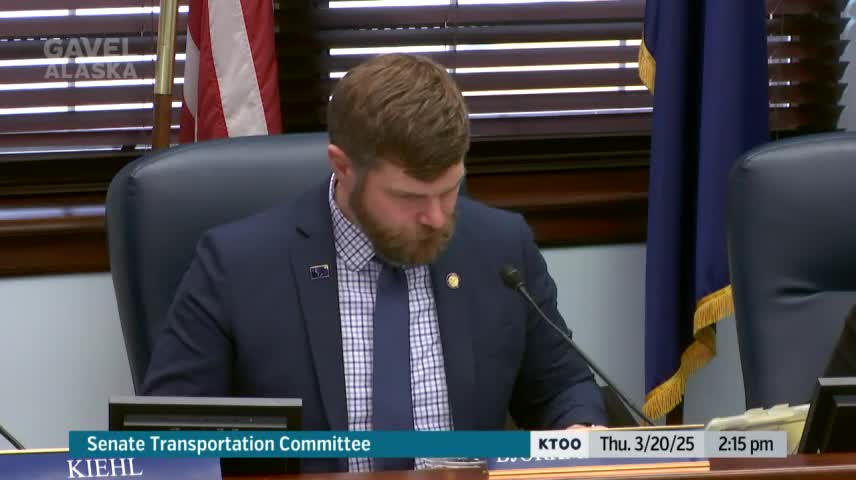
Juneau, March 20, 2025 — Sen. Robert Myers presented Senate Joint Resolution 11 to the Senate Transportation Committee on Thursday, asking Congress to consider waiving the Merchant Marine Act of 1920 (the Jones Act) for U.S.-intraport shipments of liquefied natural gas to enable Alaska to import its own North Slope gas by tanker while pipeline options are developed.
Myers said the Alaska Department of Natural Resources projects shortfalls in Cook Inlet natural gas supplies beginning soon, and that two projects aimed at monetizing North Slope gas'a state pipeline (AKLNG/AGDC) and slope-based LNG export projects'face long timelines that may not meet near-term needs. "The issue we are facing is that there are currently no LNG tankers in the world that are Jones Act compliant," Myers told the committee, and thus Alaska cannot legally ship its own gas between U.S. ports without a waiver.
Why it matters: The Jones Act requires vessels moving cargo between U.S. ports to be U.S.-built, U.S.-owned, U.S.-flagged and primarily crewed by U.S. citizens. Witnesses and senators said no Jones Act-compliant LNG tankers exist today, which blocks the option of shipping North Slope LNG to Cook Inlet customers by sea unless Congress grants a waiver.
Invited testimony and options: Former lieutenant governor and Kielak LNG CEO Mead Treadwell spoke in favor of opening options that might include reflagging foreign-built vessels under a congressional waiver, building U.S.-built Jones Act-compliant tankers or pursuing a mixed portfolio of solutions. Treadwell said American icebreaker capacity and shipyard capacity are constraints; he noted polar security cutter procurement cost increases and long delays and said U.S. shipbuilding costs remain substantially higher than in Asia.
Treadwell described three near-term options: (1) pursue a Jones Act waiver paired with reflagging existing foreign-built tankers for U.S. service; (2) incentivize construction of U.S.-built Jones Act-compliant LNG tankers (a costly and time-consuming option); or (3) rely on imports or traded cargoes while pipeline or in-state projects mature. He also noted prior congressional waivers for Alaska and other U.S. needs, citing examples from 2006, 2010, 2011 and a 1996 Puerto Rico-related waiver.
Committee discussion and economic concerns: Senators pressed witnesses on likely consumer price impacts, logistics and whether reflagging would require a statutory exemption. Treadwell said shipping and regasification costs factor into final delivered prices and that buyers in Asia drive many global LNG economics. Committee members emphasized the immediate need to explore options to avoid higher costs for Alaska residents if in-state supplies tighten.
Formal action and next steps: No committee vote was taken on SJR 11. Senator Myers told the committee he and staff have worked with utilities on the resolution language and will share revised wording on one clause that references a February cold-snap event in Anchorage per the request of a utility.
Ending: The hearing closed with committee members asking for continued coordination among state officials, project proponents and the congressional delegation; no formal decision or committee substitute was recorded at the March 20 hearing.