Get Full Government Meeting Transcripts, Videos, & Alerts Forever!
Get email alerts on the Rural Energy Pce Bulkfuel topic
No spam. Unsubscribe anytime.
AEA details rural power programs: PCE payouts, circuit riders, bulk-fuel backlog and Renewable Energy Fund activity
Summary
Alaska Energy Authority officials told the House Finance Committee that the Power Cost Equalization program covers 92 communities and that deferred maintenance on rural powerhouses and bulk-fuel facilities totals hundreds of millions of dollars, creating reliability and environmental risks.
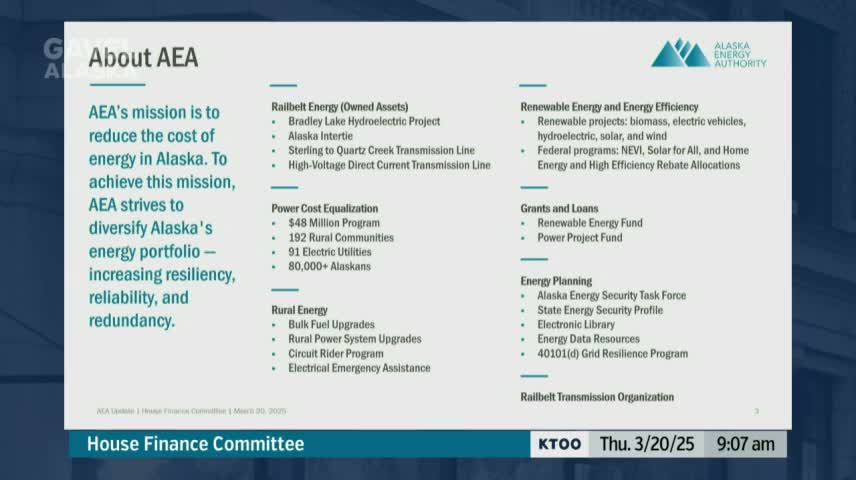
Alaska Energy Authority staff summarized rural energy work for the House Finance Committee on March 20, describing the Power Cost Equalization (PCE) program, circuit rider technical teams, deferred maintenance in rural powerhouses and bulk fuel, and the Renewable Energy Fund's recent activity.
Lede and why it matters AEA said PCE serves 92 communities and roughly 80,000 Alaskans, and that changes to rail-belt costs directly affect PCE program floors and caps. The agency told lawmakers rural diesel-fired powerhouses and aging bulk-fuel tank farms are at high risk from deferred maintenance and climate-driven erosion, which creates both environmental and reliability concerns for remote communities.
Key points from AEA - Power Cost Equalization (PCE): AEA said the PCE program covers 92 communities and that the legislature previously increased the residential PCE cap from 500 kWh to 750 kWh per residential consumer; AEA said it is paying rural community bills in under 30 days and has improved staff retention. - Circuit riders: AEA said it currently budgets for four circuit rider positions, with three filled and one vacant; the program cost in AEA's request is $710,000 and circuit riders often travel in pairs. AEA said three simultaneous electrical emergencies is its current record; to staff three simultaneous incidents without contractors would require roughly six circuit riders. - Deferred maintenance: AEA estimated deferred maintenance on rural powerhouses at about $300,000,000 and a conservative estimate of roughly $1,000,000,000 for bulk-fuel infrastructure needing upgrades or replacement. The agency said an average complete powerhouse can cost on the order of $6,000,000. - Bulk fuel upgrades: AEA stated the average bulk-fuel tank replacement averages around $11,000,000 and that coastal erosion and riverbank loss have created urgent near-miss situations that prompted emergency responses this year. - Renewable Energy Fund (REF): AEA described the REF's long run: 294 grants awarded totaling about $324,000,000, with more than 100 projects in operation and 56 in development. AEA said the program saves roughly 13 million gallons of diesel a year historically and that federal infrastructure dollars in recent years pushed additional capital into many projects.
Lawmakers' questions and clarifications Committee members asked whether school districts are eligible for PCE and how federal receipts affect eligibility. AEA staff stated schools are not eligible under current statute because school funding can be supported by other federal or state funds; the agency said eligibility rules were statutory and could be altered only by legislative action or RCA regulatory change.
Context and next steps AEA asked the legislature for operating budget support for the circuit-rider program (the governor included the request in the operating budget) and reiterated that pipe/repair work and new construction of tank farms often require multi-session capital approaches because individual projects cost several million dollars each.
Ending AEA officials urged continued legislative attention to long-term O&M funding and to align grant conditions and recovery mechanisms with community capacity; no committee action or votes were recorded during the presentation.