Get Full Government Meeting Transcripts, Videos, & Alerts Forever!
Get email alerts on the Utilities Regulation topic
No spam. Unsubscribe anytime.
House committee questions RCA appointees on staffing, rural energy and system reliability
Summary
Three governor's appointees to the Regulatory Commission of Alaska (RCA) — Mark Johnston, Steven DeVries and John Springsteen — appeared before the House Community & Regional Affairs Committee for questions about workforce turnover at the commission, rural utility challenges and looming energy supply issues for the Railbelt.
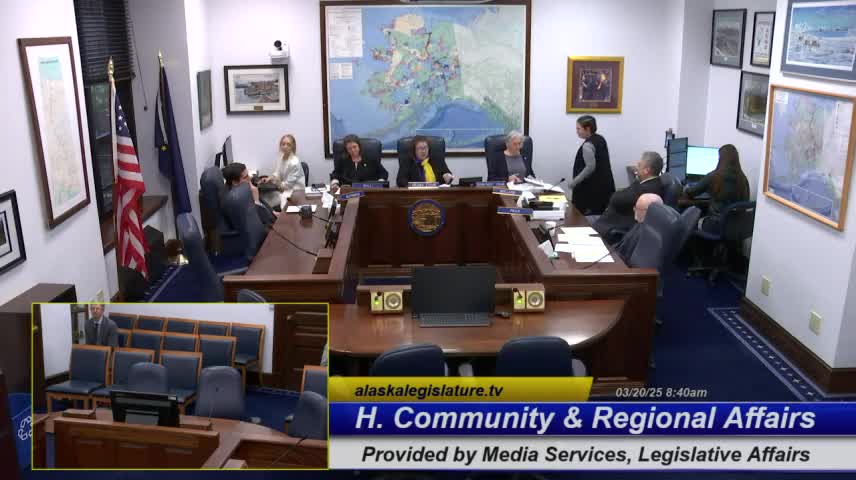
Three governor-appointed commissioners for the Regulatory Commission of Alaska appeared before the House Community & Regional Affairs Committee on March 20 for a confirmation hearing and to answer legislators’ questions about staffing, rural utility operations and larger energy-system concerns.
Mark Johnston, one of the appointees, described the commission’s staffing challenges and offered recruitment ideas, saying, “We have, like all other state agencies, experienced a fairly high rate of turnover. We have a high vacancy rate, and we are like many state agencies, we have some very technical positions, and those are the ones that are difficult to fill.” Johnston, a certified public accountant who described more than 40 years of accounting and utility-sector experience, told the committee the commission has experimented with internal career “laddering” and with recruiting retired technical staff and veterans to fill hard-to-staff roles.
Steven DeVries, who spent three decades with the Alaska Department of Law, told legislators that his prior work representing state agencies and intervening in RCA dockets gave him direct experience with the commission’s procedures. John Springsteen, the third appointee and a former executive at the Alaska Industrial Development and Export Authority, described private- and public-sector projects he said inform his perspective on transmission, generation and financing for energy projects across the state.
Legislators used the hearing to press the appointees on several themes: how the RCA can retain staff with technical skills, how the commission coordinates with the Rail Belt Reliability Council (RRC) and the rail-belt transmission organization on longer-term planning, and how the commission is preparing for potential natural-gas supply limits that could affect generation in Southcentral Alaska.
Johnston said the commission attempts to be “forward looking” and works with the RRC and other bodies on reliability and transmission standards. He and Springsteen described tools the RCA uses to convene utilities and private parties and to request updates; Springsteen said the commission is using its convening authority to discuss potential curtailment and contingency plans with utilities. Deputies and staff also told the committee that many planning requirements are driven by federal statutes and by utilities’ own filings, and that cost and staffing — not lack of statutory authority — are frequent constraints.
Public testimony on the appointees was opened and closed without in-room or online speakers. The committee read a statutory notice required by AS 39.05.080 and concluded the hearing. No confirmation votes were recorded during the meeting; the committee noted that the House Resources Committee would also hold its review and that additional public comment opportunities may be scheduled.