Get Full Government Meeting Transcripts, Videos, & Alerts Forever!
Get email alerts on the Grip Hvdc Cook Inlet topic
No spam. Unsubscribe anytime.
AEA wins $206.5 million GRIP award for Cook Inlet HVDC link; $143.8 million funding gap remains
Summary
The Alaska Energy Authority said it secured a $206.5 million federal GRIP (grid resilience) award to build a submarine HVDC cable across Cook Inlet to add a redundant transmission route. AEA reported a $413 million project estimate, about $63 million of identified nonfederal match and a remaining funding gap of roughly $143.8 million.
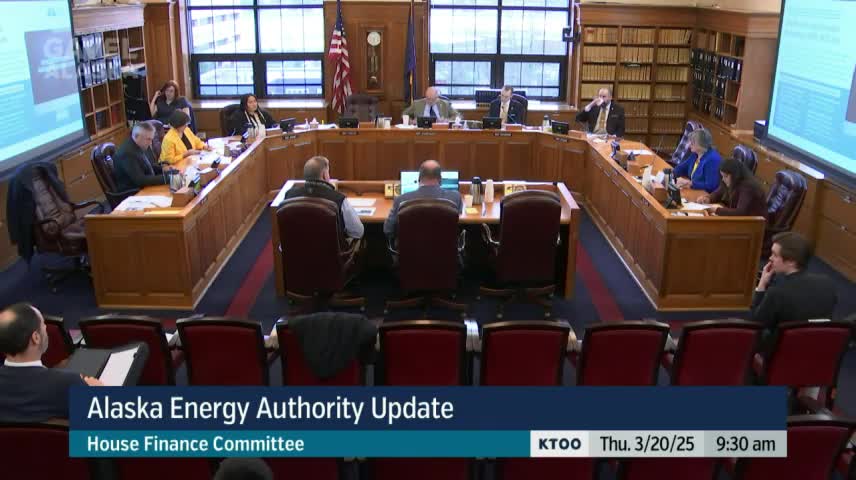
The Alaska Energy Authority told the House Finance Committee on March 20 that AEA and its utility partners secured a $206,500,000 federal grant for a Cook Inlet submarine high-voltage direct-current (HVDC) cable intended to add redundancy and resilience to the rail-belt transmission network.
Why it matters: AEA said the HVDC submarine cable would provide a parallel link to reduce the rail-belt's vulnerability to outages — including the four-month loss of northbound transmission during the Swan Lake Fire several years ago — enable more renewable integration and expand transfer capability between the Kenai Peninsula and Anchorage/Fairbanks areas.
Project scope and funding - Federal award: $206,500,000 (AEA presentation). AEA said this amount was the fifth-largest award nationally among competitive GRIP awards. - Total estimated project cost: $413,000,000 (presentation). AEA said $206,500,000 is secured and that $143,800,000 remains to close funding requirements. - Ongoing costs and benefits: AEA estimated construction-phase job creation of about 1,470 jobs, $129,000,000 in labor income and a total economic output of about $332,000,000; annual operations and maintenance were estimated at roughly $6,000,000 per year. - Technical details: AEA described the HVDC cable as a state-of-the-art submarine direct-current line spanning roughly 38 miles that uses converter stations at each end to reduce long-distance losses and increase transfer efficiency.
Match and implementation questions Committee members asked how the nonfederal match would be provided. AEA said it has identified roughly $63,000,000 of match (including a $12.7 million state contribution already appropriated and $50,000,000 AEA moved from another transmission project via bonding) and remains short approximately $143,800,000. Thayer said match sources could include further state appropriations, additional AEA bonding, private-public partnerships or other nonfederal sources; AEA said there is no requirement that the match be a state appropriation specifically.
Timing AEC noted that the grant requires an eight-year completion window; AEA said it is in the first year of an eight-year period and expects to phase the work and financing over that time. AEA also described a projected construction and licensing window between 2024 and 2032 in materials presented to the committee.
Ending AEA officials described the GRIP award as a competitive national success for Alaska, noted that about half of the project funding is already identified, and said closing the remaining financing gap is a near-term priority as AEA and partners develop procurement and construction schedules.