Get Full Government Meeting Transcripts, Videos, & Alerts Forever!
Get email alerts on the Transportation Planning topic
No spam. Unsubscribe anytime.
House panel adopts amendment to HB 26 to explicitly include ferries in statewide transit planning
Summary
The House Community & Regional Affairs Committee adopted an amendment to House Bill 26 to explicitly include ferry operators in the Department of Transportation and Public Facilities’ statewide public and community transit plan. The committee then moved the bill from committee as amended.
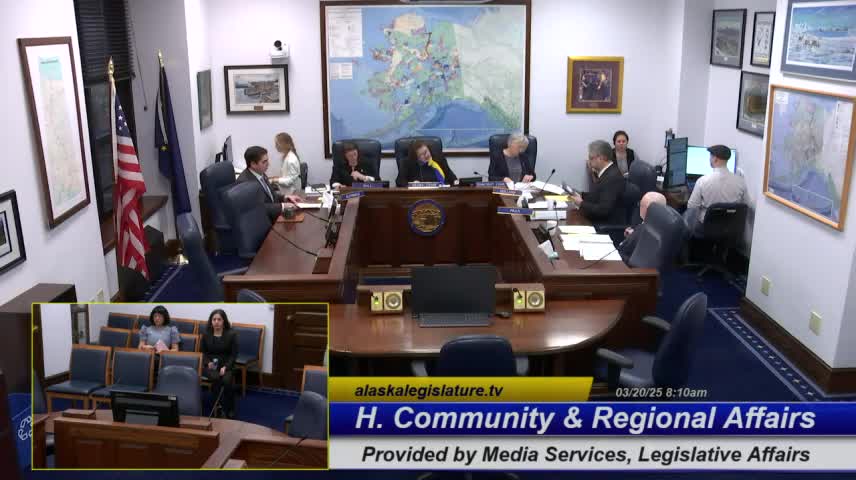
The House Community & Regional Affairs Committee on March 20 adopted an amendment to House Bill 26 to explicitly include ferry operators in the statewide public and community transit plan that the Department of Transportation and Public Facilities (DOT&PF) is required to produce.
Representative Genevieve Mina, sponsor of House Bill 26, said the measure is intended to “broaden DOT scope to be more multimodal and specifically include public transit in its planning responsibilities.” The bill was before the committee for third reading and consideration of one amendment.
The amendment, advanced to name ferry operators in the statute’s list of transit partners, drew a mix of support and reservations from committee members. Representative Holland argued adding ferries would “reduce the barrier to recognizing how important, particularly in our regional coastal communities, the ferry system is a transit modality.” Representative Prox cautioned against singling out individual modes inside a broad statutory authority, saying naming specific items can implicitly diminish others.
Andy Mills, special assistant and legislative liaison for DOT&PF, told the committee that many of the planning activities sought by the bill are already directed by federal statutes and regulations and are being carried out by the department. "The activities that we understand are being asked for are already directed by the federal requirements and being conducted by the department," Mills said, adding that most limits on service expansion are funding-related.
Representative Mina said she supported the amendment and the bill because codifying public transit in statute helps preserve emphasis on those efforts if department leadership changes. She told the committee, "just because a department is currently doing something doesn't necessarily mean that they're going to do it forever," emphasizing the bill’s role in maintaining continuity of planning attention to public transit.
On a roll call, the committee approved Amendment A1 4–2. The clerk recorded the roll as: Representative Hall — yes; Representative Holland — yes; Representative Prox — no; Representative Reffers — no; Co-chair Hemshutt — yes; Co-chair Mears — yes. After adoption of the amendment, the committee moved House Bill 26 as amended from committee with individual recommendations and an attached fiscal note; there was no recorded objection to moving the bill from committee.
Committee discussion repeatedly framed the underlying constraint as funding rather than statutory authority: members and DOT&PF staff said federal funding rules and limited federal transit dollars largely determine the department’s ability to expand service. Several members urged that the statutory change still matters because it signals state priorities and codifies stakeholder engagement requirements for community and public transit operators.
The committee concluded its consideration of HB 26 and signed paperwork to move the bill from committee. The bill will proceed with the committee’s recommendations and the attached fiscal note.