Get Full Government Meeting Transcripts, Videos, & Alerts Forever!
Get email alerts on the Bradley Dixon Diversion topic
No spam. Unsubscribe anytime.
Alaska Energy Authority advances Dixon Diversion plan to boost Bradley Lake output
Summary
The Alaska Energy Authority outlined plans to file a FERC amendment for the Dixon Diversion project that would increase Bradley Lake's output by about 50%, with a $342 million estimated cost, a 50-year financing model and a target in-service date around 2030 if permitting and funding proceed as expected.
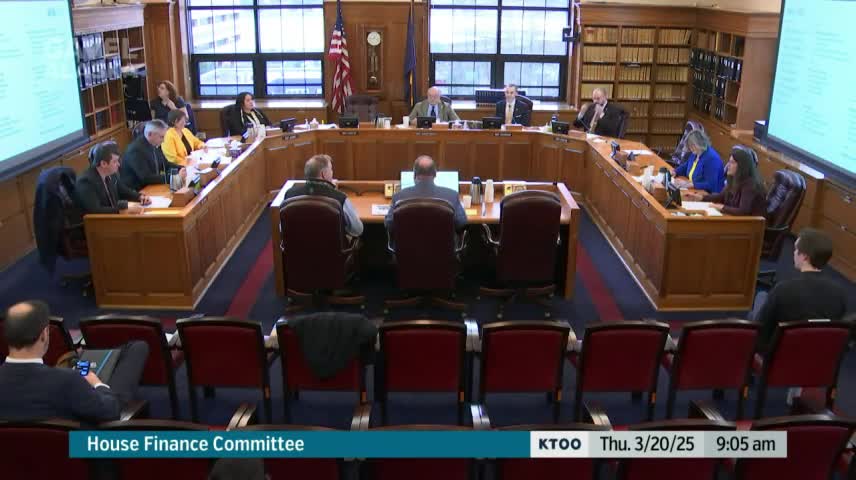
Curtis Thayer, executive director of the Alaska Energy Authority, told the House Finance Committee on March 20 that AEA is advancing the Dixon Diversion project at Bradley Lake and plans to file an amendment with the Federal Energy Regulatory Commission in January as part of the permitting timeline.
The diversion is designed to move additional water into Bradley Lake via a roughly five-mile tunnel and a dam raise; AEA's planning materials estimate the project would boost Bradley Lake's output by about 50% and could power the equivalent of up to 30,000 homes. "The Bradley Lake project right now is 30 years old, 32 years old, and it is a fairly young hydro project," Thayer said during the committee presentation.
Why it matters: Bradley Lake supplies low-cost bulk energy to the rail belt and is a key part of Alaska's ability to displace natural gas generation. Committee members pressed AEA on schedule, cost, financing and operational life because a larger Bradley affects rail-belt energy economics and rural Power Cost Equalization calculations.
Key facts and timeline - Estimated project cost: $342,000,000 (AEA presentation). - Estimated output gain: about 50% relative to current Bradley output; AEA said the increase is the equivalent of up to 30,000 homes and would displace an estimated 1,500,000,000 cubic feet of natural gas annually (presentation figures). - Financing and life: AEA said its finance model is based on a 50-year amortization for repayment even though typical hydro assets can operate far longer; Thayer said "the 50 years represents what we can finance for." - Permitting and schedule: AEA intends to file an amendment to its FERC license in January; Thayer said FERC review is expected to take 12 to 18 months, with AEA's internal schedule targeting a FERC finish by 2028 and physical completion around 2030, subject to approvals and funding. - Construction work: AEA described the major civil work as boring a roughly 14-foot diameter tunnel through mountain rock (six to eight months of drilling once permitted) and selecting a dam-raise height (options discussed included 7 feet or 14 feet; a 28-foot option was ruled out as too expensive).
Questions from lawmakers and clarifications - Cost per kilowatt-hour: Representative Bynum asked whether the additional kilowatt-hour cost would be separated from existing Bradley rates; Thayer said the added capacity would be accounted for separately and shared among utilities based on their percentage shares (e.g., Chugach's 56% share). He declined to provide a final cents-per-kWh estimate for project output on the floor, saying the per-kWh number depends on financing and potential tax credits. - Project life vs. financing: Representative Galpin asked why AEA used a 50-year life in financial modeling rather than the 100-year operational life sometimes assumed for hydro. Thayer replied the 50-year figure reflects what AEA can finance. - Permitting status: Representative Hannon asked whether the project is under construction; Thayer said it is not under construction but has completed years of public consultation (work began in 2022), environmental and pre-engineering studies and that $6,500,000 was included in the current year's budget to complete remaining pre-construction work.
Context and background Bradley Lake (AEA describes it as the state's largest hydro project) sits about 27 air miles northeast of Homer and currently supplies roughly 10% of the rail-belt energy mix at roughly 4' per kilowatt-hour for the low-cost share allocated under existing power-sale agreements. AEA said past projects using water diversions (for example, a 2020 West Fork/Upper Battle Creek diversion) increased output on similar systems and completed on time and on budget.
What remains open AEA is continuing engineering work, finalizing the dam-raise sizing, securing financing sources and completing FERC filings. Thayer said AEA has started conversations with potential lenders, including the Department of Energy Loan Program, and has an accounting firm analyzing tax-credit eligibility; he noted tax credits could change project economics by as much as roughly $100 million according to the presentation.
Ending note AEA described Dixon Diversion as an active priority that, if permitted and financed as planned, would materially increase renewable output available to the rail belt and reduce reliance on natural gas generation. The project remains contingent on the FERC amendment, final financing commitments, and utility participation under negotiated cost shares.