Get Full Government Meeting Transcripts, Videos, & Alerts Forever!
Get email alerts on the Impeachment Law topic
No spam. Unsubscribe anytime.
Bill would expand statutory grounds for impeachment; judicial groups warn of vagueness
Summary
Senate Bill 15 would enumerate modern statutory grounds for impeachment — adding terms such as corruption, incompetence, negligence, willful neglect of duty, oppressive use of office and misconduct in office — and prompted opposition from the State Bar and trial-lawyer groups.
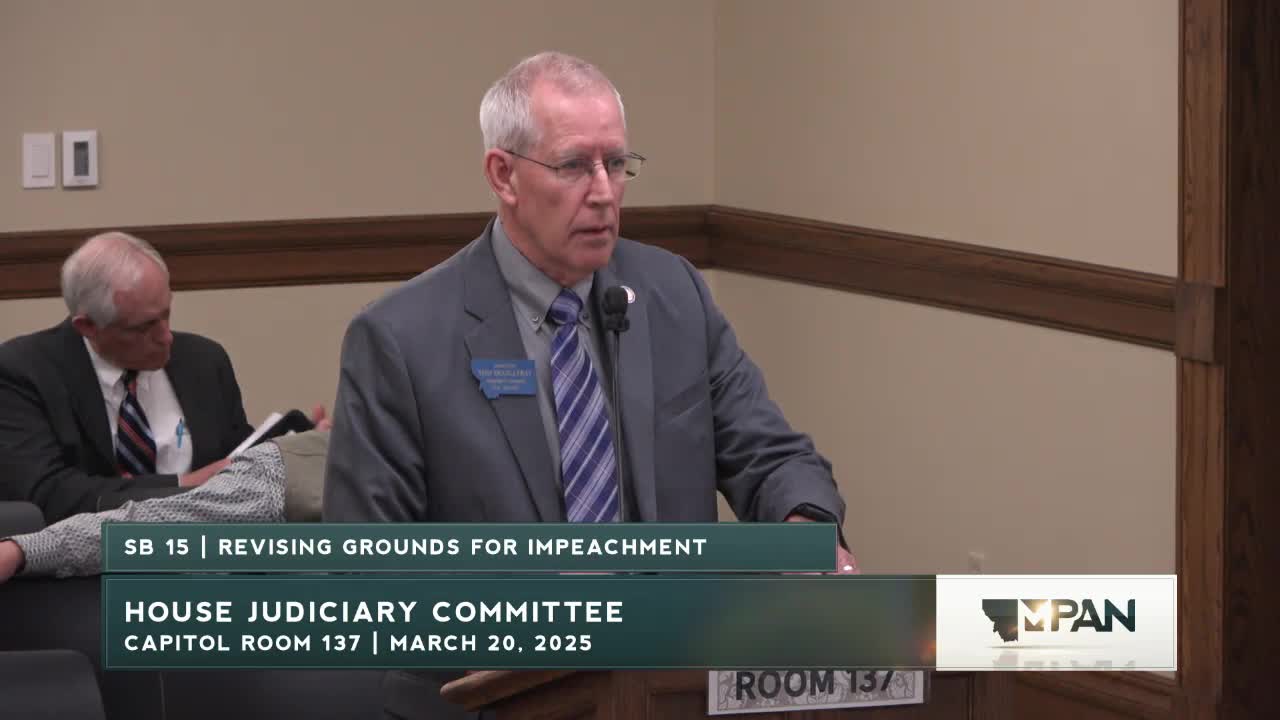
Senate Bill 15, presented to the House Judiciary Committee by Senator Tom McIlvray, proposes to modernize the statutory grounds for impeachment and to enumerate specific grounds — including corruption, incompetence, negligence, willful neglect of duty, oppressive use of one’s office, and misconduct in office.
McIlvray opened by citing Article V of the Montana Constitution and said the bill would update language dating to 1889. He told the committee the change would enumerate conduct that the legislature may treat as sufficient for impeachment and stressed the constitutional safeguard already in place — removal by conviction requires a two-thirds vote of the relevant chamber.
Opponents from the State Bar, the Montana Trial Lawyers and the Judicial Standards community warned the bill inserts ambiguous and subjective standards into impeachment law. A representative for the State Bar argued the inclusion of negligence as an impeachment standard is especially problematic because negligence requires no intent and would invite politically motivated impeachment filings over judicial rulings or ordinary mistakes.
Bruce Spencer of the State Bar warned that mistakes and clerical errors — the kind of error a judge could correct with a nunc pro tunc order — should not be grounds for impeachment. Opponents said adding broadly phrased grounds such as “incompetence” or “oppressive use of one’s office” risks politicizing impeachment, deterring qualified judges from service, and opening protracted legal battles.
Sponsor testimony emphasized that enumerating misconduct in statute would provide clarity and a remedy for officials who seriously fail to perform duties, including examples such as corruption or a senile judge unable to carry out duties. McIlvray said the constitutional two-thirds requirement remains a high bar and that the bill is intended to provide modern, plain-language standards for the legislature to apply.
No votes or formal committee action on the bill are recorded in the transcript. The committee spent significant time on this bill; opponents urged defeat and proponents urged careful consideration and amendment if needed.
Why this matters: impeachment is the legislature’s ultimate constitutional remedy for serious official misconduct. Expanding or changing statutory grounds affects the balance between holding officials accountable and insulating judges and other officers from politically motivated removal attempts.