Get Full Government Meeting Transcripts, Videos, & Alerts Forever!
Get email alerts on the Endowment Enforcement topic
No spam. Unsubscribe anytime.
Lawmakers consider bill to give donors a path to enforce written endowment agreements
Summary
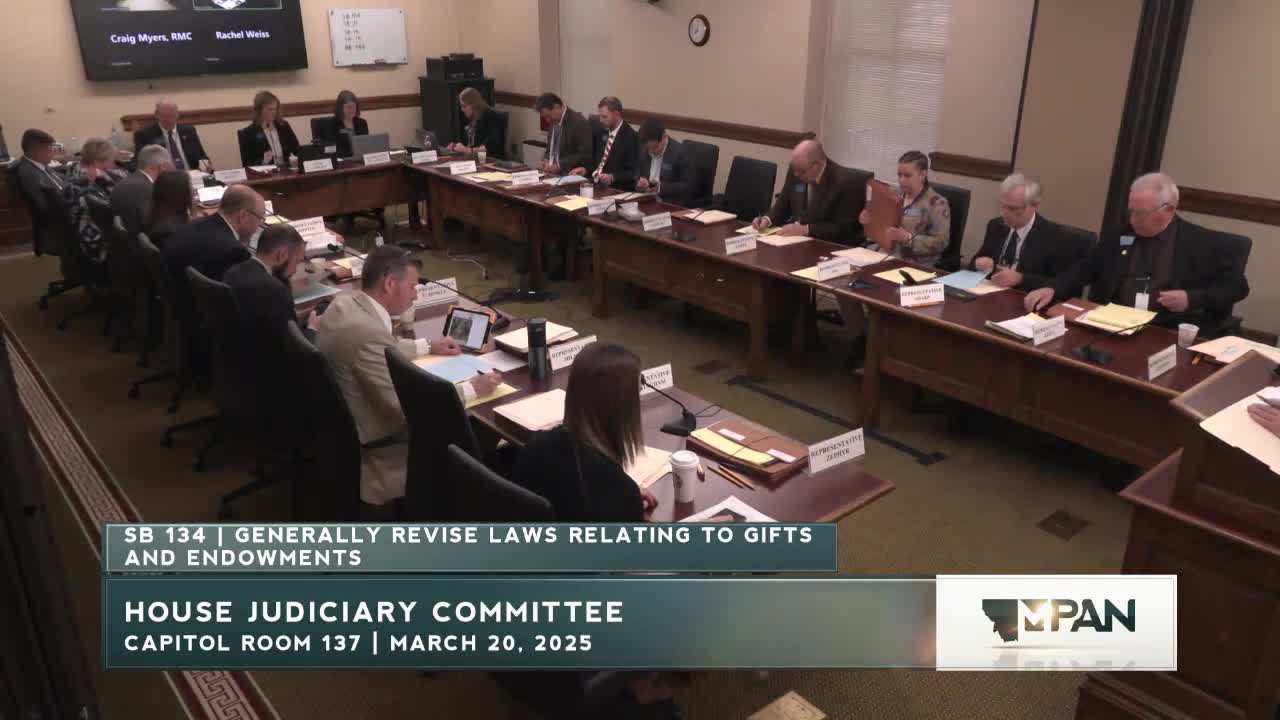
At a House Judiciary Committee hearing, sponsors and witnesses debated Senate Bill 134, which would let private donors sue to enforce written endowment agreements and limit remedies to court-ordered compliance or transfer of funds to like-purpose charities while barring return of donated funds.
Senators and witnesses told the House Judiciary Committee that Senate Bill 134, the Safeguarding Endowment Gifts Act, would create a legal pathway for donors to enforce written endowment agreements if a charity violates donor-imposed restrictions.
Senator Greg Hertz, sponsor of the bill, told the committee, “This is an act creating the Safeguarding Endowment Gifts Act.” Hertz said Montana currently lacks clear legal protections when a donor’s intent for an endowment is ignored and that the bill would let courts order remedies that keep funds devoted to their intended charitable purpose.
Megan Schmidt, senior director of government affairs for Philanthropy Roundtable, testified in support and described the change as a way to treat restricted gifts as enforceable agreements. “This bill gives donors the ability to file a complaint with the court of a violation being found in a written endowment agreement,” Schmidt said, adding that courts could order remedies consistent with the charity’s purpose but not return donated funds to donors.
Schmidt and other proponents told the committee the bill would not allow donors to reclaim gifts or seek damages. She said the legislation provides clarity for courts and donors by treating a written restricted gift more like a contract than an unrestricted donation.
Committee members pressed proponents on two recurring issues: the bill’s retroactive date and the scope of remedies. Representative questions focused on why the bill reaches back to 1975 and how courts would implement remedies. Schmidt told the committee that the retroactivity date was negotiated with stakeholders and argued it was meant to cover large endowments made years earlier when problems may only surface long after the donation.
Proponents also described the remedial toolbox the bill would allow. Schmidt said courts could order an accounting, interpret a gift agreement, or transfer the remainder of an endowment to a charity with a similar mission; the bill, she said, explicitly removes the donor’s ability to get a refund of the gift.
Opposition testimony was limited at this hearing; several representatives asked for more examples and legal detail. Committee members asked proponents to provide case studies and statutory cross-references so the committee could evaluate how similar laws have operated elsewhere.
The hearing closed after sponsors and proponents answered questions. No committee action or vote on the bill was recorded in the transcript.
Why this matters: the proposal would change how restricted gifts are treated in Montana courts, potentially increasing donors’ leverage to enforce written agreements while limiting charities’ exposure to being forced to return funds. That balance was central to the committee’s questions and the proponents’ answers.