Get Full Government Meeting Transcripts, Videos, & Alerts Forever!
Get email alerts on the Tort Reform topic
No spam. Unsubscribe anytime.
Georgia House approves broad tort-reform bill after hours of testimony
Summary
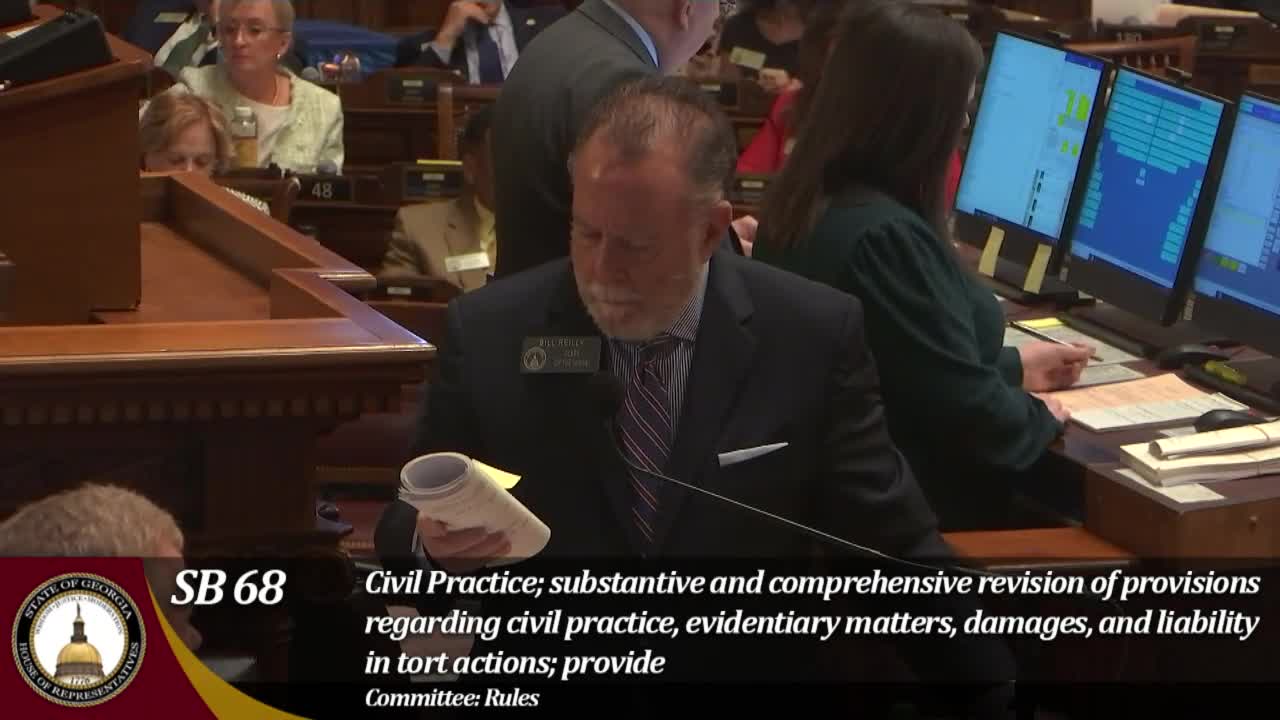
After more than a dozen hours of committee hearings and nearly an hour of floor debate, the Georgia House passed Senate Bill 68, a package of changes to civil procedure, evidentiary rules and premises-liability standards. The measure passed 91-82 and was immediately transmitted to the Senate.
ATLANTA — The Georgia House voted 91-82 on March 20 to pass Senate Bill 68, legislation that revises parts of the state's civil practice, evidence and premises-liability law in a package proponents described as curbing lawsuit abuse and opponents said will restrict access to justice for injured Georgians.
Supporters said the bill clarifies when discovery may proceed, limits certain trial-stage arguments about non-economic damages, allows juries to consider seat-belt use and narrows the circumstances under which property owners can be held liable for violent crimes that occur on their premises. "This is a bill that makes reasonable revisions to our civil practice act," Representative James Perchett told the chamber in opening remarks as he presented the measure.
The bill was the subject of lengthy hearings in multiple subcommittees and drew more than 13 hours of testimony, including from victims, trial lawyers, insurers, hospitals and business groups. Opponents said the measure would make it harder for people with catastrophic injuries to win full compensation and could reduce access to care for uninsured or underinsured patients.
"Don't let some girl who's been raped not be made whole," said Representative Al Williams, describing the stakes for victims who rely on civil claims. Other opponents warned the changes to the collateral-source rule and to procedures for bringing claims could shift medical costs to taxpayers and emergency departments.
Provisions summarized on the House floor include: limiting when attorneys may "anchor" non-economic damages with specific dollar figures until closing arguments; moving voluntary-dismissal timing toward a system tied to the defendant's answer (60 days after an answer rather than at swearing of the first witness); clarifying standards and admissible evidence for premises-liability and "negligent security" claims; permitting jurors to see certain evidence of seat-belt use; and allowing juries to consider amounts actually paid for medical care in some circumstances.
Supporters argued the changes will make awards more predictable and reduce pressure on insurance markets. Representative Chaz Cannon said the bill will "curtail lawsuit abuse" and help small businesses that operate on thin margins. Several supporters also argued the measure does not bar any class of victims from bringing claims, and they pointed to changes the committee adopted after hearings.
Opponents said the bill's new standards will raise the bar for plaintiffs and prolong litigation through automatic procedural steps that will slow access to evidence and trials. Representative Stacey Evans, speaking for the minority report, said the insurance data relied on by proponents was not independently verified by the contractor who produced the report and cautioned against enacting major civil-procedure changes based on incomplete data.
Committee and leadership notes recorded on the floor included that the Rules subcommittee held more than 13 hours of testimony and that the House adopted committee substitute language. After passage, Representative Whit Burchett moved and the House approved an immediate transmittal of the bill to the Senate (the motion passed 94-77).
The vote was among the closest of the day. Chairman Butch Parish, who spoke during "chairman's time," urged passage and framed the measure as a response to concerns raised by businesses and health-care providers during the hearings. "I believe this bill is a giant step forward in the right direction to do tort reform in this state," Parish said.
What happens next: Because the House approved immediate transmittal, SB 68 will return to the Senate for any further action there. The bill contains effective-date and repealer sections; those and specific statutory cross-references will determine how quickly any changes take effect if both chambers and the governor approve the final measure.
The debate highlighted competing priorities: supporters emphasized predictability for businesses and insurers, while opponents emphasized preserving jury trial protections and full remedies for victims of catastrophic injury. The House record shows speakers from both sides warned of downstream effects for hospitals, emergency care and low-income patients if collateral-source and evidence rules are altered.
— Votes and formal actions related to this bill are recorded below.