Get Full Government Meeting Transcripts, Videos, & Alerts Forever!
Get email alerts on the Corrections Capital Projects Prison topic
No spam. Unsubscribe anytime.
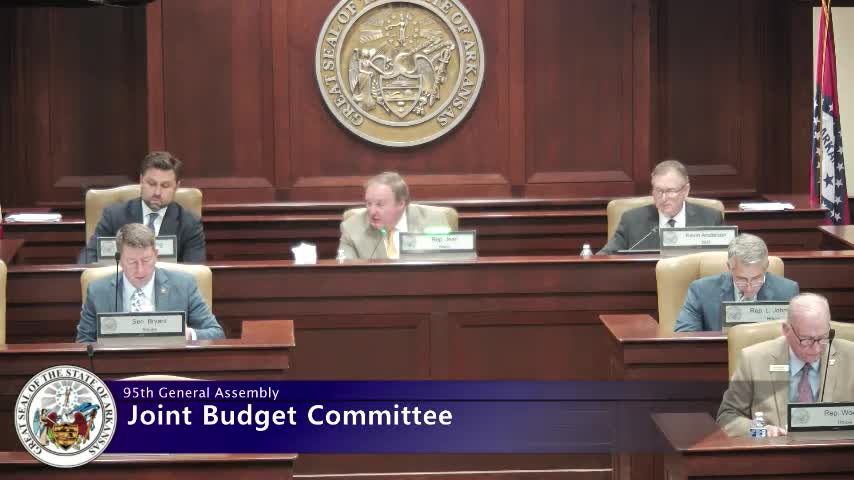
Joint Budget Committee approves appropriation measure tied to 3,000‑bed prison estimate after hours of debate
Summary
The Joint Budget Committee voted to give Senate Bill 354 a "due pass" recommendation after extended questioning about an $825 million cost estimate, contingency funds, site infrastructure and staffing; the measure is an appropriation step, not final funding.
The Joint Budget Committee voted to give Senate Bill 354 a due‑pass recommendation after lengthy questioning about cost, siting and staffing for a proposed 3,000‑bed corrections facility.
Senator Dismay moved for due pass on Senate Bill 354, an appropriation measure tied to a consultant estimate that places the construction and associated infrastructure cost at about $825,000,000; the committee later approved the motion in separate senate and house roll calls. The vote produced 17 affirmative votes on the senate side and 16 affirmative votes in the house panel.
Committee members repeatedly pressed administration witnesses and the project consultant on what the estimate includes and on contingencies. Joe Profiri, identified in the record as an advisor to the governor, told members that "the estimate for this project, which includes utilities, is $825,000,000." Members sought more detail on water, wastewater, road work, site preparation and staffing costs; witnesses said engineering work to scope utilities was underway and that many utility options could affect final costs.
Why it matters: the committee’s action allows the capital project process to move forward but does not itself appropriate operating dollars or fully fund construction. Several senators noted that future funding steps — including use of restricted reserves — would require additional approvals and, in some cases, a three‑fifths vote by the relevant legislative body.
Committee discussion and concerns centered on three themes: the reliability of the cost estimate and consultant history, the additional infrastructure and off‑site costs that could fall to state or local governments, and the availability of staff to operate a large new facility. Several members urged a slower pace and more detailed engineering and budget documentation before final funding votes.
Members said some funding already exists in prior set‑asides but disagreed about amounts and what they cover. The transcript records references to $75,000,000 and to a $330,000,000 restricted reserve; committee leaders and staff said those existing sums and any additional allocation would be the subject of later funding decisions and, where required, supermajority approval.
The committee record shows members pressed whether the proposed campus could be activated in phases and how long construction would take; witnesses said activation of an initial facility could occur within roughly 18 months with full completion targeted several years later. Several legislators warned that even if capital construction proceeds, the state could face operating challenges — recruiting hundreds of correctional staff in a rural area and potential impacts on county law enforcement staffing.
The committee separated discussion from decision in the record: witnesses described the estimate and design choices (discussion); the chair and members emphasized that the committee vote was an ‘‘appropriation only’’ step that does not lock in final funding (direction); and the roll calls on both sides of the chamber recorded the formal decision to give SB 354 a due‑pass recommendation (formal action).
Votes at the meeting: the senate roll call resulted in 17 affirmative votes on the due‑pass recommendation; the house panel recorded 16 affirmative votes. The committee chair said the committee will continue engineering work and budget discussions before any final appropriation is released for construction contracting.
What’s next: members said competitive procurement and engineering studies must still be completed, and additional appropriations or reserve transfers would require separate approvals. Lawmakers also requested more detail from the governor’s office, the Department of Corrections and the selected consultant on prior project performance, line‑item estimates and the phased schedule for activation and staffing.
Ending: With the due‑pass recommendation approved, the measure moves forward in the legislative process; committee members concluded the meeting by scheduling continued subcommittee work and returning to the topic as engineering and cost details become available.