Get Full Government Meeting Transcripts, Videos, & Alerts Forever!
Get email alerts on the School Unification topic
No spam. Unsubscribe anytime.
Committee approves unification of Arkansas School for the Deaf and School for the Blind; sponsors cite improved services and new campus plans
Summary
Lawmakers voted to pass HB 1810 as amended to unify the state schools for the deaf and the blind under a single board and superintendent, supporters said the change will streamline services for students with combined or overlapping needs and better use resources for a planned new campus.
Representative Joey Carr presented HB 1810 as amended to the House Education Committee, proposing the unification of the Arkansas School for the Deaf and the Arkansas School for the Blind under a single board of directors and administrative structure.
"Currently, they're 2 separate entities and 1 negative result of this is we have several students that are blind and deaf and they are not receiving the complete support," Carr said, adding the change would create a single board with parental advocates for blind and deaf students and centralize administrative functions.
Nicole Walsh, superintendent of the Arkansas School for the Deaf, told lawmakers the unification would create "a cohesive process of operation to ensure that every one of these students' needs are met" and would allow better use of personnel and resources. Courtney Salas Ford of the Department of Education described the amendment as a technical clean-up consolidating accounts and adjusting the effective date of an emergency clause to the fiscal-year start to avoid accounting problems with Title 19 provisional funding codes.
Board members, alumni and parents testified in favor. Philip Powell, a board member born deaf, said the change would be "fantastic for young deaf and blind children." Robert Fagan, chair of the board of trustees, described site visits to larger combined schools and said a nationwide search produced a superintendent certified in both deaf and blind instruction. Several parents and current school staff spoke about service gaps for students who are deafblind and urged lawmakers to support the merger so students could access coordination of orientation, mobility and ASL instruction in one system.
Officials said current enrollment across both schools is relatively small: testimony referenced roughly 100–110 students at the deaf school and about 60 at the blind school in recent remarks and a separate estimate of 67 total was also given in committee testimony.
Supporters described operational consolidations already underway: shared nursing services, combined food service, coordinated transportation, and plans for a new consolidated campus with state funding and a recent groundbreaking. David Burton, director of safety, and other administrators said combining services has allowed the schools to share specialized staff and equipment and to expand the clinical and nursing capacity available to students.
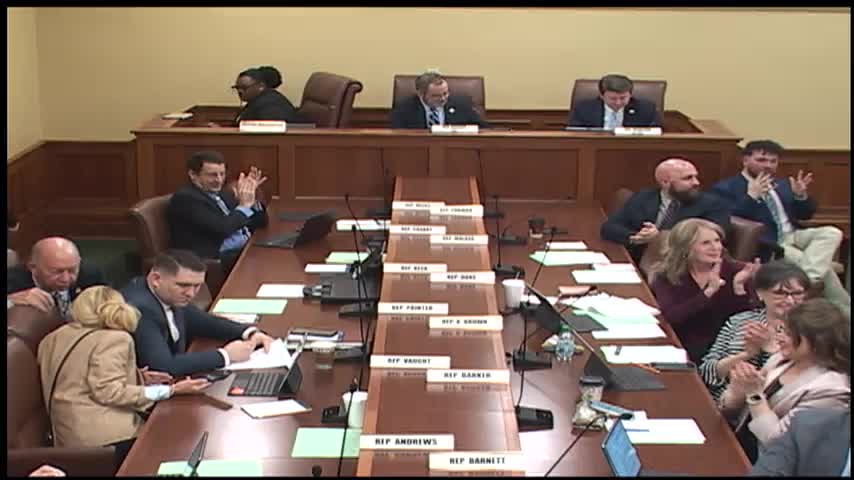
After extensive testimony and member questions, the committee approved HB 1810 as amended by voice vote; the transcript records adoption and the chair declared the bill passed as amended.