Get Full Government Meeting Transcripts, Videos, & Alerts Forever!
Get email alerts on the Open Government topic
No spam. Unsubscribe anytime.
Senate passes bill redefining 'public meeting' despite opposition citing transparency concerns
Summary
Senate Bill 3/76, which narrows the definition of public meetings and bars certain disclosures after two-member outside conversations, passed after extended debate over transparency and clarity.
The Arkansas Senate passed Senate Bill 3/76 on March 20, 2025, a bill that revises definitions under the state's Freedom of Information Act and restricts what two members of a governing body may disclose about another member's position after a private conversation.
Sponsor Senator Clark said the measure seeks a clearer statutory definition and includes an amendment from the Association of Counties. "Public meetings means the meetings of more than 2 members of any bureau commission state agency. It takes more than 2 people to have a meeting," Clark said on the floor.
Opponents argued the bill would reduce transparency and could enable back-channel decision-making. "I think there's 2 reasons to vote no on this bill. 1 is that it's anti transparency. The other is that it's anti clarity," Senator Tucker said during floor debate. Tucker warned that the bill could permit a "daisy chain" of one-on-one conversations that, taken together, produce a governing-body decision outside public view.
Senator Sullivan, a supporter, said informal one-on-one conversations between officials occur frequently and that existing practice and stakeholders support the change. "Folks, this is a good bill," Sullivan said, adding that county and municipal officials who have served locally back the measure.
Debate referenced prior work on FOIA clarification (Senate Bill 2/27), with critics saying SB3/76 conflicts with that earlier compromise. Senator Tucker cited a state Supreme Court case involving Fort Smith where informal, off-meeting conversations led the court to find that the governing body had acted outside a public meeting.
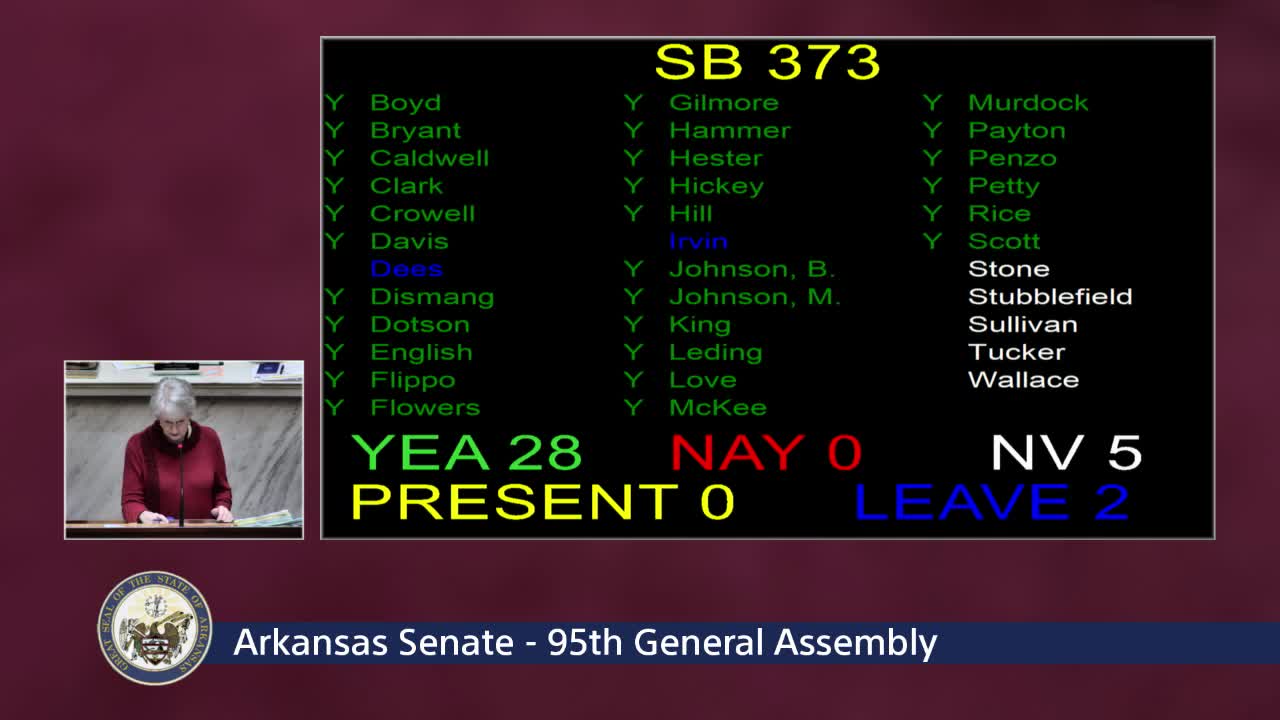
The Senate adopted the bill on a recorded vote summarized on the floor as 19 yeas, 10 nays, 1 not voting and 3 present. The bill was transmitted to the House.
The bill drew sustained floor time and sharply divided senators over whether the change would reduce legal uncertainty or weaken public oversight.