Get Full Government Meeting Transcripts, Videos, & Alerts Forever!
Get email alerts on the Historic Preservation Food Access topic
No spam. Unsubscribe anytime.
Historic Poor Farm seeks modest FY2026 operating budget as programming, school partnerships expand
Summary
Staff reported growing partnerships, new school programming, a kitchen project and continued reliance on outside funding; capital requests for FY2026 are modest and focus on natural‑areas management and small site amenities.
Johnson County staff and site partners briefed supervisors on the Historic Poor Farm’s FY2026 outlook, reporting stronger program partnerships, new school‑based programming, progress on visitor‑center and kitchen projects and a modest capital ask focused on natural‑area management and small site amenities.
Why it matters: The Historic Poor Farm is a county property hosting growing local‑food programs, educational partnerships and community events. Its operating needs, capital projects and partnerships affect local food access, school programming and historic‑preservation objectives.
Elsa DeWalt, the county’s local food and farm manager, and Jason Graham of Iowa Valley RC&D presented accomplishments for 2024: more than 44,000 pounds of produce grown for food‑access partners; 73 community garden plots managed by partners; 17 farm businesses accessing land; five farmer workshops; and a new pilot where sixth graders from the Iowa City Community School District participated in a farm‑based “Can You Dig It” program. Jason said the pilot will expand with additional rotations and the district is exploring a longer career‑technical internship tied to the site and an ag curriculum.
Elsa said community partners brought more than $700,000 in outside funding this year to support staff, training and technical assistance and that many programs on the farm are supported by partner grants rather than county operating dollars. Site accomplishments listed by staff included landscaping around the historic asylum and entrance sign, a new local food newsletter, progress on a Dairy Barn Visitor Center (quotes stage) and ground broken on a kitchen; staff said framing work was underway.
On FY2026 capital and operations, staff asked for a modest capital package focused on natural‑areas management (continuing a contract with a natural‑areas contractor), signage for the reflection circle/cemetery area, raised beds/benching, and durable equipment for the new kitchen such as rolling carts, covers and shared cooking implements. Elsa said revenue projections for FY2026 did not include potential future grant awards and that some ARPA funding may shift as projects finalize.
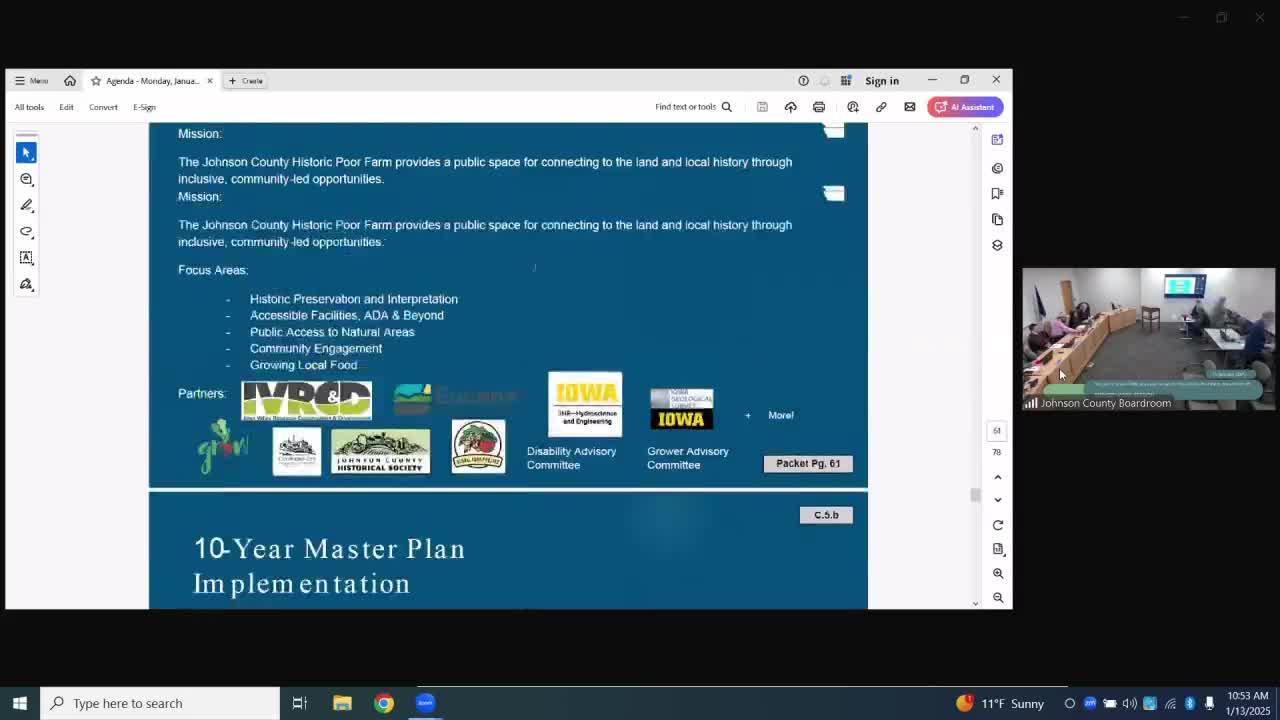
Partnerships, volunteers and long‑term planning: Staff described strong partnerships with Iowa Valley RC&D, Global Food Project and the historical society, and said partners are increasingly coordinating programming and leveraging external grants to support operations. Elsa described a long‑range 10‑year master plan and said staff are preparing an update with new visuals and maps to show progress and remaining priorities. Supervisors discussed whether the County Conservation Department might assume natural‑areas maintenance after the current contractor (Eocene) contract ends; staff said that conversation could begin now to allow time for capacity planning.
Ending: Supervisors heard that the Historic Poor Farm’s programming and school partnerships are expanding, that FY2026 capital requests are focused and modest, and that staff will return with finer details as ARPA and other project funding decisions conclude.