Get Full Government Meeting Transcripts, Videos, & Alerts Forever!
Get email alerts on the Water Quality topic
No spam. Unsubscribe anytime.
Bridal Iowa Watershed Management Authority wins IDNR planning grant; Johnson County commits ARPA cash match
Summary
The Bridal Iowa Watershed Management Authority (WMA) received an IDNR Comprehensive Water Quality Management planning grant. The planning budget is $221,000: $125,000 from IDNR, $91,000 in Johnson County ARPA cash match and $5,000 from Bel Plain; Houston Engineering was selected as consultant and planning work runs through December 2025.
Johnson County staff updated supervisors on formation and planning progress for the Bridal Iowa Watershed Management Authority and an Iowa DNR Comprehensive Water Quality Management grant awarded to the WMA.
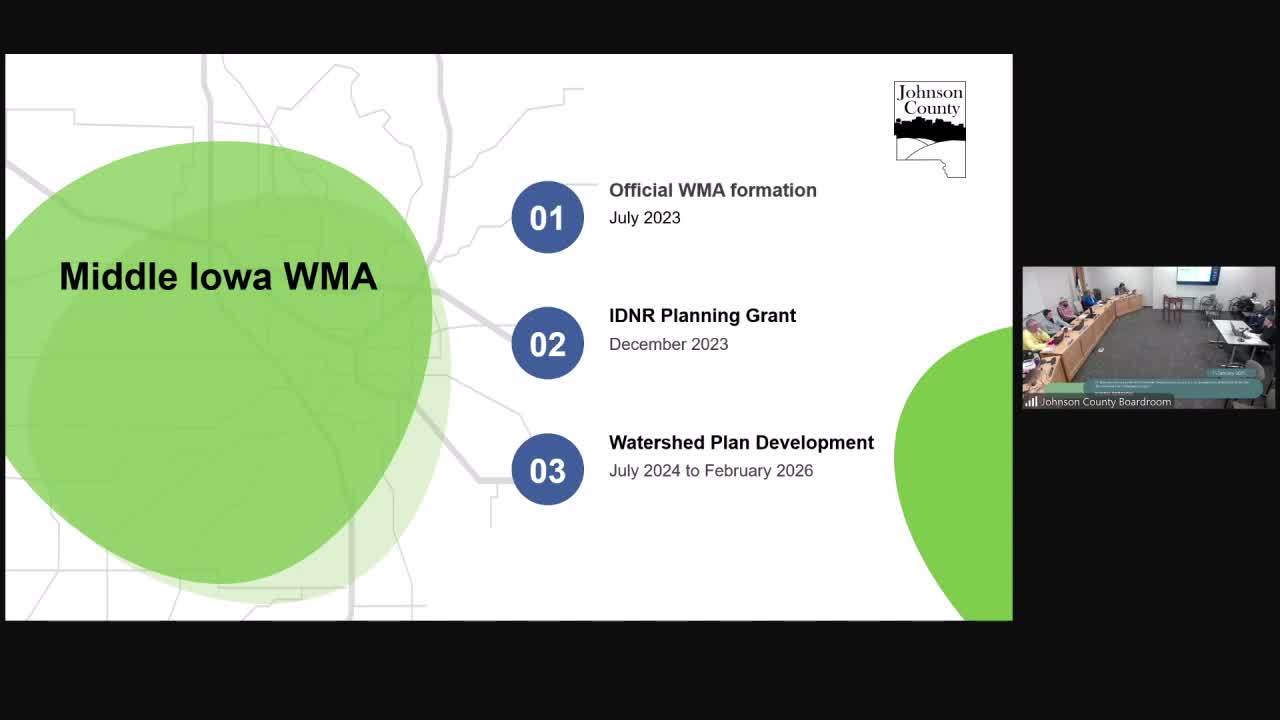
The lede: The WMA officially formed in June 2023 under an intergovernmental 28E and in December 2023 received notice of intent to award an IDNR planning grant. The total planning budget is $221,000: $125,000 from the IDNR grant, $91,000 cash match from Johnson County (ARPA funds) and a $5,000 cash match from the city of Belle Plaine; North Liberty (sic) serves as fiscal agent and Houston Engineering was chosen to lead plan development.
What the grant will produce: The consultant will compile existing data, develop draft plan chapters (introduction, watershed characterization are already underway), prioritize subwatersheds for focused planning and prepare a riparian and stream-buffer management plan. The WMA plans to select four priority subwatersheds for detailed analysis and modeling. The final watershed plan is due December 2025 with an outreach workshop planned for February 2026.
Outreach and partnerships: Staff described active outreach events (cover-crop demonstrations, farmer dinners, soil-health events) and a student logo contest to increase local engagement. The WMA currently includes 14 official members: multiple cities, five counties and three soil and water conservation districts; partners include state and federal agencies and nonprofits.
Why it matters: Staff emphasized that local watershed plans improve competitiveness for larger federal funding and help target on-the-ground practices such as bioreactors and saturated buffers to reduce nitrogen and sediment.
Next steps: Consultant modeling and subwatershed prioritization will continue through spring 2025; outreach events and a professionalized logo will support engagement. Staff said they will return with updates as chapters and outreach events proceed.
Ending: Supervisors were supportive and noted the county's leadership role in regional watershed planning and grant match commitments.