Get Full Government Meeting Transcripts, Videos, & Alerts Forever!
Get email alerts on the Emergency Management topic
No spam. Unsubscribe anytime.
Emergency Management outlines $5.59 million revenue plan, HAZMAT truck refurbishment and storage facility plans
Summary
Emergency Management reported strong grant returns, steady HAZMAT program costs and plans to refurbish a HAZMAT truck rather than buy a new vehicle; staff also described a proposed storage facility to protect equipment.
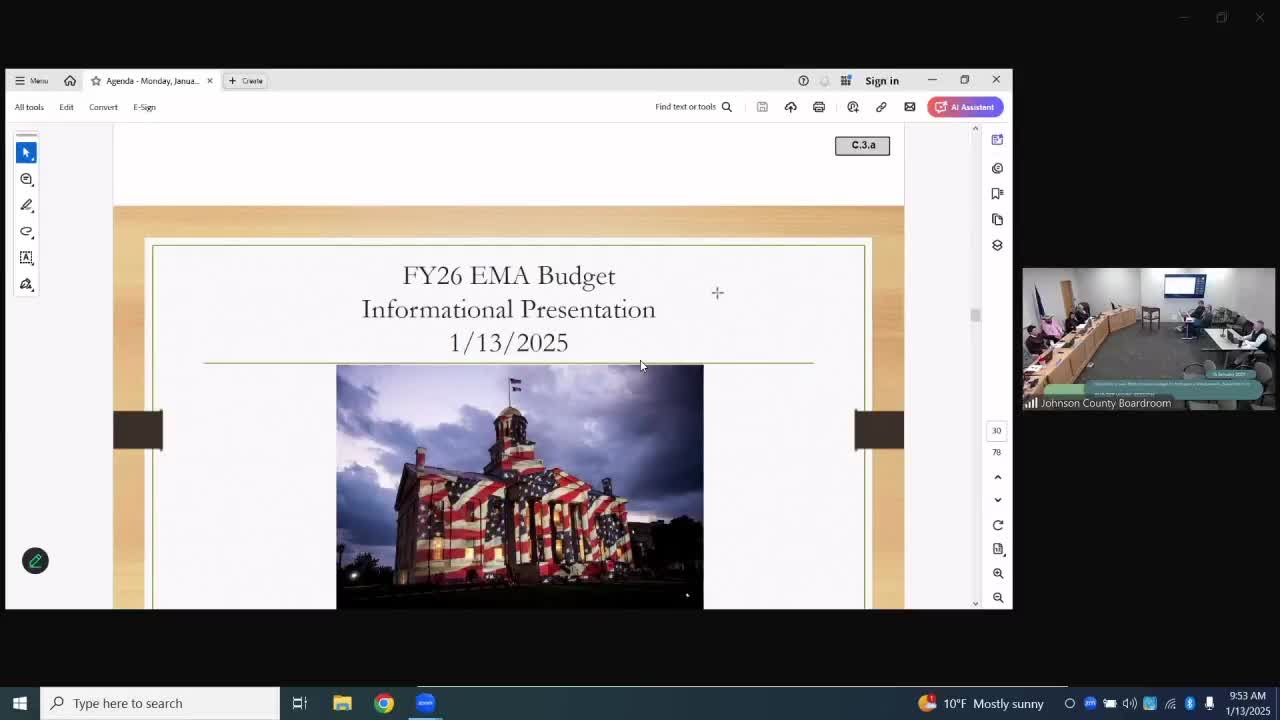
Johnson County’s Emergency Management Agency (EMA) detailed its fiscal year 2026 budget overview during the supervisors’ meeting, highlighting decades of grant activity, roughly $4.93 million in “soft” grant returns and an FY2026 revenue picture that the presenter said would total about $5,586,186.
Why it matters: EMA manages multi‑agency teams (HAZMAT, dive, bomb) and the countywide joint emergency communications center (JEC). EMA expenditures and capital planning affect regional public‑safety readiness, grant leverage and special‑response capability.
David (Emergency Management staff) told the board that since his hiring he has focused on recovering federal and state funds for county programs; he said EMA has returned roughly $4.93 million to the county through grants and other “soft” funding to support programs such as the JEC and HAZMAT. The presenter noted the JEC once received nearly $2 million in communications grant funding to offset startup costs.
HAZMAT: The HAZMAT program is a countywide multi‑agency team that includes fire departments, the sheriff’s office and volunteers. David said most HAZMAT calls are transportation‑related rather than fixed‑site spills and that the county seeks to bill responsible parties and recover response costs when allowed. He said historic collections from billed incidents total about $29,368.51 since fiscal 2012, with a small outstanding collections amount being worked through. The HAZMAT program is funded in part by a per‑capita assessment that has increased over time (the presenter described the rate rising from $0.25 to $0.50 and then to $0.75 per capita to build a replacement fund for equipment).
David told supervisors that the county is planning to refurbish the existing HAZMAT truck rather than purchase a new vehicle because new specialty equipment prices have risen sharply; he said one multi‑sensor monitor that cost $81,000 after COVID now lists for about $160,000. The county is setting aside approximately $25,008.20 annually toward truck replacement/refurbishment and expects to continue billing versus absorbing costs whenever possible.
Storage facility and capital: David said the county plans a storage facility to protect specialty equipment from UV, weather and other wear (he cited repeated tire damage to trailers as an example). Tiffin has donated an acre of land for a roughly 50,000‑square‑foot heated storage garage the EMA expects to build; design‑build bidding was described as targetting an April solicitation and a May award with construction between May and December in the presenter’s timeline. David said the storage building is primarily a heated garage (not an armored structure) and that staff aim to keep the interior at about 50 degrees in winter to reduce equipment wear.
Revenue and budget totals: David outlined EMA’s revenue sources including per‑capita assessments from cities and townships, grants, reimbursements and program fees. He presented a projected $5,586,186 in total revenues for FY2026 and said the county tax asking for EMA operations was roughly $5,000,004.76 (figure presented by staff). He said EMA operations themselves use about $97,007.21 annually from the per‑capita revenue for fixed program costs, and that additional grant funds and reimbursements are used for special projects.
Partnerships and specialty teams: David emphasized regional collaboration and grant leverage — he described shared personnel (e.g., Cedar Rapids Fire members on the dive team), joint grant awards for equipment (bomb robot funded by homeland security grants, for example) and training partnerships that reduce county costs. He said most specialty team budgets are heavily supported by outside grants and partner contributions.
Ending: David asked supervisors to consider the storage building and refurbishment plan as a sensible approach to extending equipment life and limiting the county’s near‑term capital exposure, and he said agency staff will continue to pursue grants to offset program costs.