Get Full Government Meeting Transcripts, Videos, & Alerts Forever!
Get email alerts on the Conservation Budget topic
No spam. Unsubscribe anytime.
Johnson County conservation leaders present lean FY26 package, flag $3M+ federal trails grants and bond spending plan
Summary
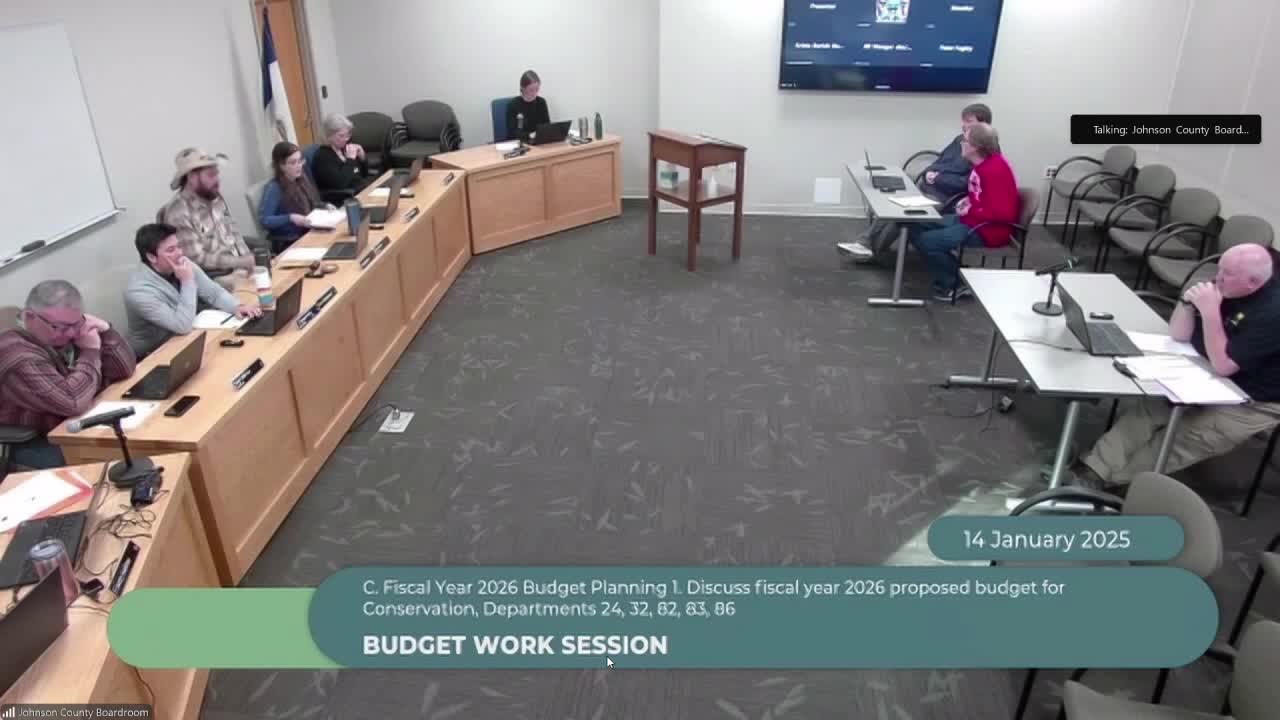
Interim Conservation Department staff and county finance officials presented a trimmed FY26 budget proposal that seeks $847,411.79 in decision‑package spending, flags more than $3 million in federal trail grants that require upfront cash flow, and outlines how remaining conservation bond proceeds will be used for trails and park projects.
Interim Conservation Department staff and county finance officials presented the Johnson County Board of Supervisors with a trimmed fiscal year 2026 budget request for conservation programs and bond projects, emphasizing federal grant cash-flow needs, equipment replacements and a smaller personnel ask.
Brad, interim conservation director, told the board the department’s General Basic (department 24) operating request is $4,326,671, and the decision package totals $847,411.79, split into approximately $513,911.79 for personnel and associated equipment and $333,500 for capital and other items. “We’ve come to the Board of Supervisors with … a lean decision package,” Brad said.
Why it matters: the conservation budget finances daily operations, maintenance and park services across nearly 2,700 county-managed acres and supports several multi‑million-dollar capital efforts that require county cash up front while federal and state grants reimburse later.
Key details and priorities
- Budget structure: Brad summarized five conservation-related budget areas: department 24 (general basic, property-tax funded operations); department 32 (REAP — Resource Enhancement and Protection, funded by state gambling and related revenues; FY26 request ~ $77,000); department 82 (conservation trust, funded by donations, grants and rentals; FY26 request $759,186); department 803 (conservation bond account for capital and reimbursable federal grants); and department 86 (wetland bank — long‑term maintenance fund).
- Federal grants and cash flow: Brad said the county has “nearly $3,000,000 in federal trails grants” that will require upfront cash flow from bond or county accounts and later reimbursements from DOT or federal sources.
- Conservation bond: Brad reviewed the earlier 2008 bond and the more recent $30 million bond approved by voters in 2024. For FY26 he proposed spreading bond spending over multiple years to avoid tax “roller coaster” effects; he suggested approximately $1.5 million per year as a smoothing target, subject to finance’s assessment.
- Decision-package priorities: The personnel portion includes possible reclassification options (for example a deputy director reclassification) and two new positions that may be requested later: a park ranger and a utility/maintenance worker. Brad said the personnel portion could be reduced if the board opts not to fund new hires this year; the equipment portion emphasizes safety and efficiency (AEDs made accessible outdoors, tree shears, vehicle replacements, a mini excavator and a replacement tractor).
- Vehicles and equipment: Brad described aging fleet replacements (trucks from 2003 and 2008) and the department’s preference for more mechanized equipment to reduce manual labor and worker‑compensation risk. The most expensive proposed capital item is a replacement tractor to replace a unit with ~7,000 hours.
- Kent Park shower house: The department has already invested roughly $1.6 million in utilities and geothermal for the Kent Park shower house. Brad said previous architecturally designed estimates for a full new building were about $4 million and that he is exploring a prefabricated option (with costs closer to examples in neighboring Linn County) to reduce total project cost and possibly split construction across two fiscal years.
- Trail projects: Bids for Clear Creek Trail phase 1 came in lower than estimates (roughly $2.8 million), reducing the originally estimated $3.8 million figure for the phase and improving the overall bond program outlook; Brad said he will ask DOT to allow carryover of federal match to subsequent phases to preserve the project’s funding balance.
- Wetland bank: The county has sold some credits at the Cedar River Crossing Wetland Bank and is holding a long-term maintenance fund (department 86). Brad said market timing and regulatory environment make pursuing an additional bank (Peckham Creek Delta) unlikely in the near term.
Board and finance context
County finance staff noted options for bonding and debt repayment terms and cautioned the board that debt‑service choices affect future budgets and tax impacts. Brad and supervisors discussed spreading bond proceeds and aligning bond spending with anticipated grant reimbursements. Supervisors pressed staff on schedule ambiguity for projects such as the Kent Park shower house and on whether personnel hires would be immediate or deferred.
Outlook and next steps
Brad said staff will refine cost estimates (especially for the shower house and trail phases), coordinate with finance on smoothing bond draws and continue work on grant reimbursements. The conservation board will consider project bids and design changes; the supervisors will incorporate the refined decision package numbers into upcoming budget votes.
Ending
Brad closed by inviting further questions and offering materials to supervisors and finance staff as the department finalizes project phasing and estimates.