Get Full Government Meeting Transcripts, Videos, & Alerts Forever!
Get email alerts on the Personnel Policy topic
No spam. Unsubscribe anytime.
Supervisors debate personnel-request process after public-health coordinator discussion; change adopted to 'no response = no'
Summary
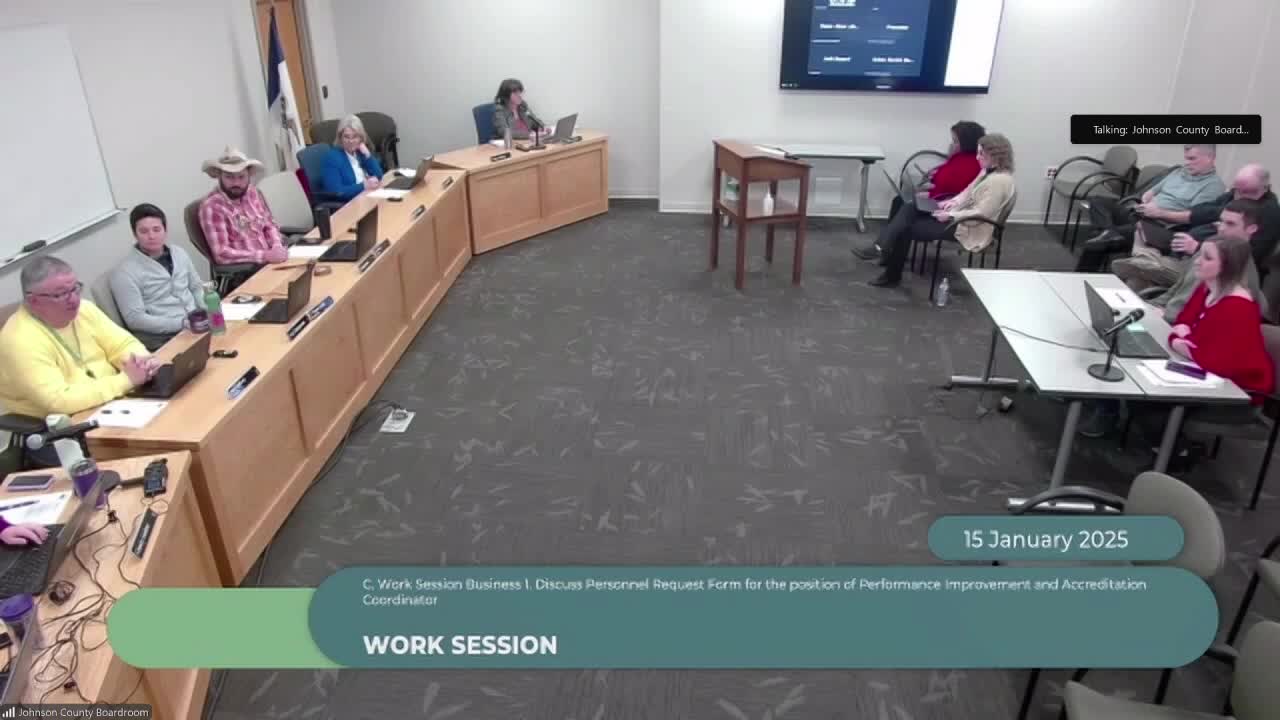
Johnson County supervisors spent part of their Jan. 15 work session reviewing a personnel request tied to the county public-health department and debating whether to change how the board handles personnel-request forms.
Johnson County supervisors spent part of their Jan. 15 work session reviewing a personnel request tied to the county public-health department and debating whether to change how the board handles personnel-request forms.
The board discussed a request to fill the county's performance improvement and accreditation coordinator position in Johnson County Public Health. Danielle (Johnson County Public Health staff) described the post as a focused role created in 2022 to lead strategic planning, PHAB accreditation work and workforce development. She praised outgoing coordinator Mike Cassella, saying "he has done an amazing job," and said the position reduced turnover and improved clinic attendance and WIC retention.
Why it matters: Supervisors framed the personnel discussion as part of a broader effort to avoid future layoffs by scrutinizing openings before hiring. The board then turned to how PRFs are handled in practice, including whether a single supervisor should be able to place a PRF on a work-session agenda.
Discussion details: Supervisor Sullivan opened with budget concerns: "I have a feeling that this year when we get to our budget, we're gonna find that we are not able to approve a large majority of the positions for which we are asked." Several supervisors pressed Public Health staff about whether existing staff could absorb the duties or whether restructuring or upcoming technology changes (Workday implementation) might reduce the need for an additional FTE. Danielle said Workday could affect administrative workload but would not be fully implemented until July; she said she would "sacrifice a lot before I went without somebody in this role" given the department's accreditation, revenue-generation and emergency-response responsibilities.
The PRF process: The board also reviewed a written practice document for personnel-request forms. The packet noted recent changes to the electronic PRF system, including a default that previously treated a nonresponse from a supervisor as a yes. Multiple supervisors said that default was unacceptable. "I think that a no response is just a no response," said Supervisor Green Douglas during the discussion. After debate over whether one supervisor or three should be required to request discussion, the chair instructed staff to change the practice so that nonresponse is treated as a no and to maintain the other practices in the packet for the time being.
Outcome: The board directed staff to revise the PRF practice to make "no response = no" and otherwise continue with the current practice until further action.
Context and next steps: No formal hiring decision was made during the work session. The performance-improvement coordinator position discussion remained informational; Public Health staff were asked to provide more regular liaison reports to supervisors to aid oversight. The PRF-rule change will be reflected in the personnel request practice document and applied going forward.
Ending: Supervisors said they intended to keep discussing department staffing and budget trade-offs ahead of the county's budget decisions later this year.