Get Full Government Meeting Transcripts, Videos, & Alerts Forever!
Get email alerts on the Public Defense Budget Hb5031 topic
No spam. Unsubscribe anytime.
Public Defense Commission seeks new financial and case-management system as providers press legislature for pay, investigators and training funds
Summary
The Oregon Public Defense Commission told lawmakers March 20 it needs a unified financial and case-management system, while dozens of public-defense providers urged increased pay, investigator rates and training funds to address thousands of unrepresented defendants.
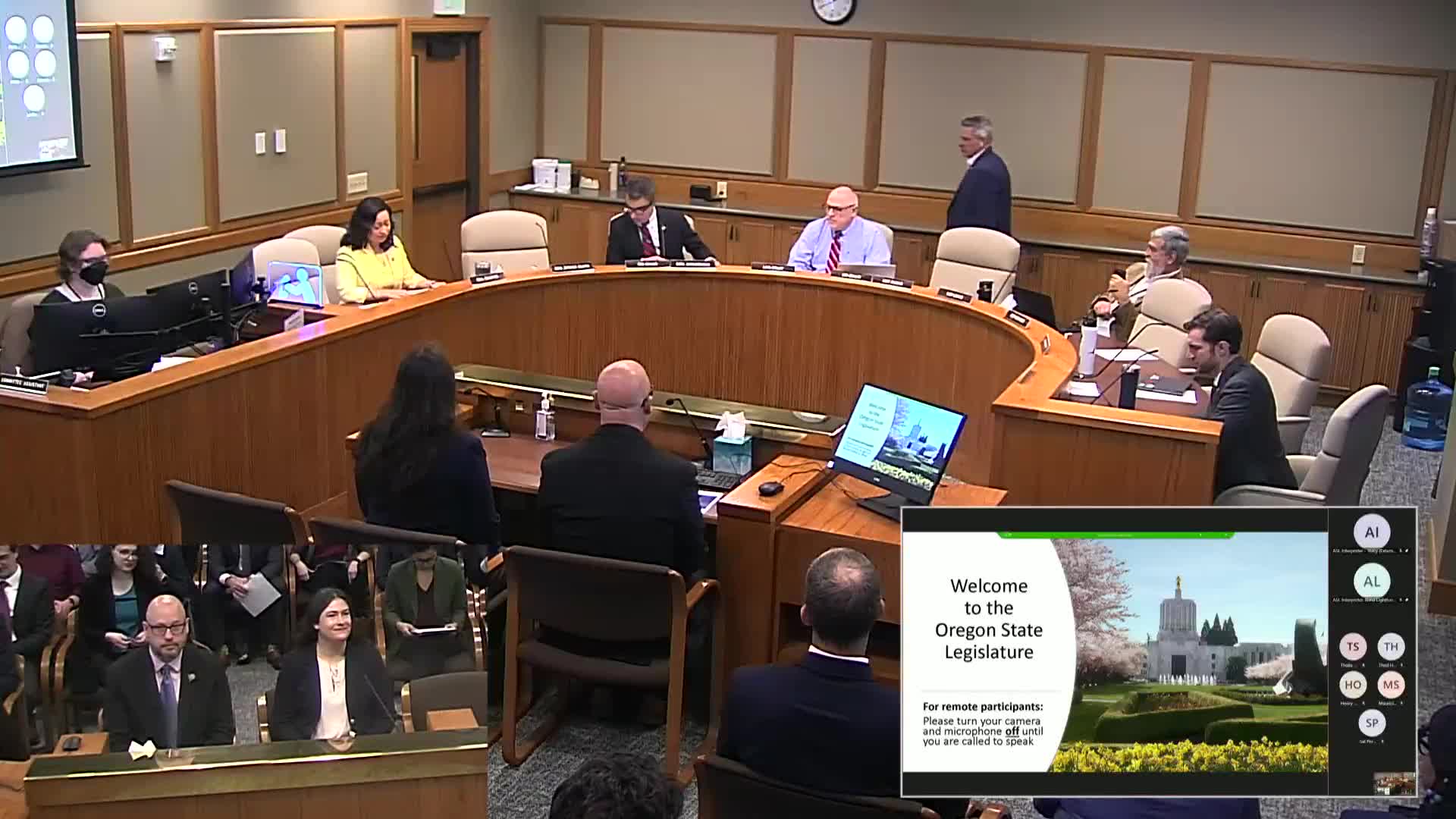
SALEM, Ore. — The Oregon Public Defense Commission told the Joint Committee on Public Safety on March 20 that it is pursuing a single financial and case management system it calls critical infrastructure, while nonprofit public defender offices and support staff urged the legislature to increase pay, investigator rates and training funding to reduce the state’s unrepresented caseload.
The hearing centered on House Bill 5031, the Public Defense Commission’s primary budget measure. Jessica Camphy, executive director of the Oregon Public Defense Commission, said the commission needs a unified system to replace multiple, fragmented databases and case-management tools. “This is critical infrastructure for the agency,” Camphy said, adding that the system would combine three “pillars”: financial functions, case management and time tracking tied to reporting and accountability.
Camphy’s chief information officer, David Martin, said recent work has advanced the project through two procurement stage gates and that the commission is pursuing a commercial off-the-shelf, software-as-a-service solution to minimize custom development. Martin described the project as a vendor-driven procurement and advised the committee that timelines are variable because contract negotiations and state procurement review can extend schedules. He said the agency’s current best estimate places procurement completion around November 2026 and a system “go-live” in the second quarter of 2028, with an anticipated 14-to-22-month implementation once a vendor is selected.
Why it matters: witnesses told the committee the state’s shortage of defense attorneys and support staff is worsening a constitutional access-to-counsel crisis, producing thousands of unrepresented defendants in Oregon courts. Many nonprofit offices argued that hiring and retention depend on closing pay gaps with district attorney offices, creating funded training and supervision positions, and increasing investigator pay so attorneys can focus on legal work.
Testimony and proposals: more than two dozen public defenders, investigators, case managers and nonprofit leaders spoke during a two-minute, registered-testimony period. Clint Oborn, executive director of Southern Oregon Public Defender, said his region has more than 700 people awaiting counsel and urged the legislature to invest an additional $19 million in nonprofit salaries to close a pay gap with the state trial division.
Caitlin Plummer, executive director of Public Defender Services of Lane County, said her office reached a manageable caseload after legislative investments and urged that contractors receive cost-of-living increases. “The answer to the unrepresented crisis is not to force public defenders to take more cases,” Plummer told the committee, urging competitive compensation and manageably sized caseloads.
Carl McPherson, executive director of Metropolitan Public Defender, said filings have increased each year for the past four years and OJD forecasts a 22% increase in case filings in fiscal 2025–27. “We have a significant supply-and-demand problem here,” McPherson said, adding that nonprofit offices are the primary recruiters and trainers of new public defenders.
Multiple witnesses asked the committee to fund training and supervised-practice pathways (including SPPE and criminal-defense clinics at law schools) and to preserve or expand contract structures that support consortia and nonprofit hiring. May Lee Browning of the Oregon Criminal Defense Lawyers Association noted a 2024 legislative allocation of $2.1 million to criminal-defense clinics and warned that nonprofits must be funded above current-service level to hire the students those clinics train.
Investigators and support staff urged higher rates and faster implementation of rate increases. Defense investigator Don Krantz recommended raising the investigator rate to $75 per hour, saying the current rate hinders recruitment and retention and forces attorneys to spend time on investigative tasks. Krantz and other investigators requested that rate changes be effective July 1, 2025, rather than January, to speed hiring and retention.
Agency budget and staffing questions: Martin and Camphy said the commission currently plans to fund the project from an existing bond request and associated position funding: the agency’s testimony cites a $13.9 million bond and approximately $2.0 million for positions. Camphy told the committee that some positions tied to the project are limited-duration and that the commission recommends delaying a systems-analyst position until a vendor is selected, while a data-analyst position remains necessary to migrate and rationalize roughly 12 existing databases. Camphy said she does not currently anticipate needing additional biennial budget changes tied to the adjusted procurement schedule.
Policy context and related proposals: witnesses referenced Senate Bill 337 (the state trial division created in 2023) and the commission’s contracting rules and recommended that the legislature fund contractors to allow pro rata compensation for work that exceeds maximum contract caseloads. Sal Peralta of the Oregon Defense Consortium recommended funding mechanisms to compensate contractors when they exceed caseload caps and the use of limited-duration crisis caseload funding.
Process and next steps: the committee opened the public hearing on House Bill 5031 and accepted registered oral testimony; the chair said written testimony would be accepted electronically for 48 hours after the hearing. Committee members did not take a final vote on HB 5031 during the session; the committee adjourned after rescheduling a planned work session on nonunanimous-jury-conviction reporting.
Ending: Testimony from nonprofit leaders, investigators and public-defense staff emphasized recruitment, pay parity, training and investigator rates as immediate levers the legislature could use to reduce the unrepresented list and stabilize the public-defense workforce while the commission proceeds with a multi-year technology procurement.