Get Full Government Meeting Transcripts, Videos, & Alerts Forever!
Get email alerts on the Workday Vacation Buyback topic
No spam. Unsubscribe anytime.
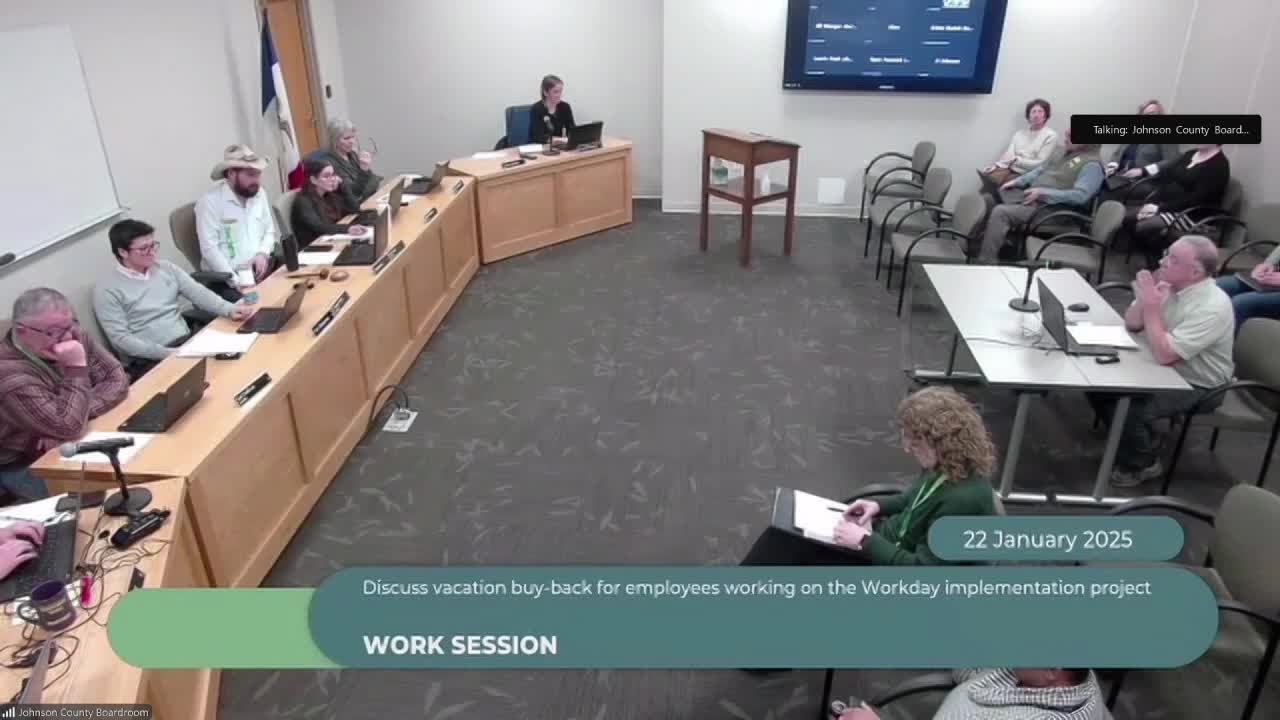
Supervisors authorize temporary accrual relief for staff on Workday project; HR to study buyout and staffing options
Summary
The Board of Supervisors directed HR to study vacation buyouts and accrual limits tied to the county’s Workday implementation and approved a temporary accrual relief so affected employees do not immediately forfeit hours.
Johnson County supervisors considered a request to allow vacation buyouts and other relief for staff who have been unable to use vacation while working on the county’s Workday implementation.
IT Director Bill Horning told the board lead workers on the Workday project have filled their vacation banks while project duties have prevented time off. Horning asked whether the board would approve vacation buyouts to prevent forfeiture of accrued time for those staffers.
The request prompted broad comment from supervisors, elected officials and department heads. Participants described multiple causes: long‑running projects (Workday, ARPA administration), public‑safety staffing constraints, and the county’s existing accrual and cap rules. Multiple department leaders and employees said staff have performed sustained overtime and in‑office coverage that limited their ability to take scheduled leave.
Human Resources Director Lindsay Jones and HR staff described options and constraints. HR noted buyouts and accrual caps were originally intended to limit large retirement payouts; staff proposed a two‑prong approach: immediate temporary relief for employees at or near the accrual cap, and a short study of broader policy options (contingency buyouts, cap extensions, targeted compensation) to recommend a long‑term path forward.
After extended discussion the board gave HR and leadership a set of directions: (1) provide a written options memo and data about affected employees (how many, by department, and how many paid hours would be lost) and (2) deliver a short timeline and recommendations within about three weeks. Board members emphasized they wanted both the short‑term fix and a broader review of policy and staffing implications.
To prevent immediate forfeiture while HR prepares the detailed analysis, supervisors agreed to a temporary accrual relief for impacted employees—an interim allowance to add hours to the accrual cap (the board discussed an example of adding 80 hours to affected employees’ banks). HR will identify eligible employees, work with payroll to implement the temporary allowance, and return with a full proposal for board consideration.
Ending: HR will return with a detailed memo within roughly three weeks that includes (a) identification of employees affected by accrual caps (Workday leads and other special project staff), (b) how many hours are at risk, (c) recommended short‑ and long‑term remedies (buyouts, extended caps, staffing adjustments), and (d) cost estimates and funding options. The board also asked department heads to consider workload and staffing changes where practicable to reduce long‑term accrual pressure.