Get Full Government Meeting Transcripts, Videos, & Alerts Forever!
Get email alerts on the Secondary Roads Budget topic
No spam. Unsubscribe anytime.
Johnson County supervisors review secondary roads budget, ask staff to revisit lighting policy
Summary
At a Jan. 27 budget work session the Johnson County Board of Supervisors discussed the secondary roads proposed FY2026 budget and five-year construction plan, asked staff to return recommendations and cost estimates on destination lighting requests, and reviewed staffing and bridge-inspection pressures tied to state policies.
Johnson County supervisors discussed the secondary roads department’s proposed fiscal year 2026 budget and five‑year construction plan during a budget work session at 1:30 p.m. Monday, Jan. 27, 2025, and directed staff to review the county’s destination-lighting policy and provide cost estimates for high‑complaint intersections.
The review focused on funding projections, priorities in the five‑year program, staffing concerns and state and federal changes that could increase bridge and road work. The board asked Secondary Roads staff to work with supervisor liaisons to develop recommendations, include budget implications, and post the current policy and any proposed changes on the county website.
The county’s secondary roads staff presented revenue and expenditure projections and a map‑linked five‑year plan. Assistant County Engineer Paul Whitep and other staff told supervisors that road‑use tax estimates recently rose — fiscal 2025 receipts were re‑estimated from about $6.75 million to “a little over $7,000,000” — while property‑tax transfers were essentially flat. Staff said total department spending in the proposed FY2026 budget would run roughly $3.3 million higher than the previous year, driven almost entirely by construction projects on the five‑year list; excluding construction and salary changes, department expenditures were down about $168,000 from last year.
County engineers and project managers described a shift in project mix toward resurfacing, restoration and rehabilitation projects (known as 3R projects) to cover more miles of pavement with fewer design and permitting complications than full reconstructions. Staff said the current five‑year plan covers about 43 miles of paving and includes projects funded from a mix of local, state (farm‑to‑market) and federal sources; several projects are shown as leveraging federal aid with local matches.
Staff raised workforce and succession issues. Kevin Braddock, maintenance superintendent, said applicant pools for entry‑level maintenance positions have shrunk: "The number of applicants is definitely topped off in the last 10 years … out of that 15 or 20 applicants, maybe only half of them have a class A CDL." Secondary Roads staff described using an apprentice program (funded by ARPA) and proposed asking the board to fund an Engineering Technician 1 position when the apprenticeship ends so the department can retain trained capacity. Staff emphasized that the apprenticeship role is a union job and that any permanent hire would follow normal hiring and bid rules.
Staff also described two decision‑package items in the FY2026 request: a GPS/AVL tracking system for trucks and equipment (presented as a tool for asset recovery, employee safety and operational accountability) and the requested Engineering Technician 1 position to preserve the pipeline developed through the ARPA‑funded apprenticeship.
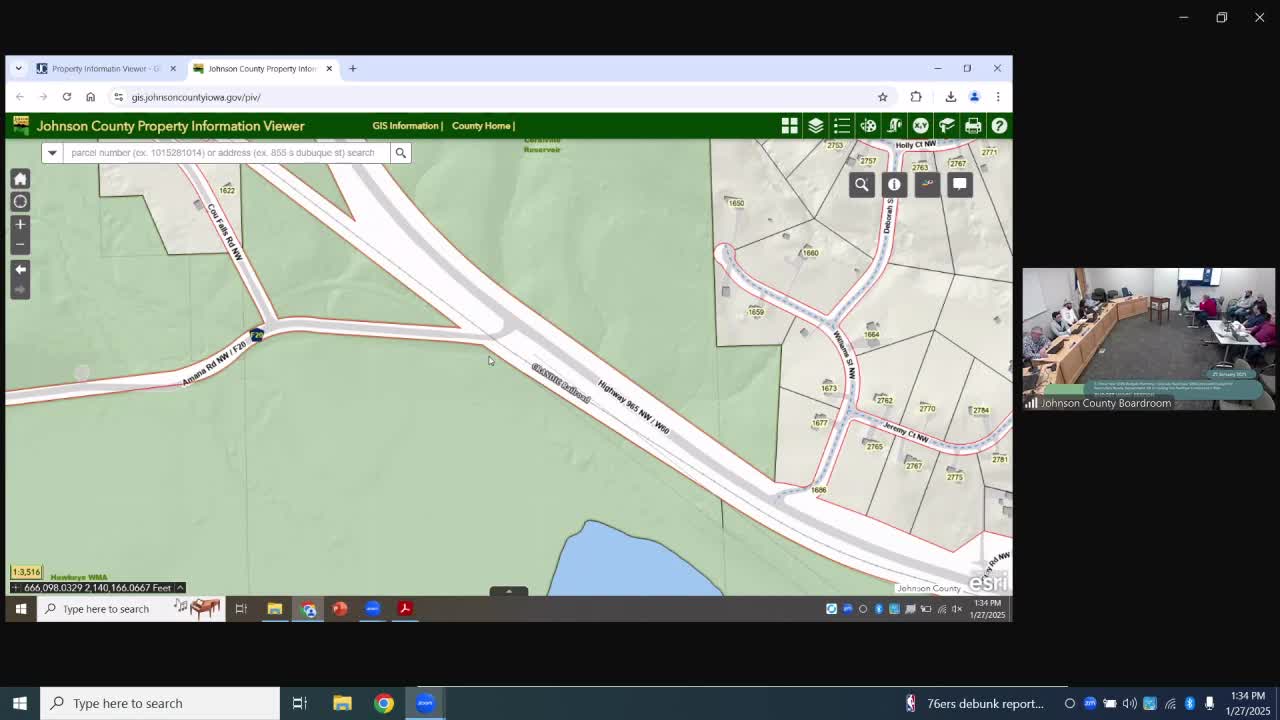
Supervisors pressed staff about public complaints on unlit intersections. A Swisher resident, Greg Brennaman, raised safety concerns at the intersection of Amana Road and Highway 965 and asked that the county consider restoring a light there. Staff said the county has a destination‑lighting policy and an evaluation tool that considers crash history, sight distance and traffic counts; under current practice, intersections must meet a set of warrants to qualify for a light. Several supervisors said the policy’s thresholds do not always match residents’ expectations for visibility and quality‑of‑life fixes and asked staff and their liaison supervisors to recommend changes that could include a complaints‑threshold or board‑discretion language.
The board gave staff specific directions: review and, if appropriate, revise the destination‑lighting policy to allow consideration of complaint counts or board discretion; produce rough one‑time and ongoing cost estimates for 4–6 frequently complained‑about locations (the board cited Amana Road at 965, Oakdale and Dubuque Street, and several Highway 1 intersections); and post the current policy to the county website while any revision is developed. Staff indicated they would return with proposed policy language, budget implications and a slideshow of five‑year projects at a March presentation.
Staff also warned of external pressures that could increase workload and costs: a state policy to allow heavier loads on roads during harvest seasons and pending federal changes to bridge‑inspection standards, both of which could force additional postings, evaluations or bridge work. Staff said many county bridges were designed to older standards and might not carry the higher loads now common on larger multi‑axle vehicles.
The meeting did not include formal votes on budget items. Supervisors set expectations and deadlines: Secondary Roads’ five‑year program and budget documents must be submitted to the state DOT by April 15; staff requested approval of their portion of the county budget by about March 27 so the department can upload items into state systems on schedule. Staff said they would return in March with maps, the finalized five‑year plan and cost detail.
The presentation also covered several modernization efforts: digitizing archival construction plans for public access, using drones and surveying software to speed document production, and plans to transition to Workday for timesheets and leave requests to reduce paperwork. Staff noted one recent staff departure (a county engineer scheduled to leave at the end of the week) and said the department has an internal pipeline to fill technical roles.
Supervisors thanked staff for the presentation and directed follow‑up on the lighting policy and cost estimates. The department will bring refined budget requests, the five‑year map and any proposed policy language back to the board in March for further review.