Get Full Government Meeting Transcripts, Videos, & Alerts Forever!
Get email alerts on the Workday Payroll Modernization topic
No spam. Unsubscribe anytime.
Workday update: Oregon officials describe rollout problems, staffing plan and budget request
Summary
Department of Administrative Services told the Ways and Means subcommittee on General Government on March 20 that Workday’s rollout caused widespread payroll errors in early 2023, described steps taken to stabilize the system and requested a policy package to consolidate and fund the program.
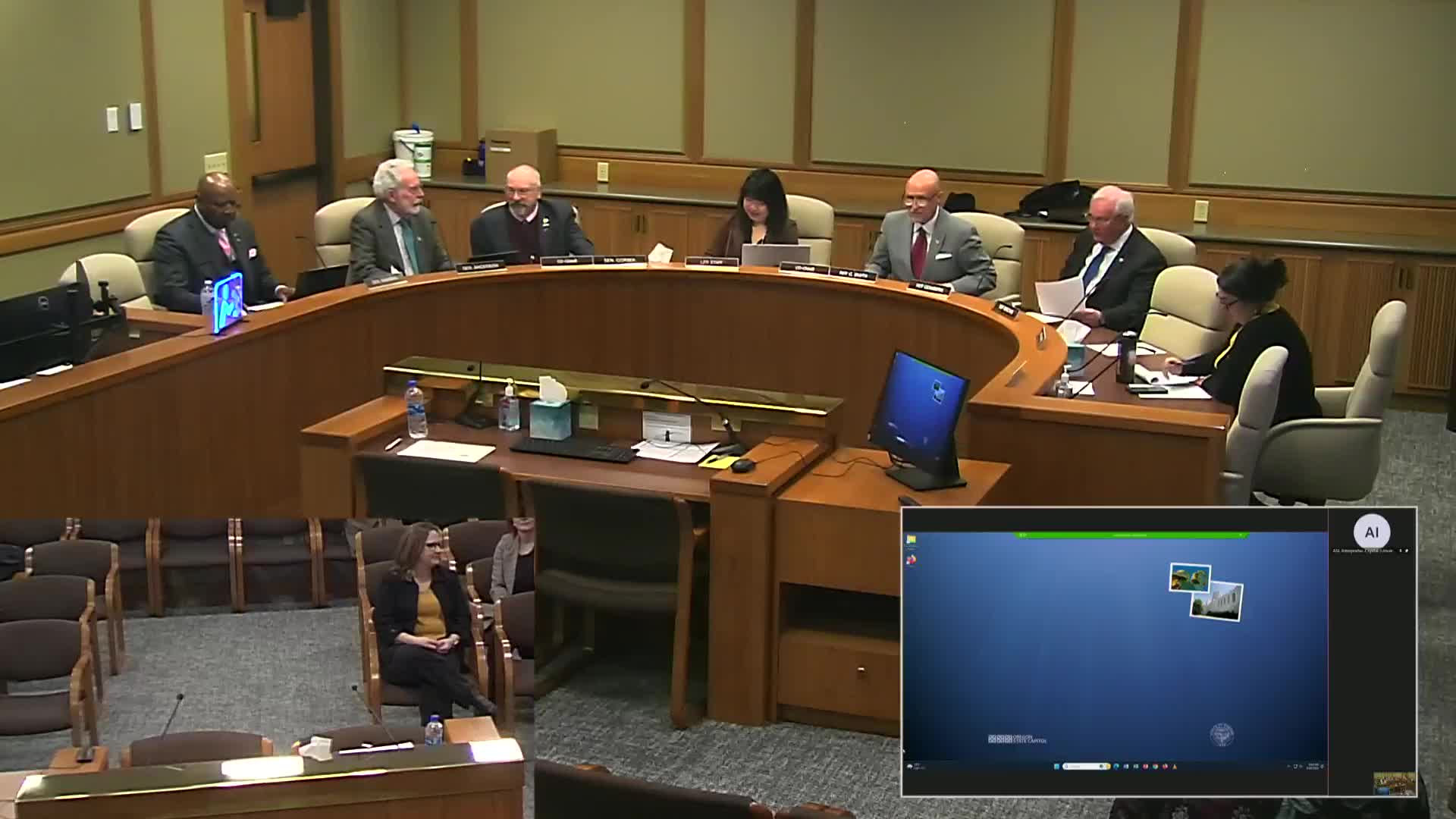
Co-Chair Smith convened the Joint Committee on Ways and Means Subcommittee on General Government on March 20, 2025, for an informational briefing by the Oregon Department of Administrative Services on the statewide Workday human-resources and payroll system.
Barry Leslie, director of the Department of Administrative Services, told the committee the rollout had “been a rocky couple of years” and said, “the buck stops with me,” while introducing a technical briefing from the Workday program team led by Renee Royston and Jody Sherwood.
The presentation laid out the scope of the Workday deployment: a single cloud-based software-as-a-service that now supports HR, payroll, time and attendance, absence management and learning for more than 45,000 state employees across nearly 100 agencies and under about 36 labor agreements. The Workday team said the system also supports roughly 62,000 non-state learners who use online training tied to agency business needs.
Renee Royston, Workday Oregon program director, described Workday as “a single system for the state of Oregon’s HR, payroll, and workforce management” and emphasized security work with the Office of the State Chief Information Officer, noting the system meets SOC 2 Type II standards.
Jody Sherwood, DAS portfolio manager, traced the program history and phasing: HR and absence management went live in 2019, learning modules in 2021, time tracking in December 2022 and payroll in January 2023. Sherwood said the payroll go‑live produced a substantial stabilization effort after initial pay cycles produced both underpayments and overpayments. She reported initial counts of about 1,700 underpayments that dropped to fewer than 400 by the third month, and overpayments that began at about 2,800 and were reduced to about 1,700 in the same interval.
Committee members pressed for causes and remedies. Sherwood and Royston said the errors stemmed from a combination of user input mistakes and technical/configuration gaps, complicated by the state’s single-system rollout (which the presenters said made a staggered migration difficult). They described immediate responses: individual payroll audits in the first 30 days, vendor-conducted independent assessments during a stabilization period from March–April 2023 through April 2024, and deployment of a case-management intake system for faster issue tracking.
The presenters described organizational changes in DAS: the Workday program now includes 34 positions (23 permanent, five limited-duration and six non-budgeted) across three teams — payroll systems, HR services and system administration — and a policy option package (Package 155) in the governor’s recommended budget would transfer those positions into a single Workday division reporting to the DAS director and request $3.2 million in other-fund limitation to make eight limited-duration positions permanent.
Committee members and presenters discussed training, agency payroll partners and ongoing operational controls. Sherwood said agency payroll teams bore most front-line service work answering employee questions and that the central Workday team handled technical system fixes. The presenters described new preventive reporting (for example, variance reports that flag checks with a 5% change) and ongoing efforts to add dashboards, improve change governance (a change advisory board) and mature release and testing practices.
There was no committee vote; the session was informational. Leslie and the Workday team frequently asked legislators to fact-check anecdotal reports before public circulation and emphasized continuing stabilization, additional staffing and governance changes, and improved training and communications as the path forward.
The presentation concluded with thanks from Co-Chair Smith, who said the briefing had “been an excellent presentation” and acknowledged payroll stability would remain a priority for the committee and the administration.
Ending note: Workday remains the state’s central HR and payroll platform; DAS asked lawmakers to approve Package 155 to consolidate program staffing and funding and to permit continued operational improvement.