Get Full Government Meeting Transcripts, Videos, & Alerts Forever!
Get email alerts on the Community Energy Grants topic
No spam. Unsubscribe anytime.
House committee advances bill allowing standalone energy resilience projects in community renewables grant program
Summary
The House Climate, Energy and Environment Committee on March 20 adopted an amendment to House Bill 2,566 to allow standalone energy-resilience projects to qualify for community renewable energy grants and moved the bill to the Joint Committee on Ways and Means.
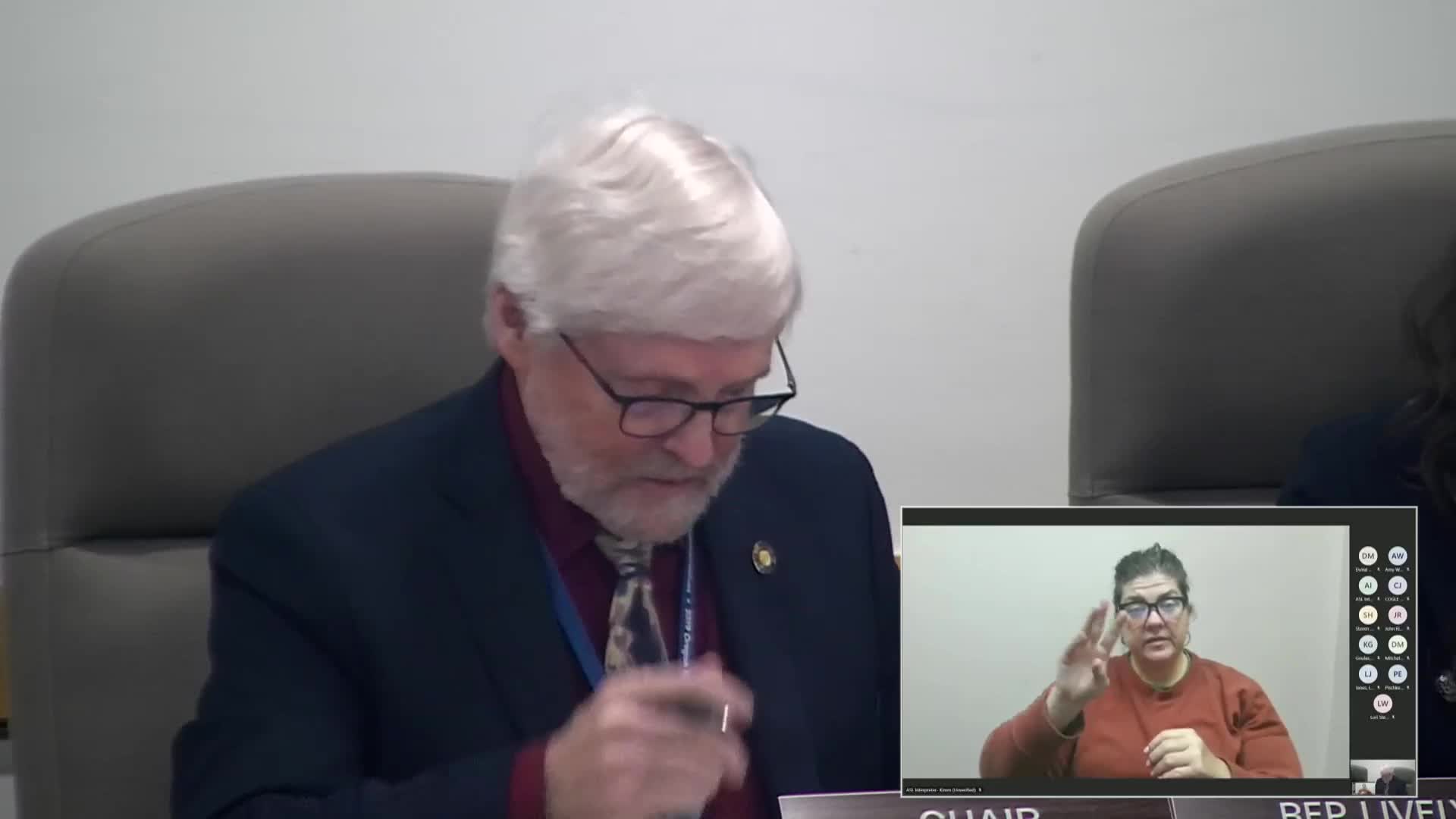
House Climate, Energy and Environment Committee Chair Troy Lively on March 20 said the committee adopted changes to House Bill 2,566 that add standalone energy resilience projects to the allowable projects under the Community Renewable Energy Grant Program and moved the bill on with a due-pass recommendation to the Joint Committee on Ways and Means.
The bill’s sponsor and agency witnesses told the committee the dash-3 amendment specifies how the Oregon Department of Energy (ODOE) may treat standalone resilience projects and clarifies percentages of grant funds the agency must reserve for certain project categories. Christie Split, government relations for the Oregon Department of Energy, said the dash-3 responds to concerns that the previously written 20% set-aside for resilience projects could be treated as a ceiling rather than a firm target.
"The way that it was originally drafted, it said that the 20% would be, a maximum. And there was some concern ... there was really a desire from the consumer owned utilities specifically to ensure that the agency would do all that we could to have that be actually 20% versus something less than 20%," Christie Split said.
Nut graf: Supporters said the change is intended to allow consumer-owned utilities (COUs) that are restricted by contracts with the Bonneville Power Administration from adding renewable generation to still access resilience funding; opponents said the change weakens the program’s renewable focus.
Split told the panel that the amendment allows flexibility if the program does not receive resilience-only applications: unused set-aside money can be reallocated to other eligible projects. She emphasized, however, that the amendment allows, but does not require, that resilience projects be nonrenewable: "the change in the bill is allowing for utilities to have resilience only projects. So they are not required to have a renewables component." Representative Gamba (vice chair) said he would vote against the bill because he believes it "dilutes" a program he views as already weak. Representative Warren said the bill’s definition of resilience addressed her concern and she would vote yes.
Several members noted why COUs had not participated in the program previously: contract restrictions with BPA often prevent adding renewables directly to COU systems. Split said the amendment is intended to enable COUs to participate in resilience projects that still provide system-level benefits and could leverage federal grid-resilience matching funds.
The committee voted first to adopt the dash-3 amendment (motion by Vice Chair Gamba). The amendment passed and the committee then voted to move House Bill 2,566 to the floor as amended with a due-pass recommendation and referral to the Joint Committee on Ways and Means.
The bill now goes to the Joint Committee on Ways and Means for consideration of fiscal impacts and any appropriation that may be required.
Ending: The committee recorded the amendment and main motion roll calls and closed the work session on the bill before opening consideration of the next agenda item.