Get Full Government Meeting Transcripts, Videos, & Alerts Forever!
Get email alerts on the Property Tax Reform topic
No spam. Unsubscribe anytime.
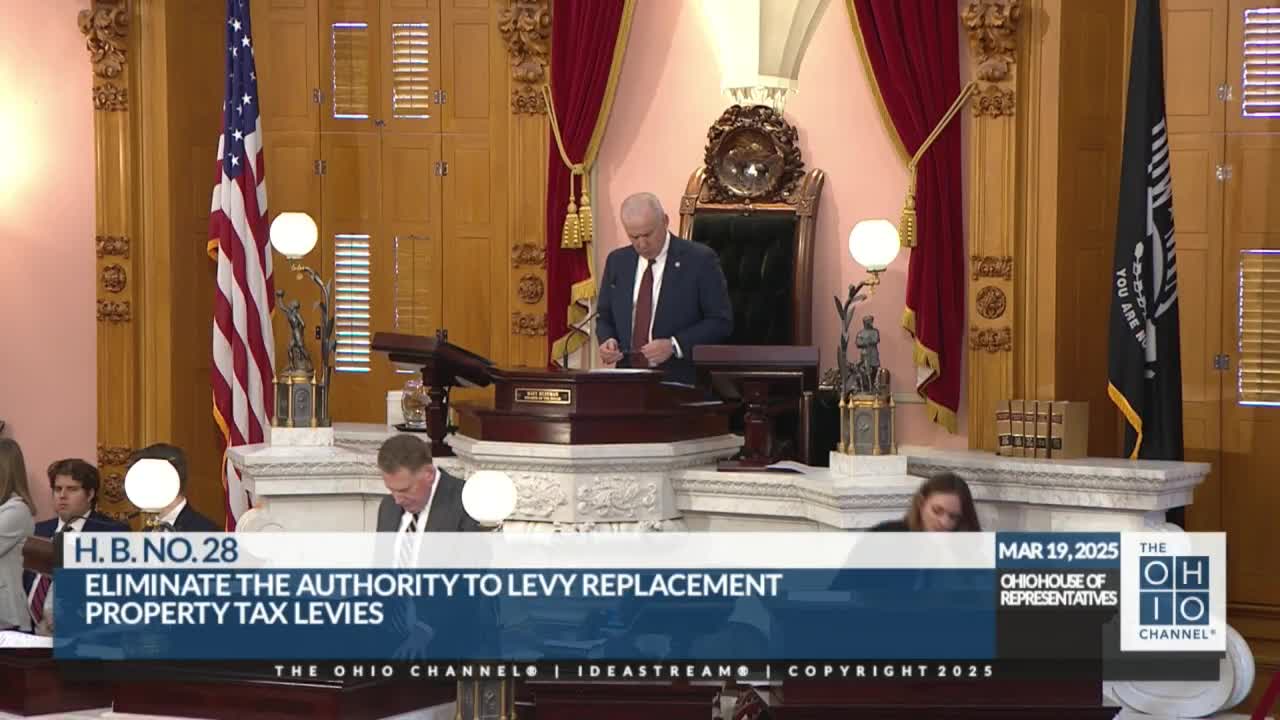
House approves ban on replacement property‑tax levies, sponsors cite transparency for voters
Summary
The Ohio House passed House Bill 28, eliminating local authority to place replacement property‑tax levies on the ballot and framing the change as a transparency measure for voters. Supporters said replacement levies create hidden tax increases; opponents warned it removes a local tool and urged compromise amendments.
The Ohio House passed House Bill 28 to eliminate the authority to place replacement property‑tax levies, advancing a package sponsors described as a transparency reform for voters. The final roll call on the bill was 62 affirmative and 29 negative.
Representative Adam Matthews, prime sponsor, told the chamber HB28 ‘‘brings needed transparency to our property tax system’’ and explained the difference between renewal levies (which retain effective tax liability) and replacement levies (which reset millage and can increase taxpayer payments when assessed value rises). He said voters commonly conflate renewals and replacements and that the bill helps clarify ballot choices.
Supporters noted that the measure was recommended by the prior General Assembly’s Property Tax Review and Reform Commission. Representative Thomas Hall, a joint sponsor, called the bill “step one” toward broader property‑tax reform and thanked Ways and Means committee members for their work.
Opponents and some local officials argued the change removes a tool local governments and service providers use to cover rising costs when state support has lagged. Representative Troy and others urged a compromise approach. Troy proposed an amendment that would preserve local flexibility while extending existing state rollback benefits to certain combined renewal+increase measures; that amendment was discussed as a way to protect taxpayers while maintaining local home‑rule options. The House voted to table the proposed amendment; the tabling motion passed by a recorded vote of 61–29.
Proponents argued that renewals with increases already allow communities to raise revenue transparently and that replacement levies result in unanticipated tax increases for voters who expect a renewal. The bill's supporters said renewal options typically pass at rates comparable to replacement levies and that HB28 aligns ballot language with voter expectations.
Why it matters: The measure changes a commonly used local funding mechanism for schools, counties, townships and other taxing districts. It could reduce the use of replacement levies and shift local strategies for funding services, but it also prompted concerns from municipal and township groups and service providers that rely on locally approved levies.
The House approved the bill’s title on the floor and transmitted the passage for further legislative processing.