Get Full Government Meeting Transcripts, Videos, & Alerts Forever!
Get email alerts on the Early Learning & K 12 Education topic
No spam. Unsubscribe anytime.
Committee hears hours-long testimony on student rights bill that would alter parental-notification rules and add OSPI enforcement duties
Summary
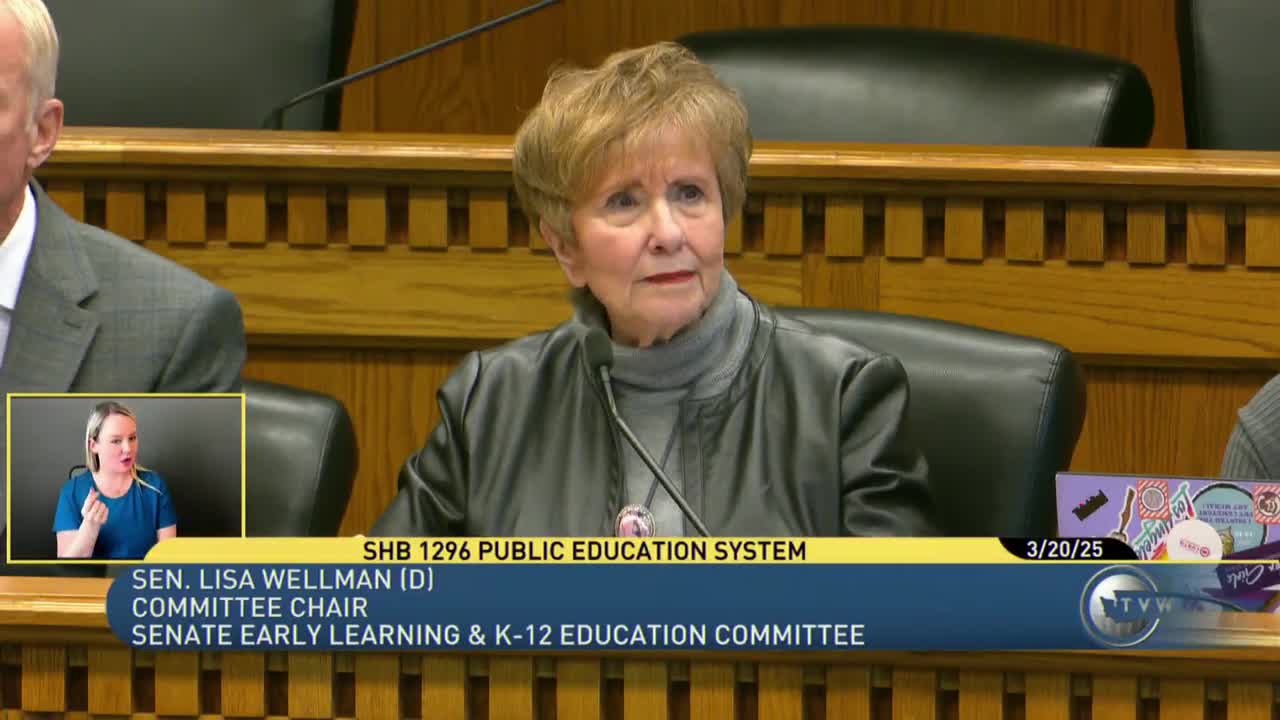
Chairwoman Wellman convened the Early Learning & K-12 Education Committee for a hearing on engrossed substitute House Bill 1296, which staff described as seeking to “promote a safe and supportive public education system through student rights, parental and guardian rights, employee protections, and requirements for state and local education entities.”
Chairwoman Wellman convened the Early Learning & K-12 Education Committee for a hearing on engrossed substitute House Bill 1296, which staff described as seeking to “promote a safe and supportive public education system through student rights, parental and guardian rights, employee protections, and requirements for state and local education entities.” Committee staff member Eileen Cotto briefed the committee on the bill’s main provisions and fiscal impacts.
The bill would: make it state policy that district, charter and tribal compact school policies “prioritize the protection of every student's safety, access to a free public education, and privacy to the fullest extent possible,” direct the Office of Superintendent of Public Instruction (OSPI) to develop technical assistance and enforce compliance (OSPI staff estimated $100,000 in FY2026), move existing model transgender policy requirements into statute (with a district adoption deadline of Jan. 31, 2026, and OSPI rulemaking by Dec. 31, 2025), require immediate parental notification within 48 hours when a student is alleged to be the victim of abuse or assault by a school employee, add a student “statement of rights” to civics curricula, prohibit adverse employment action for staff who support students exercising legal rights, and modify provisions of the 2024 voters’ initiative commonly referred to in testimony as Initiative 2081. The bill also includes an emergency clause to make it effective immediately.
Why it matters: supporters said the bill clarifies and restores protections for vulnerable students and for educators who assist them; opponents said it would weaken parental rights established by the 2024 initiative and risk federal Title IX compliance. ‘‘The bill is student centered,’’ Representative Stonier said during her opening remarks, adding that ‘‘student rights . . . can coexist with the parental rights that you all have been discussing in this committee.’’
Supporters’ testimony: advocates, students and school counselors told personal stories of harassment and harm, and urged passage. Emily Carmichael, a public-school parent, said her 14-year-old experienced repeated bullying and that ‘‘this bill provides a more robust system of protection for students like her including better staff training and protocols for addressing bullying and harassment of students.’’ Tim Boyd, president of the WA Chinook Council, focused on retaliation protections for educators, calling it ‘‘imperative that our public schools create a warm, welcoming, and safe place for all of our students’’ and saying staff must be protected from discipline when they support students.
Students and youth organizers described school as the only safe place for some young people. Albert Johnson, a Spokane high-school student, said he came out to friends and advisors at school before telling his parents because ‘‘school is a good place to try different names and pronouns and see how they feel before coming out to your family.’’ Danny Aschini of Gender Justice League cited state Youth Risk Behavior Survey data presented during testimony to show higher rates of harassment and abuse affecting LGBTQ youth.
Opponents’ testimony: multiple parents, local elected officials and advocacy groups asked the committee to reject the bill or to clarify provisions they said would remove parental notice or allow schools to withhold medical and disciplinary information. Mike Johnson and others argued the bill conflicts with federal Title IX and warned of potential federal funding risk; one speaker claimed a DOE complaint had been filed. Several speakers referenced Initiative 2081 (the 2024 parents’ bill of rights) and stated it had been upheld in state court; they argued ESHB 1296 would ‘‘undo progress’’ and ‘‘sever the parent–child relationship.’’ Amanda McKinney, Yakima County commissioner, described the change as ‘‘remov[ing] certain rights of parents and legal guardians enrolled at public schools’’ and urged a no vote.
OSPI and committee staff responses: Eileen Cotto walked through the bill’s drafted text, the required OSPI rulemaking dates and the fiscal note numbers, including OSPI’s FY2026 estimate of $100,000 for technical assistance and a nonzero but indeterminate local cost (the chart referenced $374,000 for district policy development and adoption). OSPI spokesperson Misha Trunisky told the panel OSPI ‘‘supports the bill as it provides much needed clarity and transparency’’ and said the agency ‘‘follows state and federal law’’; when asked about Title IX exposure, OSPI staff said they were monitoring federal guidance but that ‘‘Washington state law has not changed, and the federal law has not changed.’’
Process notes and clarifications from staff: staff read state statute RCW 28A.605.010 (the state rule that districts adopt procedures about removing students from school grounds) during questions to clarify when a student may be removed from school property without parent authorization. Staff also pointed out that the bill replaces repeated references to "transgender students" with "gender expansive students" or ‘‘gender inclusive schools’’ and contains a list of 24 student rights to be included in educational materials.
What the committee did: this hearing was informational; no committee vote on ESHB 1296 was recorded during the session. The committee chair reiterated that written testimony would be accepted and distributed to members.
Ending: supporters asked the committee to advance the bill to protect both students and educators; opponents urged preservation of the 2024 initiative and expressed concern about parental access and Title IX. Committee staff and OSPI said they would continue to monitor federal guidance and provide rulemaking and fiscal detail as requested. The record remains open to additional written testimony.