Get Full Government Meeting Transcripts, Videos, & Alerts Forever!
Get email alerts on the Reentry Council topic
No spam. Unsubscribe anytime.
Committee hears bill expanding Statewide Reentry Council membership and allowing stipends for lived-experience members
Summary
Senate Bill 51-39 would expand the Washington Statewide Reentry Council from 15 to 22 members, add representation including currently incarcerated individuals and crime survivors, and remove a statutory prohibition on compensation so agencies may provide stipends to class-1 members with lived experience.
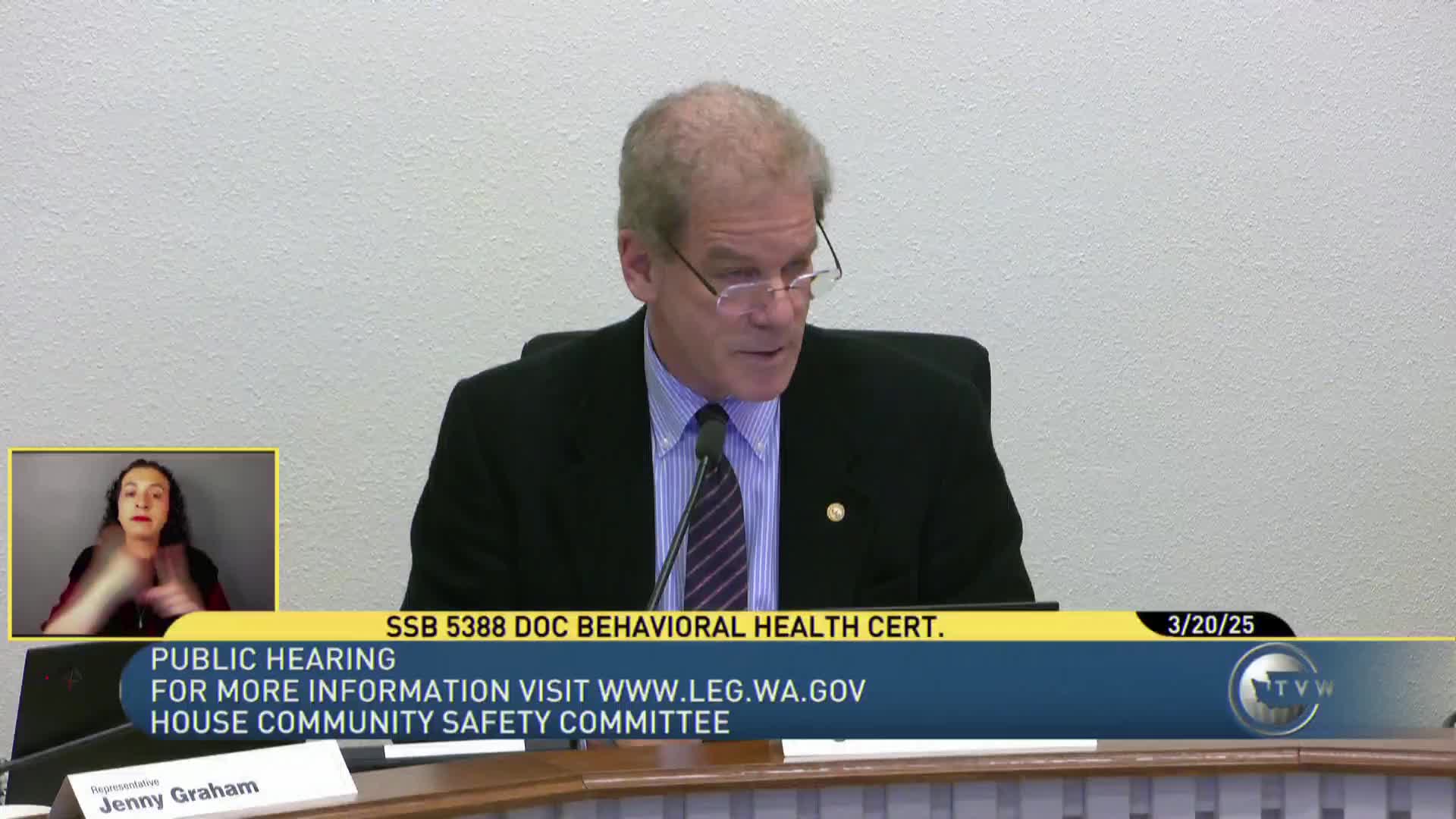
Senate Bill 51-39, in public hearing before the Community Safety, Justice & Reentry Committee, would expand the Washington Statewide Reentry Council, add specific seats for people with lived experience and crime survivors, and permit compensation for council members as provided under state law for class-1 part-time groups.
Staff and sponsors described the council’s role: established in 2016 within the Department of Commerce, the council advises the legislature and governor, reviews policy and funding recommendations, applies for grants, and pursues reentry goals, including the Reentry 2030 executive directive. The bill would expand membership to 22 by adding two community members who are currently incarcerated, two people who are survivors or victims of crime, and agency representatives from the Health Care Authority, Department of Social and Health Services, and the Employment Security Department. Quorum would increase from seven to 12 members.
A key statutory change is removal of language prohibiting council members from receiving compensation; the bill instead makes members eligible for compensation consistent with state law for class-1 part-time groups and allows agencies to provide stipends (subject to available funding and limits) for low-income or lived-experience members. Witnesses called for inclusive representation: Senator Claire Wilson and Janelle McPhee, the council’s executive director, emphasized that meaningful inclusion of lived experience and survivors improves policy and outcomes.
Public testimony: the Department of Corrections and the council’s executive director testified in support. Dr. Esther Matthews, a management analyst with the reentry council who described her lived experience of incarceration, told the committee the council had surveyed roughly 14,000 people in state prisons and found that most respondents were unaware of the council. She said formal seats for currently incarcerated people would help close that gap and honored commitments under the Nothing About Us Without Us Act.
Clarifying details: the bill text does not define “community members” further in statute; committee staff said they would review definitions and implementation logistics. Vice Chair Simmons offered a friendly amendment request (accepted by the sponsor) to ensure that of the incarcerated members one would be drawn from a men’s facility and one from a women’s facility to increase representational diversity. The bill preserves the council’s authority to meet virtually and allows stipend mechanisms already authorized for class-1 groups; the stipend cap noted in statute is not more than $200 per day for eligible class-1 members.
Next steps: the committee held public testimony and accepted multiple agency and lived-experience speakers in support; committee members asked staff to refine statutory language and definitions on membership and participation logistics. No committee final action was recorded in the hearing segment.