Get Full Government Meeting Transcripts, Videos, & Alerts Forever!
Get email alerts on the Distributed Energy Resources topic
No spam. Unsubscribe anytime.
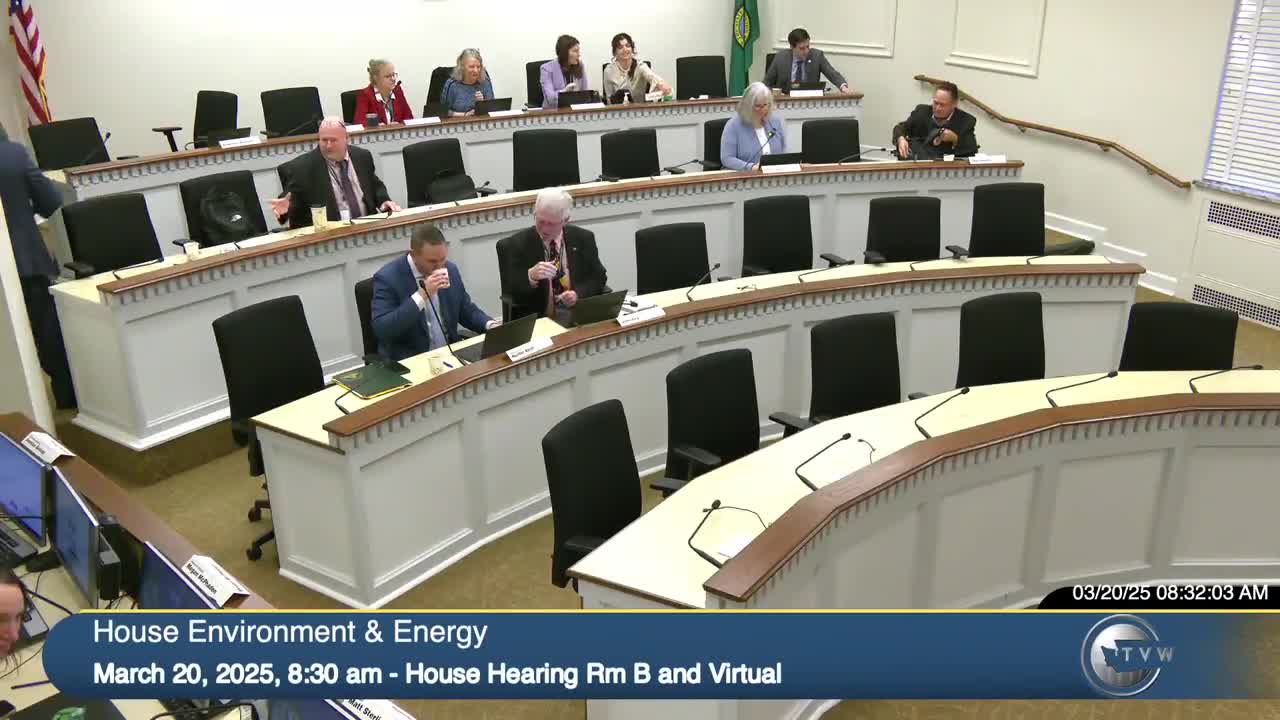
Committee weighs SB 5445 to steer utilities toward local distributed energy projects
Summary
Senate Bill 5445 would add a set of distributed energy priorities for the state energy office, clarify agrivoltaics tax treatment, narrow some SEPA exemptions and create an alternative compliance pathway under the Energy Independence Act that counts accelerated conservation and demand response.
Senate Bill 5445 would add a set of "distributed energy priorities" for the state energy office, clarify tax treatment for agrivoltaic projects on farm and agricultural land, create narrow categorical exemptions under the State Environmental Policy Act and allow qualifying utilities new ways to meet the Energy Independence Act's 15% requirement through accelerated conservation and demand response.
Why it matters: The bill is intended to shift some utility compliance spending from out‑of‑state renewable energy credits into local projects that can support grid reliability, local jobs and community resilience as electricity demand grows.
Committee staff Jake Lipson briefed the panel that the bill "does 4 main things," including defining a priority list that covers solar generation, non-utility-scale wind, energy storage and demand response; treating agrivoltaic systems on eligible farmland so they do not trigger back taxes under the Open Space and Land Use Taxation Act; narrowing some categorical exemptions under SEPA; and adding an alternative compliance pathway to the Energy Independence Act for utilities.
Senator Matt Behnke, sponsor of the bills, framed the measure around local control and grid reliability, saying the state faces rapid projected demand increases and must give utilities "flexibility as we transition" to clean energy. Behnke cited the need for local metrics and annual reporting to assess projects’ effectiveness.
Utility and developer representatives from public utility districts (PUDs), cooperatives and private firms told the committee the bill would incentivize investment in local projects rather than buying RECs from outside the state. Liz Anderson, executive director of the Washington PUD Association, said the bill’s alternative compliance option would let utilities keep investment and jobs "at home" rather than spending millions on out‑of‑state renewable energy credits. Sheila Korsen of Mason County PUD No. 3 described potential projects—additional rooftop solar, batteries and community solar enrollment on a PUD operations building—that could fit the bill’s priorities. Ryan Collins of Snohomish PUD said the change would convert capacity resources into units compatible with the state’s clean energy framework and help close a gap in the current regulatory system. Joel Hansen of Ameresco said building assets "creates jobs in our communities" in a way that buying RECs does not.
Environmental and consumer advocates said they support parts of the bill but urged technical fixes. Charlie Thompson of the Northwest Energy Coalition said the striking amendment raises a valuation question: "the language in section 6 4 little 3 I allows utilities to claim up to as many as 30 years of credit for conservation savings in a single year," which the coalition viewed as inconsistent with regional best practices. Thompson also said the coalition was wary of adding biomass and geothermal to the distributed energy definition without further discussion.
Key provisions and clarifications discussed in committee testimony and the striking amendment: - Agrivoltaics: The bill treats agrivoltaic facilities (solar plus concurrent agricultural production) so they remain eligible for current‑use valuation under the Open Space and Land Use Taxation Act and do not trigger back taxes; that provision mirrors an earlier House bill discussed by the committee. This tax treatment was not changed in the striking amendment. - SEPA categorical exemptions: The bill creates categorical SEPA exemptions for certain solar projects—parking lots, rooftop structures of 1,000 square feet or less, and reclaimed surface mines or landfills that are served by and accessible to emergency fire response—unless the parcel is partly or wholly covered by water. The striking amendment narrowed that exemption to undisturbed or previously developed lands that are not timberland, farm and agricultural land or other open space lands eligible under the Open Space and Land Use Taxation Act; it also limits exemptions so only one such structure can exist on a parcel without triggering SEPA review. - Energy Independence Act (EIA) compliance: The bill would allow qualifying utilities to satisfy their statutory 15% target through a combination of eligible renewable resources and distributed energy priority projects, adding accelerated conservation and demand response as explicit mechanisms. Under the striking amendment, accelerated conservation and demand response are clarified as the only two new mechanisms a utility may use. For distributed energy projects sited within a utility’s service area and meeting other criteria, the amendment applies a higher multiplier for credit toward the EIA target: a four-times (4x) multiplier through 2029 for specified distributed projects (the prior version used a double multiplier for smaller projects up to 5 megawatts).
What the committee did: No final vote was taken. Committee members heard testimony from sponsors, PUDs, developers and environmental groups, asked questions about how the EIA targets are calculated and how credits would be valued, and suspended the hearing to consider the bill further.
Context and next steps: Supporters argue the bill will direct compliance spending into local infrastructure and resilience projects, while critics want clearer and more conservative valuation methods for conservation credits and caution about expanding the definition of distributed energy without guardrails. The committee did not adopt final changes in the hearing; further technical work and stakeholder negotiations were discussed.
Ending: The committee paused consideration of SB 5445 for additional work on the striking amendment and valuation methodologies and did not take final action during the March 20 hearing.