Get Full Government Meeting Transcripts, Videos, & Alerts Forever!
Get email alerts on the Education Private Online Schools topic
No spam. Unsubscribe anytime.
Senate exempts fully online private schools from class‑size, calendar and vaccine rules
Summary
Senate Bill 827, as amended, bars the State Board of Education from requiring certain accredited private online, self‑paced schools to meet class‑size, operating-schedule or vaccination requirements; the Senate passed the measure after debate about oversight and voucher eligibility.
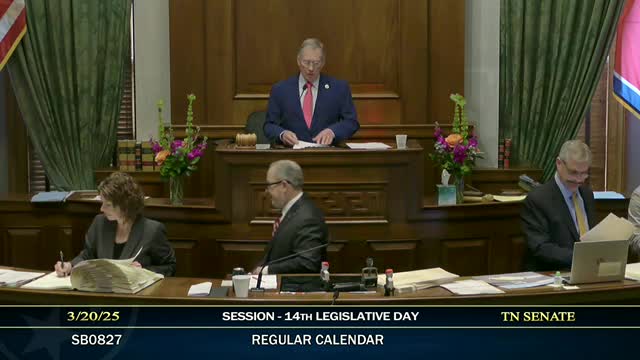
The Tennessee Senate passed a bill exempting certain fully online, self‑paced private schools from some State Board of Education requirements on class size, operating schedule and vaccinations.
Senator Frank Hensley, sponsor of Senate Bill 827, said the measure targets a narrow group: private schools certified as category 3 (nonpublic) that operate fully online and use a self‑paced curriculum. An Education Committee amendment narrowed and rewrote the measure to apply to schools accredited by the Education Accreditation Commission and offering fully online, self‑paced programs.
Senator Sarah Yarbrough and others raised concerns that the measure significantly loosens requirements for schools that could receive education scholarship funds. Yarbrough warned that removing minimum instructional days or hours could "limit the educational advancement of a child in a pretty significant way" and urged caution because taxpayer funds may be used to fund private education.
Hensley said category 3 schools would not qualify for vouchers under existing law and that the bill does not change eligibility for education scholarships; he said the bill only addresses wholly online, self‑paced schools and their unique scheduling and vaccination considerations.
The Senate adopted the Education Committee amendment and then approved the bill on third reading, 25 ayes to 5 nays. Debate focused on the trade‑off between flexible instruction models and consistent state standards for minimum instructional time and public‑fund accountability.