
Board approves restoration and rear additions at 1735 Lenox Avenue, debates roof color and window details
Get AI-powered insights, summaries, and transcripts
Sign Up Free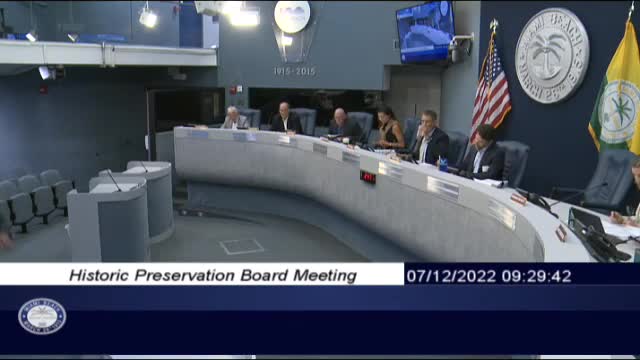
Summary
The Historic Preservation Board approved a certificate of appropriateness July 12 for restoration and rear additions at a 1936 Palm View house at 1735 Lenox Avenue, while members and preservation groups pressed the applicant to use historically accurate window muntins and questioned a proposed gray barrel-tile roof color.
The Historic Preservation Board on July 12 approved a certificate of appropriateness for work at 1735 Lenox Avenue, a one‑story contributing single‑family home in the Palm View Local Historic District originally designed in 1936 by Lester Avery. The project, presented by applicant representatives, restores the front façade elements and adds two one‑story additions at the rear that staff said will not be visible from Lenox Avenue.
Staff recommended approval, noting the front‑façade restoration — including reintroduction of the open porch, an arched central window feature and low planter walls — and supported rear additions not visible from the street, while asking the applicant to refine the front window muntin details to be more historically accurate. Applicant representatives said they accepted staff conditions and described the rear additions and a new pool and cabana as necessary to modernize use of the property without waivers or variances.
Public comment came from Daniel Serrato of the Miami Design Preservation League, who thanked the owners for stewardship but urged (1) historically accurate window muntins (favoring high‑relief, dimensional muntins versus flat applied muntins) and (2) concern about a trend toward darker barrel‑tile roof colors on Mediterranean‑style homes. Board members discussed those points during deliberations; several members recommended operable windows rather than fixed glazing for the front window to match the original condition and preserve ventilation options. Staff said the city code requires barrel tile on Mediterranean‑style structures and that staff typically enforces a neutral material; the staff analyst said black would not be approved and that the proposed lighter gray tile was acceptable for resiliency and heat‑island reasons, though the board discussed preferring red or historically white barrel tiles common locally.
After discussion a motion to approve the application with staff recommendations passed on a roll‑call vote of 5–1 (one board member opposed because of roof‑color concerns). The board directed the applicant to work with staff on final window muntin details and to consider operable sash on the front opening.
Why this matters: The approval preserves and restores a contributing house in a local historic district while allowing rear additions to meet modern living needs; the debate reflects broader neighborhood concerns about roof materials and authenticity in single‑family historic districts.
Votes at a glance
- HPB220516 (1735 Lenox Avenue) — Certificate of Appropriateness for partial demolition, restoration, and construction of attached additions: passed, roll‑call tally 5 yes, 1 no.
Next steps: Applicant will submit final permit plans incorporating staff conditions on window detail and coordinate final roof tile specifications with staff.