Get Full Government Meeting Transcripts, Videos, & Alerts Forever!
Get email alerts on the Public Health Tobacco topic
No spam. Unsubscribe anytime.
Community coalition asks Covina to expand outdoor smoke- and vape-free rules; presents survey results
Summary
Members of the Breathe Clean Covina Coalition asked the Covina City Council to expand local smoking and vaping prohibitions in outdoor areas, presented survey results showing majority support for restrictions in specific public spaces, and offered to meet with city staff to discuss potential policy updates.
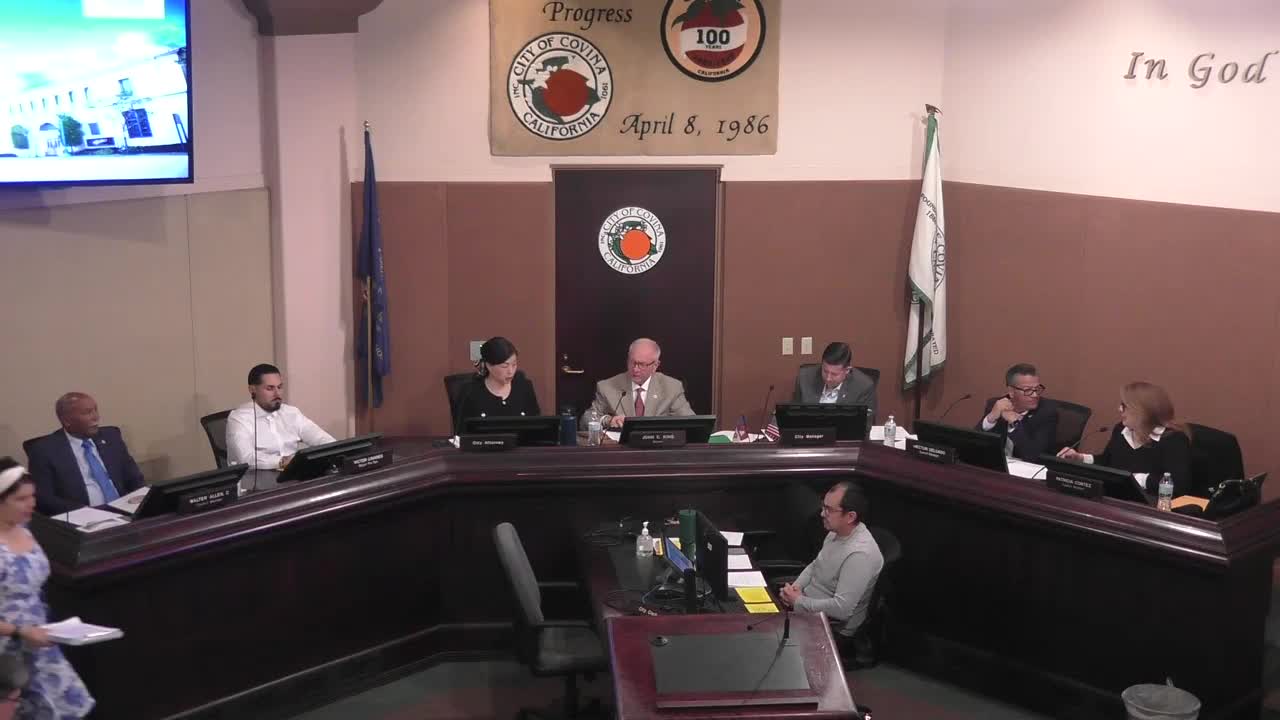
Members of the Breathe Clean Covina Coalition addressed the Covina City Council during public comment on Feb. 18, asking the city to expand existing smoke-free rules for outdoor spaces and presenting survey results they say show broad resident support for additional restrictions.
Belinda Campos Bresnahan, who identified herself as project manager for the LAC+USC Medical Foundation Wellness Center and a founder of the coalition, said the group surveyed residents between Nov. 1, 2022 and Feb. 29, 2024 and left a packet of results with the city clerk. She told the council that respondents supported prohibiting smoking and vaping in outdoor restaurant areas (83% support), outdoor malls and stores (83% support), and outdoor service areas (79% support). The coalition asked for one-on-one briefings with councilmembers and staff to discuss possible policy changes.
Other coalition speakers said they had tabbed and presented educational materials at city events, engaged senior centers and school-based programs, and reached out to community partners. Christina Navarro, a Covina resident and parent, said she appreciated the city’s existing ordinance that bans smoking in recreation areas but urged the council to extend restrictions to sidewalks, bike paths, bus stops, dining areas, and large outdoor events. Yaneth Rodriguez, from the University of Southern California’s Department of Population and Public Health Sciences, summarized decades of academic findings and highlighted recent research suggesting prenatal secondhand tobacco smoke exposure may increase the risk of childhood acute lymphoblastic leukemia; she said secondhand smoke is linked to immediate risks such as asthma and heart attacks and noted the Environmental Protection Agency has long classified secondhand tobacco smoke as hazardous.
Why it matters: The coalition frames expanded outdoor smoke-free rules as a public health measure, citing research and local survey results. Any change to city ordinances would require staff evaluation and a formal legislative process, so the council did not take action during the meeting but received the coalition’s materials and asked staff to follow up on meetings.
Council reaction and follow-up: Mayor King acknowledged receipt of the packet and councilmembers thanked the coalition for their outreach. Staff noted the packet had been received by the city clerk and invited coalition members to meet with staff and councilmembers to discuss next steps. The coalition asked to take a photograph with the council at the end of public comment; the council accommodated the request.
Public details provided by the coalition in the packet include the percentages above; the coalition indicated they had surveyed residents at a range of community events, including softball games and other gatherings. The coalition also offered to collaborate on public education and outreach if the council directs staff to pursue ordinance updates.