Get Full Government Meeting Transcripts, Videos, & Alerts Forever!
Get email alerts on the Energy Community Choice Aggregation topic
No spam. Unsubscribe anytime.
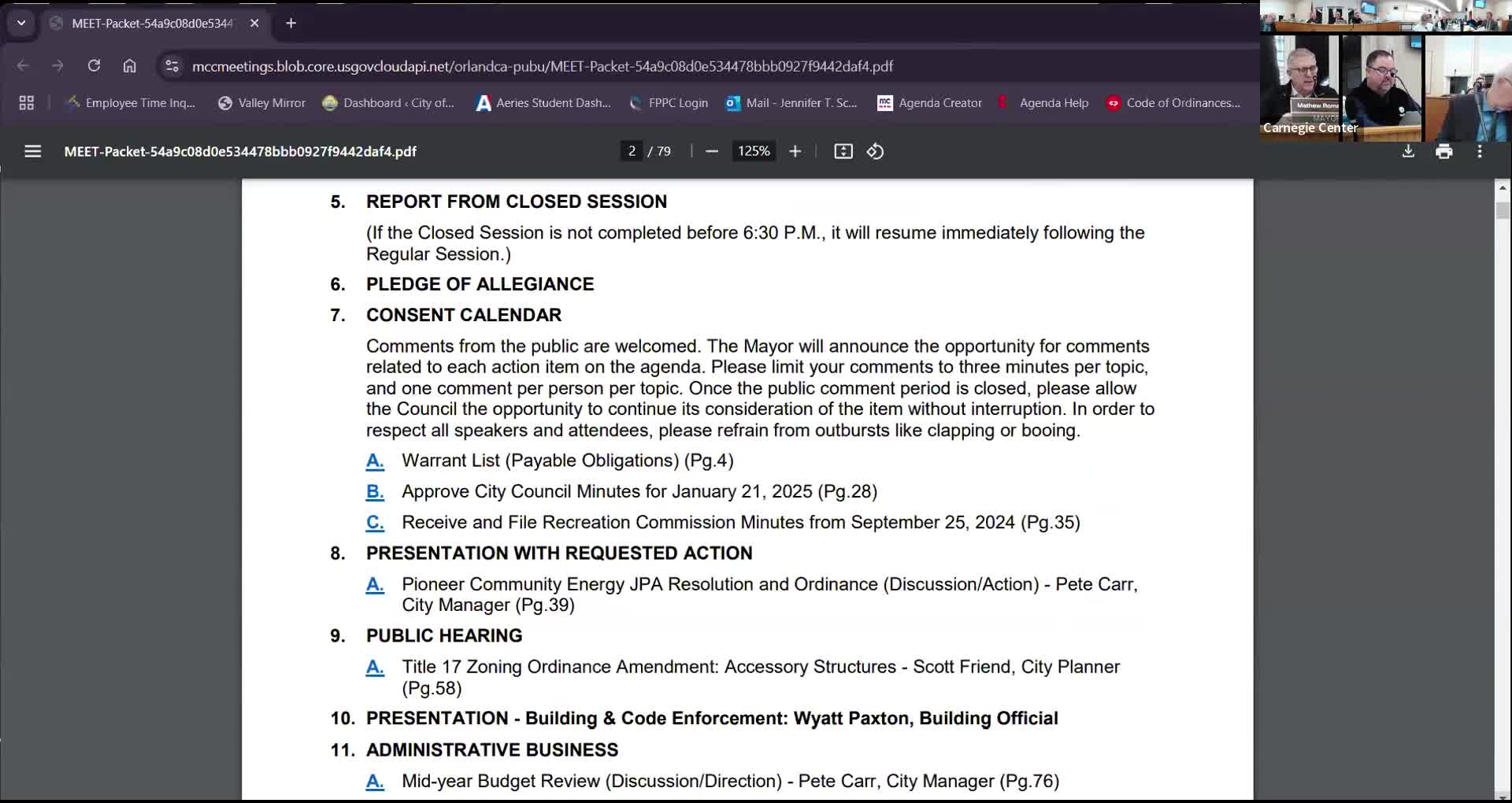
Orland council OKs joining Pioneer Community Energy; ordinance to implement community choice aggregation advances
Summary
The Orland City Council voted 3–2 to join Pioneer Community Energy and approved an ordinance to implement a community choice aggregation program after a lengthy staff presentation and public questions about rates, opt-outs and reliability.
The Orland City Council voted 3–2 Tuesday to join Pioneer Community Energy and to authorize the city to implement a community choice aggregation (CCA) program, a move city staff said aims to reduce energy costs for residents while expanding local renewable procurement.
Lisa Delavi, community outreach manager for Pioneer Community Energy, told the council the authority’s impact assessment found the expansion would not harm existing Pioneer customers and that the recommended launch timing is October 2027. “Yes. We can expand into [Glenn] County, Orland, and Willows with no financial impacts to existing customers while still protecting our rate payer savings,” Delavi said.
The vote followed about an hour of staff presentation, questions from council and residents, and public comment. Councilors raised questions about opt-out rules, service reliability during outages and whether Pioneer’s procurement approach could result in future higher costs if state incentives or market conditions change.
Delavi said customers would be automatically enrolled but could opt out online at no penalty. “There’s no cost to opt out,” she told Council Member McDermott when asked about consumer protections. Delavi also clarified that Pacific Gas & Electric would still own and operate the transmission and distribution network and would continue to handle outages and line repairs.
Council discussion focused on tradeoffs between local control of power procurement and exposure to state regulatory changes. Several residents and business owners asked whether Pioneer’s renewable-heavy product mix might become more expensive if tax incentives or renewable credits change; a resident warned renewables were “five times more expensive than natural gas” under some scenarios.
Actions recorded on Tuesday included two separate votes tied to Pioneer’s expansion: approval of an amended and restated joint powers agreement to add Orland to Pioneer’s JPA membership and adoption of an ordinance authorizing implementation of a CCA program. Both votes passed on 3–2 roll calls. Mayor Romano and Council Member Barr voted no on both items; Council Member Smith, Council Member McDermott and Vice Mayor Toll voted yes.
Pioneer officials said the expansion study was done by Pacific Energy Advisors using two years of PG&E usage data, and that Pioneer expects to submit an implementation plan to the California Public Utilities Commission (CPUC) for approval within 90 days after jurisdictions complete local approvals. Delavi said jurisdictions will have an “off‑ramp” in the implementation process should they decide not to proceed before enrollment begins.
Public commenters included small-business owners and residents who voiced both support for immediate rate relief and concerns about long-term regulatory risk. A county official attending said neighboring jurisdictions had done substantial due diligence and that several jurisdictions that attempted to form independent CCAs had instead joined established providers such as Pioneer.
The council votes forward the city to the CPUC submission step. If the CPUC approves the implementation plan, Pioneer and the city will continue outreach and education ahead of the targeted October 2027 service launch.
Votes at a glance
- Amended and restated Joint Powers Agreement (Pioneer Community Energy membership): Motion to adopt; mover/second not recorded on the roll; roll-call: Barr — No; Smith — Yes; McDermott — Aye; Vice Mayor Toll — Aye; Mayor Romano — No. Outcome: Passed, 3–2.
- Ordinance authorizing implementation of a Community Choice Aggregation program under Public Utilities Code section 366.2: Motion to adopt first reading; roll-call: Barr — No; Smith — Yes; McDermott — Aye; Vice Mayor Toll — Aye; Mayor Romano — No. Outcome: Passed, 3–2.
Why it matters
Community choice aggregation shifts the generation procurement decision from an investor-owned utility (PG&E) to a local joint powers authority. Proponents say CCAs can prioritize lower rates and local renewable projects; critics warned council that state policy changes or reduced renewable incentives could alter the long-term economics.
What’s next
Staff will file Pioneer’s implementation plan with the CPUC after all participating jurisdictions pass required local resolutions and ordinances. CPUC review can take up to 90 days, and the earliest operational launch for the 13 jurisdictions Pioneer studied is October 2027, according to Pioneer staff.
Ending
Councilors who voted for the measures said the city retains the option for jurisdictions and customers to opt out during the implementation window, and Pioneer reiterated its commitment to public education and local customer service through a Rockland call center.