
Committee approves amended bill to expand barber licensing and board support roles
Get AI-powered insights, summaries, and transcripts
Subscribe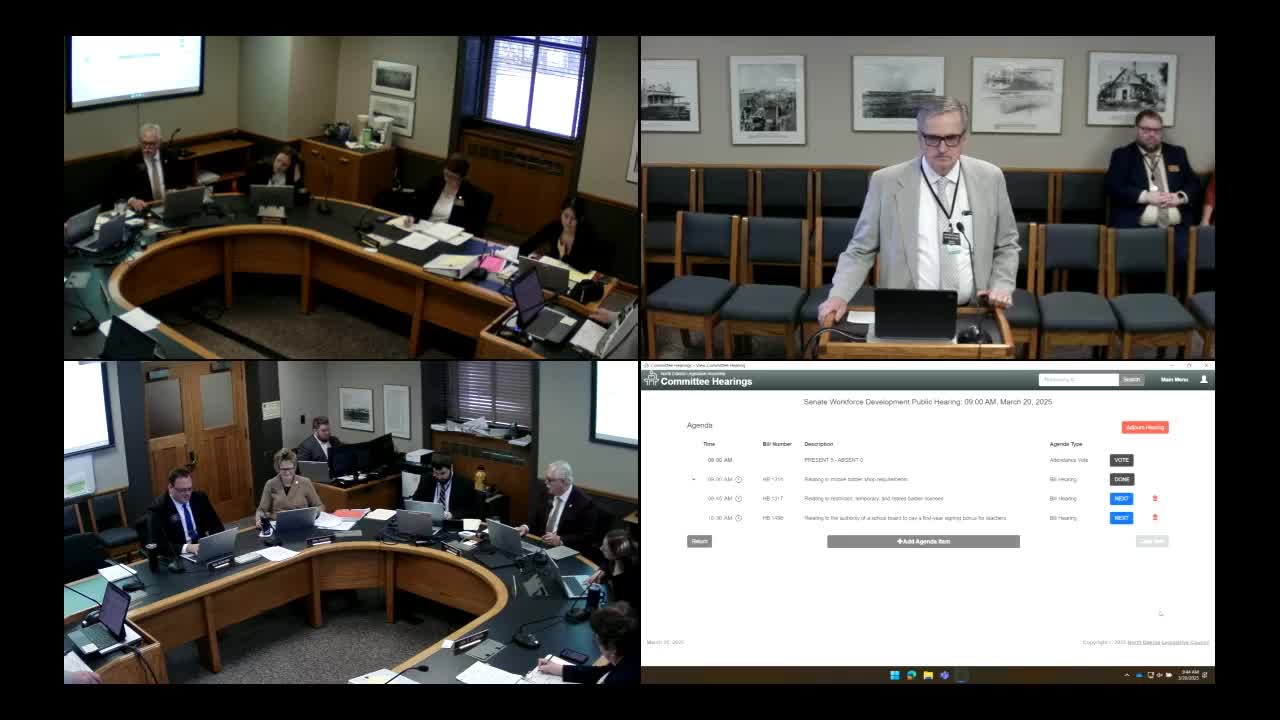
Summary
House Bill 13‑17 passed the Senate Workforce Development Committee as amended; the bill adds restricted, temporary and retired licenses, increases instructor fees, and adds two nonvoting board members to aid inspections. The attorney general's office successfully sought removal of language suggesting board members could provide legal advice.
The Senate Workforce Development Committee voted unanimously to recommend passage, as amended, of House Bill 13‑17, a measure the Barber Board requested to add new license categories, clarify continuing‑education rules, increase instructor fees and expand board membership to help with inspections.
Representative Bernie Satrim introduced the bill on behalf of the Barber Board. Amanda Guzman, secretary‑treasurer of the Barber Board, testified that the bill would create three new license types: a restricted license that permits someone who has completed part of the required hours and passed a written exam to work in a host barbershop but not own one; a temporary license to let newly trained individuals work while they await the next exam; and a retired license available to applicants who are at least 65 years old or have at least 20 years of barbering experience and who work no more than five days a month. Guzman said the temporary license would last three months and be renewable if the applicant could not take or pass the exam.
Guzman also said the board seeks to add two nonvoting members to help with annual shop inspections and office duties; she told the committee the board currently inspects 97 licensed shops each year. The bill would also change continuing‑education wording to apply to all licensed barbers and increase the instructors' license fee from $25 to $250, Guzman said, to align with other states and to ensure instructors remain active.
Mary Kay Kelsch, assistant attorney general and director of the general counsel division, offered a friendly amendment to remove language that listed "legal advice" among duties the new nonvoting members could provide. Kelsch explained the attorney general's office already provides assigned counsel to boards and that a private attorney on a board could not ethically give legal advice to that board without a special appointment; she said the change was intended to avoid conflict and confusion.
The committee voted to adopt the amendment (recorded as a unanimous yes vote) and then approved the bill "do pass as amended" on a unanimous roll call. The clerk recorded yes votes from Senators Wabamah, Axman, Larson, Bosche and Powers.