Get Full Government Meeting Transcripts, Videos, & Alerts Forever!
Get email alerts on the Economic Development topic
No spam. Unsubscribe anytime.
Lawmakers seek guardrails for Good Life Districts after disputed approvals and pending projects
Summary
Senators proposed amendments to clarify how Good Life Districts are approved, financed and expanded after several projects advanced with limited guidance. The changes aim to require MOUs, evidence of land control and financial viability, and to prohibit eminent domain for district assembly.
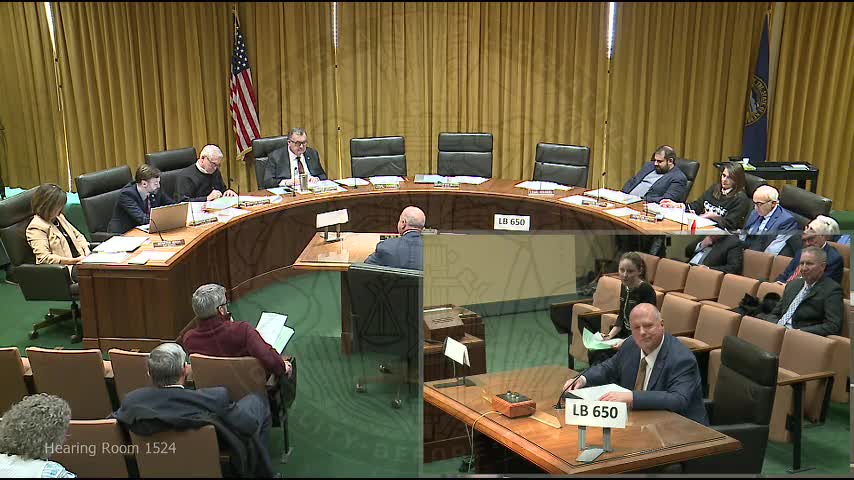
Senator Brad Von Gillern and others told the Revenue Committee that LB707, with AM615, and companion measures are intended to fix ambiguities that emerged after the Good Life District program was enacted. "The Good Life District program encourages transformational developments," Von Gillern said in opening remarks, but implementation raised questions about land control, the use of tax-exempt public entities, expansion authority, and when a district could be rescinded.
The amendment package presented several solutions: require a memorandum of understanding between an awardee and the municipality that documents how the local collections will be used and administered; require that land inside a proposed district be owned or under contract by the applicant; require applicants to submit evidence of financial viability (capital stack, letters of intent); change automatic expansion language so the Department of Economic Development (DED) has discretion ("may" rather than "shall"); prohibit use of eminent domain to assemble Good Life District land; and create a limited process to terminate unstarted applications while protecting bondability of in-progress projects.
Municipal officials and developers urged fast certainty. Paul Younes, president of Younes Hospitality (Kearney), and Brenda Jensen, Kearney city manager, said the Kearney application is "shovel ready" and that delays have held up a planned, largely undeveloped 200-acre district near I-80 that would add hotels, retail and a sports-entertainment campus. "If we get the approval, we could start in 30 days or less because we have our plans ready," Younes told the committee.
Other cities urged caution about retroactive or unduly disruptive changes. Bellevue Mayor Rusty Hike testified that he and the city council invested roughly $40 million based on their Good Life designation and that AM615’s changes to occupation-tax caps and remittance provisions would increase their project costs and could force billions of dollars in planned tax turnbacks to be remitted to the state. "AM615 to LB707 undermines the $40,000,000 investment Bellevue has made under existing law and jeopardizes the tax revenue source to construct the district," Hike said, adding concerns about a potential $12 million shortfall to local taxpayers under certain scenarios.
The Nebraska attorney general’s office said it had worked with stakeholders and presented a framework to resolve disputes in Gretna’s pending application; AG Mike Hilgers described an outline that would allow a primary developer to develop land it controls while enabling sub‑developers to pursue pieces of a wider district under comparable rules, provided a robust memorandum of understanding protects taxpayer interests.
Supporters emphasized the potential long-term revenue: Von Gillern estimated that successful Good Life projects produce large private investment and higher state sales tax revenue in future years, and proponents in Grand Island and Kearney described the projects as transformational: Grand Island said its district could generate hundreds of millions in additional state revenue and attract sports tourism.
The committee heard competing requests: municipal and developer proponents asked the Legislature to act quickly to provide certainty for projects ready to break ground; the sponsor and some city officials urged careful guardrails to avoid unintended subsidies, tax-exempt construction, or premature expansion authority. No final committee vote was recorded; senators said further drafting and negotiation would continue.
Ending: The committee left both LB707 and LB510 open for follow-up work; the attorney general and sponsor circulated possible compromise language that stakeholders said they would continue to refine.