Get Full Government Meeting Transcripts, Videos, & Alerts Forever!
Get email alerts on the State Budget topic
No spam. Unsubscribe anytime.
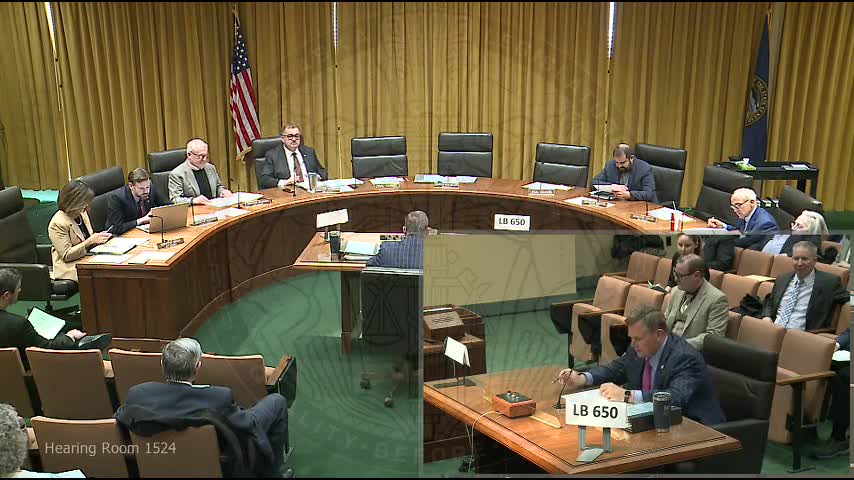
Nebraska revenue committee hears broad opposition to proposed LIFO cuts in LB650
Summary
Senator Brad Von Gillern opened the Revenue Committee hearing on LB650 by saying the "last in, first out" bill aims to reduce recent incentives and exemptions to help close a projected $292 million biennial shortfall while preserving state reserves.
Senator Brad Von Gillern, the bill’s introducer, told the Revenue Committee that LB650—amended by AM690—was intended to reduce discretionary spending and help close a projected $292 million biennial shortfall while preserving Nebraska’s financial reserves. "The positive financial impact of the bill as amended is estimated to be $88,000,000 in the upcoming biennium and $132,000,000 in the following biennium," Von Gillern said in his opening remarks.
The hearing drew a long line of proponents and opponents. Neil Sullivan, state budget administrator for the Department of Administrative Services, testified in support, saying the governor’s office favors rolling back recent exemptions and incentives added to the tax code so the state can pursue property-tax relief. "We are constitutionally required to approve a balanced budget by the end of the session," Sullivan said, adding that Nebraska is "not broke" though the state must take steps to sustain reserves.
Opponents argued LB650 would reimpose taxes or remove incentives that state and local officials, developers and private firms have been relying on. Kent Rogert, representing AT&T and CTIA, told the panel the measure would effectively add a new sales tax on certain wireless tower lease payments by removing language in the tax code (77-2701.16) that industry and the Legislature clarified in 2021. "This would be a tax on a tax, and the end user who actually uses these services is subject to and pays a sales tax on these," Rogert said, warning that costs would be passed to consumers.
Speakers from agriculture and economic development groups said the package risks undercutting nascent bioeconomy investments. Lucas Freschl of Falls City Edge and the Nebraska Economic Developers Association and Trevor Lee of the Nebraska Economic Developers Association said repealing or reducing credits for sustainable aviation fuel, renewable chemicals and biodiesel — sections identified by proponents — could stall recruitment of multibillion-dollar projects that are promoting new markets for Nebraska corn and soybean producers. "A reduction of these incentives could stall the momentum our efforts have created," Freschl said, citing announced projects and the state’s feedstock availability.
Short-line rail stakeholders urged preserving the Short Line Modernization Tax Credit, enacted in 2024, saying the program leverages private investment to repair rural freight infrastructure and yields safety and pavement-cost savings for the state. Justin Bentas, a consultant for short-line rail clients, said Nebraska’s eight short-line railroads move more than 125,000 carloads a year and that the credit helps deliver $2 of private investment for every $1 of tax credit.
Broadcasters and public-safety advocates also opposed sections that would remove an exemption for tower-lease income. Jim Timm of the Nebraska Broadcasters Association warned the change would raise operating costs for local TV and radio stations and impair emergency alerting, because broadcasters cannot easily pass such costs to viewers and listeners.
Agriculture groups signaled conditional support for the bill only if it produces significant property-tax relief. Bruce Reker of the Nebraska Farm Bureau said members are willing to "put things on the table" but stressed the value of measures such as the Nebraska Advantage Rural Development Act, Short Line Railroad credits, and biodiesel incentives for rural economies.
Several witnesses raised technical and fairness questions about contractor purchasing rules, the sales-tax collection allowance for merchants, and buyer-based exemptions for manufacturers. Tax attorneys and manufacturers’ representatives asked the committee to preserve or clarify an existing buyer/purchasing-agent rule for option 2 and option 3 contractors and to avoid unintended consequences for nonprofit and manufacturing construction projects.
Senator Von Gillern and multiple testifiers urged the committee to weigh the tradeoffs: the bill uses a LIFO approach that targets newer incentives first, returning the tax code to its prior state, but that also means some programs that have been in place only a short time would be scaled back or removed. No final committee action or vote was recorded at the hearing; the sponsor said he would continue consultations and possible drafting changes after the hearing.
Ending: The committee received extensive written testimony (one proponent submission and dozens of opponents) and indicated it will continue working with affected parties and agencies before deciding whether to advance LB650 or further amend it.