Get Full Government Meeting Transcripts, Videos, & Alerts Forever!
Get email alerts on the Appointments Confirmation topic
No spam. Unsubscribe anytime.
Nebraska HHS committee reads written testimony for six gubernatorial appointees, including nominees to NCDHH and Health IT board
Summary
On a snowy day in March the Health and Human Services Committee read written testimonies from six gubernatorial appointees, four for the Nebraska Commission for the Deaf and Hard of Hearing and one for the statewide Health Information Technology Board; no votes were recorded during the reading.
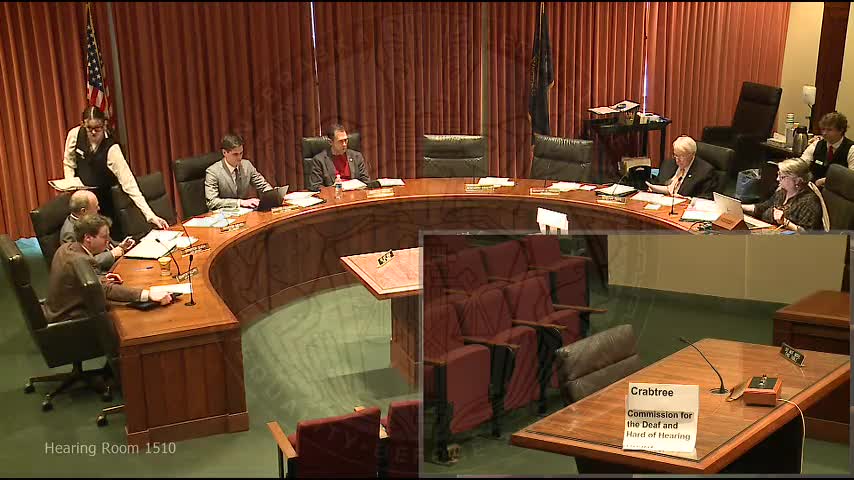
Lincoln — The Nebraska Legislature’s Health and Human Services Committee on a snowy March day read written testimony for six gubernatorial appointees, including four nominees for the Nebraska Commission for the Deaf and Hard of Hearing (NCDHH) and a nominee to the statewide Health Information Technology (HIT) Board.
The readings were conducted in place of in-person testimony because of inclement weather. Committee members acknowledged senators Riebe, Frederickson, Quick and Ballard before staff read the submitted letters and statements into the record.
The committee heard written statements from Kay Crabtree, John K. Culver, Valerie Hitz, Richard D. McCallan and Julie Mraz (applicants for NCDHH seats) and from Drew Gonczrowski, director of the Division of Medicaid and Long Term Care at the Department of Health and Human Services, who was appointed to the HIT Board. The submissions described each nominee’s background and priorities for the positions.
Kay Crabtree, a professor at Bryan College of Health Sciences and an applicant for the NCDHH, described a hearing-loss journey that included two surgeries and bilateral cochlear implants and credited Nebraska Vocational Rehabilitation (Nebraska VR) with financial support for assistive technology. Crabtree wrote that she would focus on “improving access to education and workforce opportunities for the deaf and hard of hearing, ensuring that students have the resources they need to succeed.” She concluded, “I believe that by working together we can create a more inclusive and accessible future for all Nebraskans.”
John K. Culver, a former Seward County commissioner and applicant for NCDHH, described more than 50 years of progressive hearing loss and said he has received dual cochlear implants. Culver said he had spent “well over $100,000 of my own money over the years” on hearing devices and related care and wrote that his board and committee experience would help him serve people with hearing loss across Nebraska.
Valerie Hitz, who identified herself as the elected vice chairperson for NCDHH, submitted a statement expressing a commitment to “equal equality, access, and empowerment” for deaf, deafblind and hard-of-hearing Nebraskans and said she looked forward to continuing work with the commission.
Richard D. McCallan detailed decades of service to deaf communities, including prior service on NCDHH, leadership roles with the Nebraska Association of the Deaf and a decade on the National Association of the Deaf board. McCallan’s written testimony noted that NCDHH “depends heavily on the section of 504” and referenced Section 504 of the Rehabilitation Act of 1973 in discussing federal disability protections.
Julie Mraz described a lifelong history of ear disease and surgeries and said she received a bone-anchored hearing aid (BAHA) implanted in October 2021 that improved her hearing in noisy environments. She wrote that those experiences would inform her perspective on the NCDHH.
Drew Gonczrowski, director of the Division of Medicaid and Long Term Care at DHHS and nominee to the Health Information Technology Board, identified himself as the Medicaid representative on the HIT Board and said Medicaid’s viewpoint is important in planning and operating a statewide Health Information Exchange (HIE). “As one of the biggest health care payors in the state, I will provide Medicaid’s perspective to help inform policy development and planning for the statewide Health Information Exchange,” Gonczrowski wrote.
Committee staff noted one online comment marked neutral for Kay Crabtree; the record showed no online comments for the other nominees. The committee did not conduct live question-and-answer or take a recorded vote during the reading; staff closed the record after reading the submitted testimonies.
The statements read into the record provide the committee with the nominees’ self-described qualifications and priorities. Any formal confirmation action, roll-call vote or committee recommendation is not reflected in the reading itself and would appear in later committee minutes if taken.