Get Full Government Meeting Transcripts, Videos, & Alerts Forever!
Get email alerts on the Postmortem Blood Draws topic
No spam. Unsubscribe anytime.
Senators weigh bill after sheriffs report mortuaries declining post‑accident blood draws
Summary
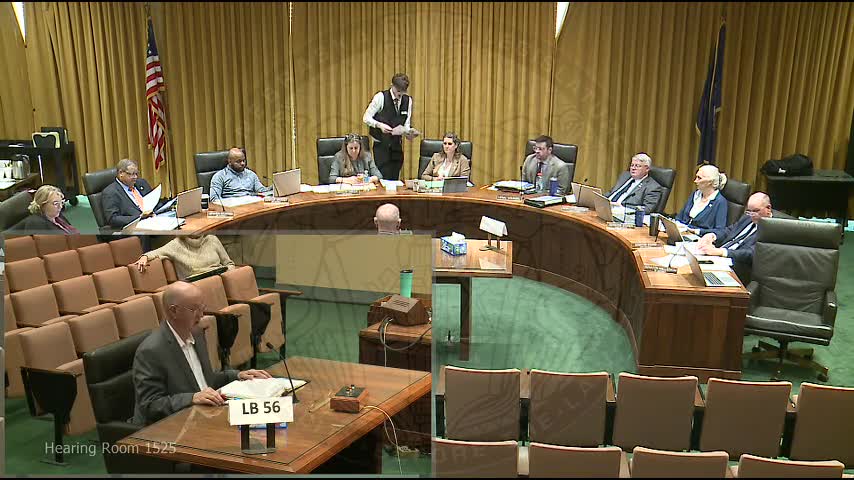
Sen. Myron Dorn introduced LB56 to require medical facilities or mortuaries to comply with law enforcement requests for post‑mortem blood draws after certain fatal vehicle crashes; funeral directors and mortuary representatives testified that the procedure is outside their scope of practice and raised training and liability concerns.
Sen. Myron Dorn, representing District 30, introduced LB56 after the Gage County Sheriff's Office reported that local mortuaries and a hospital declined repeated requests for blood draws in fatal motor vehicle crashes, a procedure Dorn said state statute (cited in testimony as 60-6102) currently requires when a driver or pedestrian dies within four hours of an accident.
Dorn told the committee his review showed two options: require mortuaries and medical facilities to comply with a peace officer’s request for a blood draw under the existing statute, or eliminate the statute altogether. He said local officials and sheriffs raised two barriers: difficulty obtaining blood from deceased bodies and concern about liability and chain-of-custody for evidence. Dorn asked for additional study and said he sought a late hearing so stakeholders could continue discussions.
Funeral directors testified in opposition. Chris Klinger, co‑chair of the legislative committee for the Nebraska Funeral Directors Association, said licensed funeral directors and embalmers are not qualified technicians for phlebotomy under the Nebraska Department of Health and Human Services definitions and that embalming contaminates or renders blood specimens unusable. Klinger and other funeral directors described practical barriers: postmortem blood kits often rely on suction and a beating heart; blood pools (livor mortis) and loss of volume can prevent reliable draws; and embalming replaces body fluids with chemical solutions that contaminate specimens. They warned mandatory draws could expose funeral homes to civil lawsuits and said many funeral directors have done informal draws as a courtesy but do not want a statutory mandate.
Committee members, including Sen. Victor Rountree and Sen. Terrell McKinney, asked whether alternatives exist, such as using trained phlebotomists, using coroners or adjusting the four‑hour requirement. Dorn and witnesses acknowledged that coroners and medical examiners or centralized autopsy services can perform sampling but that travel times and limited capacity (autopsy services were described as centralized in Omaha and often delayed) complicate meeting a four‑hour window. Dorn said stakeholders will continue discussions over the summer to seek a practical solution that preserves the statistical data collected by the Department of Transportation while addressing operational feasibility and liability concerns.
No formal committee action was taken; the introducer indicated further work with mortuary representatives, county attorneys and law enforcement is planned.