Get Full Government Meeting Transcripts, Videos, & Alerts Forever!
Get email alerts on the Commercial Electrification topic
No spam. Unsubscribe anytime.
Energy Office board approves EV-ready exception and electric-ready circuit language; tables air-barrier inspection sequencing
Summary
The Energy Office low-energy code board approved a commercial EV-ready exception and updated electric-ready circuit language for future electric cooking and clothes-drying equipment, and agreed to develop combined air-barrier inspection sequencing language offline.
The Energy Office’s Low Energy and Carbon Code board on Thursday approved changes to commercial electric‑readiness rules and a new exception to the EV-ready requirements for large parking lots, and tabled a proposed change about the timing of third‑party air‑barrier verification so staff and proposers can combine competing wording.
Board members voted to add an exception to the commercial EV-ready requirements that allows design teams to terminate conduit runs at a future transformer or panel location rather than running all conduits back to the existing service. The board’s rationale: the change gives designers flexibility on very large parking fields where meeting conduit‑routing and service‑sizing criteria can be impractical. The straw poll on the proposed edits to C4.10.5 returned unanimous support in the meeting’s roll call (18 yes, 0 no, 0 abstain) and the proposal passed.
The board also amended the electric‑ready language covering future electric cooking and clothes‑drying equipment. After discussion about whether the code should require designers to calculate “heating load” for appliances, members agreed to replace that term with “equipment load,” add a cross‑reference to the National Electrical Code (NEC) for circuit capacity, and to require a dedicated circuit sized appropriately for the replacement application. Members voted in favor of the combined edits (straw poll: 18 yes, 0 no, 0 abstain), and the change will be applied in two mirrored sections of the commercial code (the C4.10 subsections discussed in the meeting).
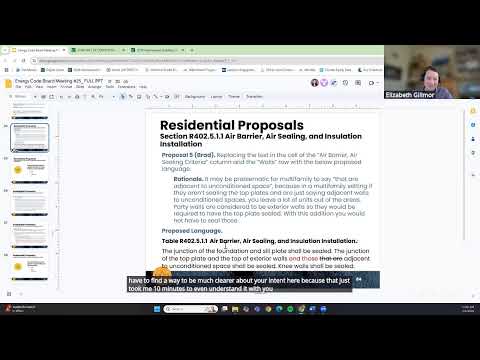
On the topic of third‑party air‑barrier verification and sequencing for larger commercial buildings, two board members (Tim and Brad) had submitted alternative wording about when a third‑party air‑leakage inspector must confirm scope and sequencing — at plan review versus before final framing/insulation inspections. Board members discussed enforceability and the coordination challenges for large projects; several members recommended combining elements of both proposals. The board did not complete that decision and agreed to have Tim and Brad work offline with staff to produce unified language for a future meeting. The item was explicitly tabled pending that rewrite.
The meeting also included one administrative correction: the board accepted an edit that clarifies which Group R occupancy types the commercial code references. That alignment was treated as an administrative fix rather than a contested policy change and the board agreed to update the citations in the commercial section accordingly.
What happened next The board asked staff and the proposers to submit combined language on the air‑barrier inspection timing for review at a future session. Staff said the approved administrative edits and the passed electric‑ready and EV exceptions will be incorporated into the next publicly posted draft of the code.
Why it matters The EV exception and electric‑ready clarifications are aimed at reducing upfront design and construction cost and permitting complexity on large commercial projects while preserving the code’s intent to make sites easier to electrify in the future. Delaying a decision on inspection sequencing preserves board time and lets the authors reconcile competing enforcement approaches before formal adoption.
Votes at a glance - EV-ready exception (C4.10.5 exception as proposed): straw poll 18 yes, 0 no, 0 abstain → passed. - Electric-ready dedicated circuit language (C4.10 edits in two sections): straw poll 18 yes, 0 no, 0 abstain → passed. - Air-barrier inspection sequencing (C402.60.20.3 / related): tabled for offline language consolidation → no formal vote. - Administrative fix to Group R occupancy references in C4.10: accepted as administrative correction → no formal recorded roll call.
Speakers Board chair Kim (chair), Tim (board member), Brad (board member), Carolyn (board member), Kevin (board member), Elizabeth (board member), Ron (board member), Adam (staff/consultant), Naomi (staff member).
Clarifying details - EV exception rationale: applied to very large parking fields (examples cited: projects with hundreds to 1,000+ parking spaces where conduit runs to existing service would be costly). - Electric‑ready edit: replaces “heating load” language for appliance readiness with “equipment load” and references NEC circuit sizing; applies to two subsections of C4.10. - Air‑barrier sequencing: proposers aim to require evidence of a third‑party testing scope and confirmation prior to issuance of permit or prior to completion of final framing inspections; consolidated language to be produced offline.
Authorities referenced - 2024 International Energy Conservation Code (IECC), commercial sections (referenced by speakers in context) - National Electrical Code (NEC) (referenced by board for circuit sizing guidance)
Searchable tags ["EV-ready","electric-ready","air-barrier","third-party testing","commercial building","C4.10","C402","NEC","Energy Office"]