Get Full Government Meeting Transcripts, Videos, & Alerts Forever!
Get email alerts on the Transportation Impact Fees topic
No spam. Unsubscribe anytime.
Panama City delays second reading of transportation impact fee ordinance after extensive stakeholder pushback
Summary
City commissioners agreed to move the second reading of a proposed transportation impact fees ordinance to April 24 and asked staff to return with a timeline and an aspirational work program after additional stakeholder meetings and a planned staff update on April 8.
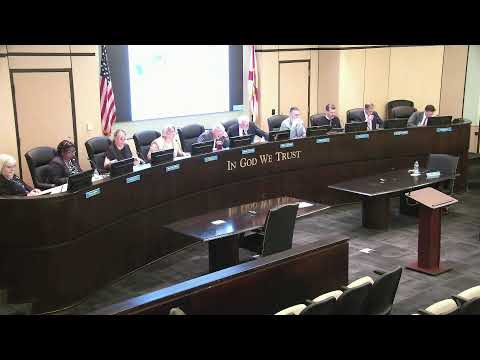
City Manager Jonathan Moore reported to the City Commission on March 18 that staff had revised a proposed transportation impact fee ordinance after a series of workshops and roundtables with builders, the chamber and community groups, then recommended more time before a final vote. "Staff has no issues, you know, if the commission decides tonight to further table it," Moore said, urging the commission to allow more opportunity for discussion.
The commission agreed. Commissioners voted unanimously to move the ordinance's second reading to the commission meeting on April 24 and directed staff to provide a timeline and a draft work program at the April 8 meeting. Moore said staff would try to identify corridors and projects inside Panama City (roughly Business 98 to State Road 390) that would be likely candidates for fee-funded improvements so developers and residents could see how collected fees might be used.
Why it matters: The ordinance would create a developer-paid revenue stream for street, sidewalk and other transportation work to address growth and congestion across two distinct planning areas: Panama City proper (infill needs such as sidewalks and safety) and Panama City North (anticipated arterial expansion around Star Avenue and other regional connectors). Builders and business groups, including Kurt Hartog of the Bay Building Industries Association, urged a delay so they could gather state-level information and return with questions. "We're here today ... to ask if we could have the ordinance tabled at least into April so we have more time to discuss this," Hartog told commissioners.
Key debate points: Commissioners and stakeholders focused on three intertwined questions: (1) how to protect and encourage infill and smaller “attainable” houses in Panama City proper so fees do not block small-scale development; (2) how to tie fees to a transparent, defensible work program showing where collected funds would be spent; and (3) whether to phase in the fee collection (some commissioners suggested initial lower percentages such as 25% or other staged approaches). Staff noted the fee study reflects current construction costs and that fees elsewhere may appear lower because they were set years ago.
Staff commitments and next steps: Staff will convene another stakeholder roundtable after builders attend legislative meetings in Tallahassee, draft an aspirational list of potential projects (for example, sidewalks and intersection capacity in the downtown corridor) and deliver an update to the commission on April 8. The commission may convert the April 24 meeting into a workshop if more discussion is needed before a final vote.
Quotes: "We can take what Commissioner Street has requested, kind of an aspirational document... and highlight some areas that are not going to be part of a major infrastructure project," Moore said. Kurt Hartog of the BBIA asked for the extra time: "We would like to continue to have some dialogue... so we have more time to discuss this with the commission." Commissioner discussion repeatedly returned to the need for a work program that builders and residents could review.
Ending: The commission's direction gives staff roughly three weeks to assemble project examples and a timeline. Commissioners said they expect another opportunity to review a revised ordinance and supporting materials before any final adoption vote.