
Westopolis reports near‑prepandemic lodging‑tax recovery, outlines sports‑tourism and partnership strategy
Get AI-powered insights, summaries, and transcripts
Sign Up Free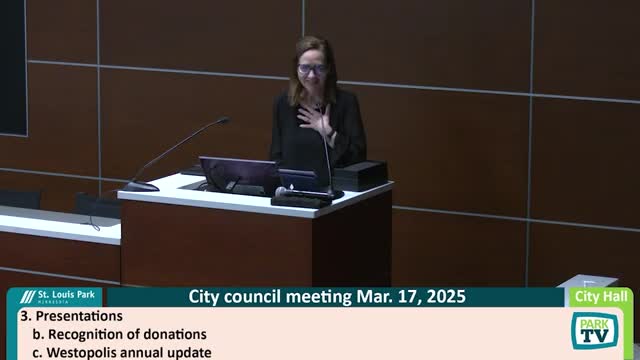
Summary
Becky Bakken, president of Westopolis, told the St. Louis Park City Council that visitor spending in St. Louis Park and Golden Valley generated $211 million in 2024, lodging‑tax revenue has nearly recovered to 2019 levels, and the organization is focusing on sports tourism and partnerships with Parks & Rec to continue growth.
Becky Bakken, president of Westopolis, told the St. Louis Park City Council that visitor spending in St. Louis Park and Golden Valley totaled $211,000,000 in 2024 and that lodging‑tax revenue is almost back to 2019 levels.
Bakken, the president of the destination marketing organization formerly known as Discover Saint Louis Park, opened her annual report by citing statewide 2023 tourism figures from Explore Minnesota Tourism: “$24,200,000,000 in total economic impact, 80,200,000 total visitors, $2,300,000,000 in state and local taxes generated, $14,100,000,000 in visitor spending and 180,000 jobs,” she said. She described Westopolis’s mission as promoting St. Louis Park and Golden Valley to drive hotel occupancy, restaurant and retail spending, and event activity.
The nut of Bakken’s presentation was funding and strategy. She explained how the group is financed: “3% is collected [on lodging], the city…keeps 5% of that 3 percent for their administrative fees…but then 95% of that revenue must go to a separate nonprofit organization whose sole mission is to market and promote the area,” Bakken said. The organization tracks nine lodging properties monthly (seven in St. Louis Park and two in Golden Valley) and two conference centers, and it uses lodging‑tax receipts and hotel performance as principal measures of impact.
Council members pressed Bakken on several operational points. A council member asked for a ballpark figure for last year’s collections; a colleague suggested roughly $1,260,000 in lodging tax was collected and that the city’s 5% administrative share would be about $60,000. Bakken did not provide a different total in the meeting and said the city finance staff could supply the precise figure.
Bakken highlighted tactical shifts Westopolis has used to boost mid‑week and shoulder‑season occupancy, including targeted incentive grants for planners willing to book events in first and fourth quarters and geo‑fenced digital advertising tied to event attendance. She said lead generation rose 9.1% year over year, the number of awarded bids increased 23%, and room nights from awarded bids rose 42% in 2024 compared with 2023.
Sports tourism and a formal partnership with St. Louis Park Parks & Recreation were a major focus. Bakken described a coordinated sales effort with parks staff and said the partnership is being recognized nationally; Jason West and Karen McManaman were cited as collaborators who have presented the model at Sports ETA and Explore Minnesota Tourism events. As examples of sports tourism wins, Bakken cited hosting the American Broomball Association and the 2023 World Cup cross‑country event (the latter drew international media and athletes to the area). She said the partnership helps the city host nontraditional sports events without permanently displacing resident use of facilities.
Bakken also reviewed how regional major events affect the local market, noting spikes tied to concerts and professional sports that drive hotel demand in the West End and adjacent corridors. She mentioned the “Taylor Swift effect” and a Morgan Wallen concert as visible examples of single events that lifted occupancy. Bakken said Westopolis’s social and digital work — including newer activity on TikTok — and targeted advertising help convert event visitors into local hotel stays.
Council members asked about public safety costs associated with large events. Bakken said she believes such costs are not a major factor in the St. Louis Park market, noting coordination happens between hotels, event organizers and police for very large events; she said she could not provide a dollar figure.
The presentation closed with an appeal to council members to help communicate Westopolis’s role to residents and to continue the partnership with Parks & Rec. Bakken emphasized that while Westopolis is visitor‑focused, its primary customer is the resident, who benefits from vibrancy, jobs and tax revenue reductions tied to visitor spending.
Votes at a glance The council approved the meeting agenda and later approved the consent agenda during the same session; both votes were taken by voice and recorded as approved.