Get Full Government Meeting Transcripts, Videos, & Alerts Forever!
Get email alerts on the Land Use Rezoning topic
No spam. Unsubscribe anytime.
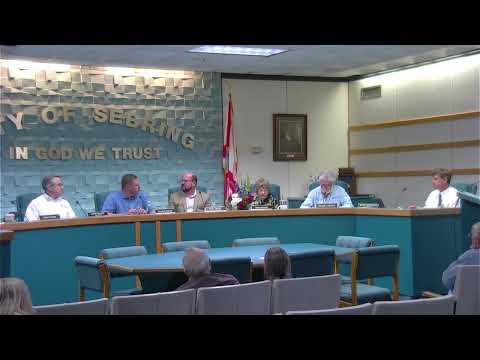
Council denies first-reading land-use changes for 1809 Home Avenue after public debate
Summary
On first reading the City Council voted to deny two linked ordinances that would have changed the future land use and zoning of 1809 Home Avenue from public/single-family to commercial, after public speakers and councilors raised questions about spot zoning, traffic and future uses.
The Sebring City Council voted on March 18, 2025, to deny on first reading two related measures—Ordinance 15-36 (future land use change) and Ordinance 15-37 (zoning change)—that would have reclassified a 1.38-acre property at 1809 Home Avenue formerly used by the Masonic Lodge from public/single-family to commercial.
The proposal drew a lengthy presentation from Marissa Barbee of the Central Florida Regional Planning Council, who described the site, existing septic service, surrounding uses and the difference between the current public land-use designation and the requested commercial designation. Barbee told the council the parcel could support up to about 42,000 square feet of nonresidential uses under a commercial future land use but noted the site’s septic system would limit development until wastewater connection was available.
The applicant’s representative, Dana Riddell of Stonehenge Land Development Consultants, said the buyers—David Lydell and Will Swain—intended to complete the pending purchase and wanted the rezoning to allow a range of commercial uses. Riddell acknowledged some potentially undesirable uses (for example, a lounge) were technically permitted under the requested commercial district but said the applicants had no present intent to operate such a use and argued redevelopment would be constrained by site size, parking and the existing building.
Members of the public raised concerns about the request being a spot zoning change, traffic impacts on Home Avenue, the absence of a concrete plan from prospective buyers and the potential for alcohol-related uses near an existing church. Jeff Carlson, Stanley Epling (Sebring Masonic Lodge secretary) and Christopher Tuffley spoke during the public hearing; Epling urged the council to move the sale forward to stop disruption to lodge activities, while others asked for either a plan development limiting certain uses or more study.
Council debate focused on compatibility with the long-range plan, whether the request amounted to spot zoning and how a commercial designation would outlast the current buyer. One councilor said a plan development that excluded a small number of uses would be preferable; another argued the parkway corridor was shifting toward commercial uses and favored the rezoning. Ultimately the motion to deny Ordinance 15-36 on first reading passed. Council then denied Ordinance 15-37 on first reading by a separate motion.
Votes (as recorded on the transcript): On Ordinance 15-36 denial (first reading) the roll call recorded Carlisle — Yes; Avery — Abstain (business partner conflict noted); Mendel — Yes; Stewart — Yes; Bishop — Yes. For Ordinance 15-37 denial (first reading) a similar roll call followed with Carlisle — Yes; Haley — Abstain (same reasons noted); Stewart — Yes; Bishop — Yes; Mendel recorded as No in the transcript’s sequence (see provenance). The council clarified on the record that, for the motion as phrased, a “yes” vote meant rejecting the requested change.
Why it matters: The council’s decision keeps the property designated for public use under the comprehensive plan and preserves the existing residential zoning classification. Councilors and members of the public repeatedly invoked the town’s prior North Sebring sector planning work and urged comprehensive rather than parcel-by-parcel changes.
Next steps: The denials were on first reading; the council treated the matters as concluded for this cycle. Applicants and property owners may return with revised applications or requests that limit certain uses or that include a plan development if they so choose.